
NORWALK – The final vision of the 125-acre waterfront park in Norwalk called Manresa Wilds was officially introduced to the public last week by city philanthropists Austin and Allison McChord along with its price tag of $410 million to remediate and transform the site.
Anchored by the former the former Connecticut Light & Power and NRG power plant — reimagined as a community hub — Manresa Wilds is expected to welcome people of all ages to reconnect with the waterfront by 2035.
Its core values center around reconnecting to the water, creating a place to gather near the Long Island Sound, learning from the three different environmental pockets, wandering a connected trail network and “playing” in a sand lab, fort forest and “The Wilds.” The park will include the Turbine Hall (88,000 square feet) gathering place, Administrative Building (20,000 square feet) that will support the public beach and community pool and provide a sundeck, the Smokestack that will be wrapped by a 4,000-square-foot pavilion at its base and the Boiler Building (120,000 square feet) that will provide space for educational and community programming.
“One of things associated with this is ‘how do we pay for all this?’” Austin McChord told the crowd of about 300 Norwalk area residents Feb. 19 at the Maritime Aquarium. “We’ve been thinking about that. We are aware that we are pretty in deep here. What we want to share today is that we have a very good understanding about what is needed in preparing the site.
“Teams have been out studying the soil, studying the tides, studying all the animals.
That number is far more expensive than the fun stuff.”
That’s when he unveiled a slide on the huge Maritime Aquarium screen that broke down that cost: Land Master Plan, Design and Community Engagement ($45 million), Abatement, Remediation and Infrastructure ($220 million), Circulation and Accessibility ($42 million) and Ecology/Nature Restoration ($103 million). Total: $410 million.
During the presentation, a slide on the Maritime Aquarium screen outlined how that estimated $410 million initial investment is allocated: Land Master Plan, Design and Community Engagement ($45 million), Abatement, Remediation and Infrastructure ($220 million), Circulation and Accessibility ($42 million) and Ecology/Nature Restoration ($103 million). Total: $410 million.
However, he emphasized that he and his wife are privately funding the initial investment required to remediate and transform the site. The project is funded entirely by private philanthropy through the nonprofit 501 (c)(3) Manresa Island Corp. He is the founder of the IT software firm Datto, which he sold for $6 billion in 2022 to Kaseya.
“What I hope you see in all of this is that the values come through,” Austin McChord said. “Your feedback has really helped us to build a better design and hopefully it will be a much better park, when all is said and done.”
Austin McChord announced that the Northern Forest section of the park will be the “first piece of the puzzle” to be put in place by next year. “We’re really excited to be in a position to open it at this time next year,” he said. “In 2028, our plan is when the real construction will start, assuming all the planning and zoning (will be approved). (Between) 2032 and 2035 will be when (all of) Manresa Wilds opens.”
Gena Wirth, design principal and partner of SCAPE, also spoke to the crowd about the specifics of the final vision of the project from a design and architectural angle.
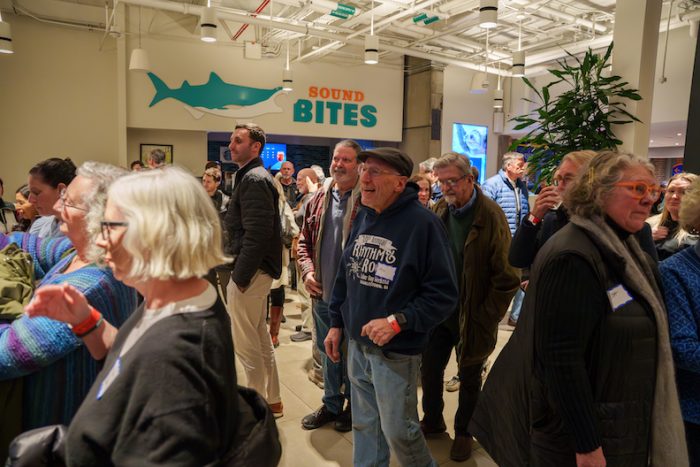
“There has been over a year of public engagement,” she said. “Over 3,000 community voices have been reached in this process. Over 2,000 people have actually sat on the island and have experienced the drama and magic of the wild landscape.”
The final vision sets a clear path toward a healthy, resilient, and welcoming public landscape that unlocks access to nearly two miles of Connecticut coastline, she added. Since announcing the project in October 2024, Manresa Island Corp. has held large-scale public meetings, surveys, site tours, and conversations with neighborhood groups, local businesses, educators, and civic leaders.
In response to the community feedback, the vision has evolved significantly, with the design team incorporating thousands of substantive refinements, including:
- Expanded natural areas and habitat protection by 30% while reducing hardscape and active features throughout the site by half
- Concentrated the most active amenities to the southernmost end of the site and reduced the footprint of active programming across the site
- Enhanced access through robust transit infrastructure supporting multiple modes of arrival, including designated bus drop-off areas, pier activation, and parking throughout the site
- Minimized lighting and reduced water features throughout the site to protect wildlife and neighboring residents
Next steps
At the event, the McChords, Manresa Island Corp. Executive Director Jessica Vonashek and representatives from landscape architecture firm SCAPE and architecture firm Bjarke Ingels Group (BIG) shared the design with over 300 community members, alongside education partners Woods Hole Oceanographic Institution, Wesleyan University, Sacred Heart University, and Norwalk Public Schools.
“Tonight marks an incredible milestone since we first embarked on this endeavor almost two
years ago,” Allison McChord said. “We’ve spent this time listening to what Norwalkers want from Manresa Wilds and made thousands of changes to the plan to ensure it can be the best park possible.”
The second phase of the project (2031-32) includes the vast majority of the landscape plan, the adaptive reuse of the Turbine Hall and Administrative Building, the community pool and pavilion, and the nature play area. The third phase (2032-35) will include the beachfront promenade, kayak terrace, additional play areas, and a pier and field station. The Boiler Building will be preserved throughout this phasing, with its adaptation and programming part of the future construction phase that is pending partner activation.
The park will even include a working part of the old substation that will continue to store and transfer power from other area power plants.
“It’s the old substation,” Jeremy Alain Siegel, Associate with BIG, said when explaining an unmarked section of the park’s rendering. “Our understanding is that it will continue to serve a role in the energy grid. There are a few locations on the Long Island Sound where you have power lines crossing.
“There will not be major energy generation on this site except for some building integrated generation in the form of PV (photovoltaic solar) panels. This site is not unique. There are some power sites in the region where there is a generation facility that has been decommissioned but usually there is a substation that is hooked into the grid there.”