New York Gov. Kathy Hochul didn’t mince words when it came to describing actions by President Donald Trump when she delivered her budget message on Jan. 20, the first-year anniversary of Trump’s second term.
“This year Donald Trump declared war on states and slashed federal support that had been in place since the 1960s,” Hochul said. “We saw the impact of that decision almost immediately. Over the summer we were forced to make tough decisions to protect (health) care and keep our system stable. Yes, the state did step up, absorbing $750 million in costs from the federal government that they had walked away from. And then the president’s ‘Big Ugly Bill’ is going to blow a $3 billion hole in Medicaid in this budget alone. Could not have planned for this, certainly not when Donald Trump took an oath of office one year ago today.”
The Executive Budget that Hochul proposed totals $260 billion, an increase of 0.7%. Spending is up slightly primarily to offset federal cuts, primarily to health care. Federal funds are down approximately $10.3 billion, an 11.4% decrease from last year. $3 billion of the amount is a loss of recurring Medicaid funding.
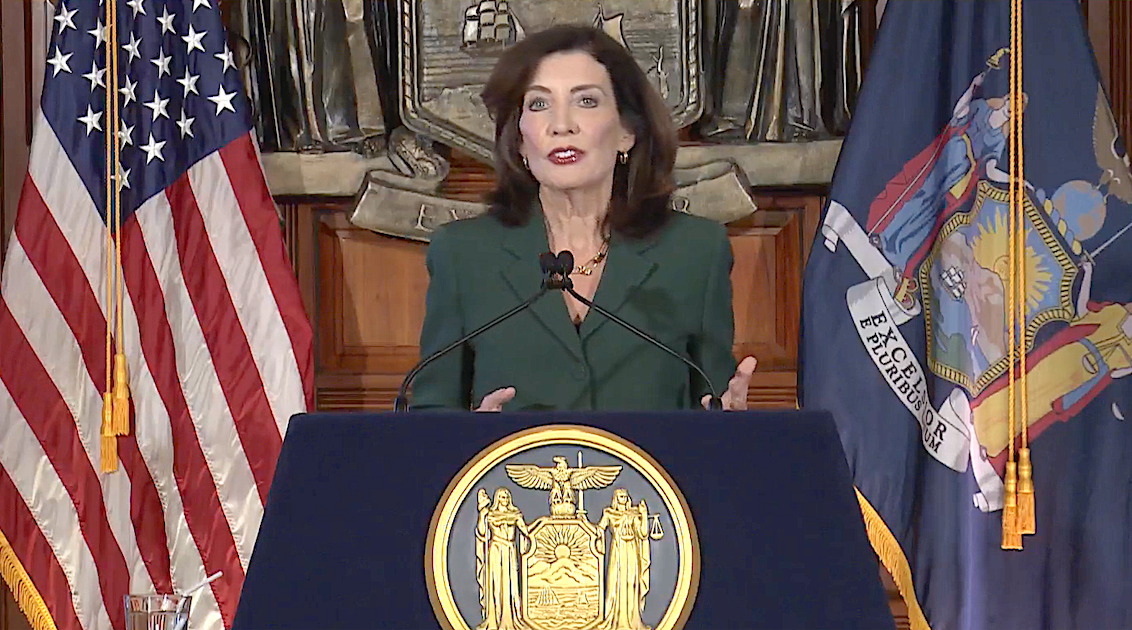
“The scope of these federal cuts would have been far worse if we had not stood up to the Trump administration, successful blocking at least $4 billion in additional cuts and freezes in court and through the ‘bully pulpit,’ meaning my phone calls,” Hochul said. She said the Trump administration had tried to make cuts in funding for law enforcement and infrastructure projects.
“We’re ensuring that vulnerable New Yorkers don’t lose essential care and we’re doing it while still protecting taxpayers,” Hochul said. “Once again there are no new income taxes on New Yorkers and this budget contains reserves at $14.6 billion. This budget continues to protect New York’s fiscal stability.”
Hochul said that revenues have continued to exceed projections driven in part by record Wall Street bonuses, which result in more income tax revenue from those people whose incomes have soared.
“When the economy is strong, and particularly when high net worth individuals and employers earn more, our revenues rise and that’s why we’re able to invest more without asking New Yorkers to pay more. This is not an austerity budget but it is a disciplined one. We continue to invest in core services that New Yorkers rely on while keeping the growth of state operating funds at a responsible level.”
Hochul said that the state will be ending taxation of tips so that service workers can keep more of what they earn. She said the budget includes $30 million to help farmers in New York who were impacted by Trump’s tariffs. Hochul said her proposed budget includes $4.5 billion for child care to expand access for working families.
Hochul said the budget includes $1.3 billion to make Universal Pre-K available for every four-year-old by 2028.
“Today, roughly 75% of the four-year-olds we expect to serve are already enrolled in Pre-K,” Hochul said. “To meet families’ needs before that age this year we’ll pilot community-wide child care to provide year-round, full-day affordable care for newborns to three-year-olds. And we’ll build on the proven success of our Child Care Assistance Program and our voucher programs so tens of thousands more families can access high-quality care for no more than $15 per week.”
Hochul said that the budget includes nearly $40 billion in school aid. She said the Universal meals rogram what was started last year will received $50 million more this year amounting to $395 million in funding.
“Funding alone doesn’t guarantee outcomes,” Hochul said. “That’s why we’ve paired historic investments with common-sense reforms like getting cell phones out of classrooms so kids start paying attention to their teachers and returning to back-to-basics instruction in reading, an approach we’ll expand to math this year.”
The budget includes a new $3.75 billion, five-year investment in clean water infrastructure. It also provides $352 million for gun violence prevention and $77 million to strengthen subway safety. There is $35 million for Securing Communities grants to protect houses of worship and vulnerable organizations.