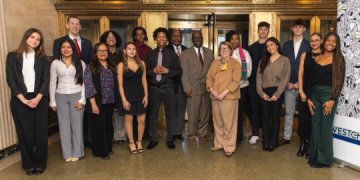
More than 200 educators representing 57 school districts convened at Manhattanville University’s Reid Castle in Purchase, New York, for a day dedicated to advancing literacy instruction and strengthening a shared commitment to helping every child learn to read.
Hosted by the Rose Institute for Learning and Literacy in Manhattanville University’s School of Education, the annual Literacy Conference: Literacy Rich Classrooms in Action welcomed teachers, literacy specialists, administrators and educational leaders from across the region for a full day of keynote presentations, workshops and conversations rooted in the science of reading.
Set against the warmth and grandeur of Reid Castle, the conference transformed Manhattanville’s campus into a hub of shared purpose and professional energy. Educators filled O’Byrne Chapel and breakout rooms throughout the day, exchanging ideas, deepening connections and leaving with research-based strategies they could bring directly back to their classrooms.
“As a former teacher, I believe literacy instruction impacts more than just academics, but the very trajectory of our students’ lives.” said Tracy McCarthy, director of the Rose Institute for Learning and Literacy at Manhattanville University. “The growing visibility of literacy and dyslexia at the state level underscores the importance of this work and bringing educators together to learn, grow and connect at our annual Literacy Conference creates a ripple effect that extends far beyond campus or the day.”
It is that sense of connection and shared purpose that continues to define the Rose Institute’s work and Manhattanville’s role in supporting educators across the region.
In her keynote address, nationally recognized reading researcher and educator Dr. Molly Ness underscored both the challenge and the promise of literacy instruction today. Framing literacy as a force that shapes not only academic success but broader life outcomes, she emphasized that educators are working in a moment of growing state and national awareness around literacy and dyslexia. Her keynote focused on bridging decades of reading research with practical classroom instruction, equipping educators with a deeper understanding of how the brain learns to read and how that knowledge can be translated into stronger teaching practice.
“The turnout we saw today, more than 200 educators representing 57 school districts, with many traveling from over an hour away, is a powerful reflection of how deeply committed our region is to advancing literacy instruction,” said Elizabeth Kimiecik, representing the Literacy Center at Putnam Northern Westchester BOCES. “Partnerships like this with Manhattanville University and the Rose Institute are critical in ensuring educators have access to the training and support they need to make a real impact in their classrooms.”
“I’m leaving with strategies I can use tomorrow,” said Sylvia Egana, reading intervention specialist at King Street Elementary School in Port Chester, New York. “As a Manhattanville alumna, it is especially meaningful to return and continue learning here. Manhattanville has always played an important role in preparing and supporting educators and it is inspiring to see the university continuing to invest in teachers and literacy instruction across our local communities.”
“At its core, our work is rooted in a simple but powerful idea: every child has the right to learn to read,” said Brian Carolan Ph.D., dean of the School of Education at Manhattanville University. “Through the Rose Institute, we are not only preparing teachers but empowering them to carry that mission forward in their classrooms and communities. Today is a celebration of that work, bringing educators together to learn, connect and leave inspired to make an even greater impact.”
“It’s incredibly exciting for Prevent Academic Failure (PAF) Reading Program to be here at Manhattanville University as a sponsor of the annual Literacy Conference,” said Elizabeth McGoldrick, literacy specialist and teacher trainer at PAF Reading Program. “Westchester is where we were founded and it remains a community we are deeply committed to serving. We are proud to support this conference in such a beautiful setting at Reid Castle and to be part of the effort to position the region not only as a thought leader in literacy, but as a true leader in implementation and impact.”
Founded through the generosity of Sandra Priest Rose, the Rose Institute for Learning and Literacy has spent more than a decade preparing educators with the knowledge, research and practical tools needed to support effective reading instruction through advanced certificates and professional development opportunities, both in-district and through several partner BOCES.
As the day ended, educators left Reid Castle with renewed energy, strengthened connections and practical strategies that will extend far beyond a single conference day.
When educators come together at Manhattanville, the impact does not end at the castle doors. It carries forward into classrooms, into communities and into the lives of students across the region, where the work of teaching children to read continues every day.
Manhattanville University (formerly Manhattanville College) is a private liberal arts institution dedicated to academic excellence, purposeful education and social responsibility. “U.S. News and World Report” ranks Manhattanville among the Top Performers of Social Mobility in Regional Universities North. The university has been recognized among the best colleges in The Princeton Review for close to 20 years. Located 30 miles from New York City on a 100-acre suburban campus in the heart of Westchester County, Manhattanville enables easy access to entertainment offerings, educational resources and business opportunities for its diverse student body. The university serves more than 1,400 undergraduate students and nearly 1,000 graduate students from more than 44 countries and 33 states. Founded in 1841, the university offers more than 75 undergraduate and graduate areas of study in the arts and sciences, education, nursing and health sciences, business and creative writing, as well as continuing and executive education programs. Graduate students can choose from over 70 graduate and certificate programs. Extracurricular offerings include more than 45 clubs and activities, and 23 NCAA Division III teams.