Readers of “Travel Talk” will know I have a weakness for Morocco, that ravishingly beautiful, romantic kingdom that in its long relationship with the United States has the most solid credentials. That’s because back in 1777, Morocco was the first country to publicly recognize the newly independent U.S.A. Despite the odd blip – and what relationship doesn’t have those? – the two have remained good friends ever since.
Morocco sits in the top left-hand corner of the African continent, and in the top-left hand corner of Morocco itself, where the Mediterranean Sea becomes the Atlantic Ocean at the Strait of Gibraltar, you’ll find Tangier. A libertine city, famously loved by the likes of William S. Burroughs, Jack Kerouac and Allen Ginsberg; home to other writers like Paul and Jane Bowles; a kind of mecca for playwrights Tennessee Williams and Joe Orton and vacation spot for The Rolling Stones, Tangier as recently as the 1970s still teemed with thieves, drug addicts, pederasts and child prostitutes.
Now, however, Tangier’s notorious “anything goes” era has passed and, besides, it was only but a part of Tangier’s rich history. In the last decade, thanks to massive investment spearheaded by Morocco’s sovereign King Mohammed VI, the city has been spruced up with new apartment buildings, fancy hotels and even a new state-of-the-art railroad station, and yet its unique character – layered, ambiguous, mysterious – somehow lingers. As Anthony Bourdain poetically put it in his “Parts Unknown” story on the city back in 2012, “The days of predatory poets in search of literary inspiration and young flesh are probably over for good – hippies can just as easily get their bong rips in Portland or Peoria – but the good stuff, the real good stuff, the sounds and smells and the look of Tangier…that’s here to stay.”
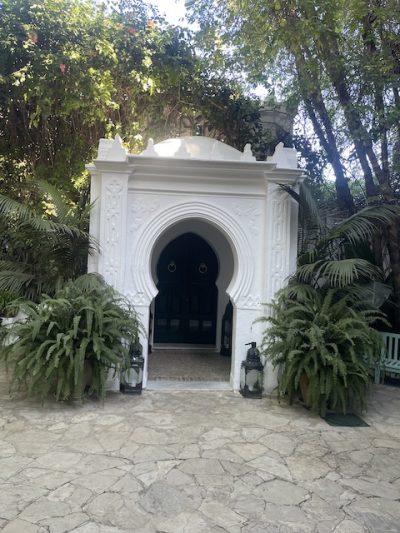
Far and away the most striking of its new hotels, one that alone would make a visit to Tangier worthwhile, is Villa Mabrouka. Originally built for a wealthy local family in the early 19th century and rebuilt as a Modernist house and sold to Sheikha Fatima bint Fahad bin Salem Al Sabah of Kuwait, the villa was acquired in 1997 by Yves Saint Laurent and his long-term partner, the French industrialist Pierre Bergé, later passing to Bergé’s protégé and husband, the American landscape gardener Madison Cox. Jasper Conran, scion of the Conran family, bought the house from Cox in 2017 and transformed it into a 12-room hotel.
Conran’s father, Sir Terence Conran, was the founder of the Conran and Habitat homewares and restaurant empire, and Conran junior himself is a couturier and designer-turned-hotelier. And with Villa Mabrouka he has triumphed, reintroducing authentic elements of Art Deco and simultaneously suffusing Villa Mabrouka with palpable 1930s glamour.
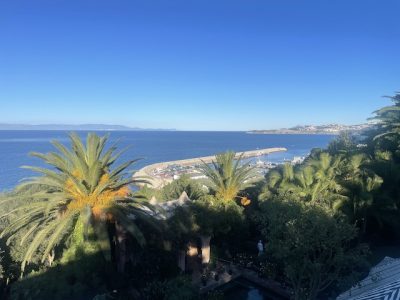
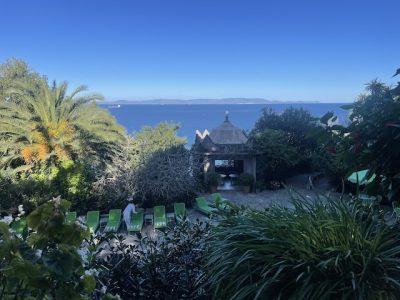
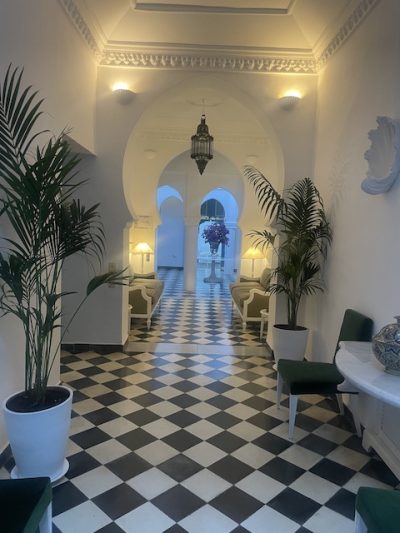
On the first floor, black-and-white marble floors connect the dining room with the cream-and-white living room (which I like to think could have come from Cole Porter’s 1930s apartment in the Waldorf Towers, or a theater stage set for Noel Coward’s “Design for Living”). Beyond the sitting room lie the terraces for outdoor drinking and dining (the sun shines here 320 days a year), with paths leading down through lush gardens – 6,000 different plantings at the last count, as laid out by Cox – to the swimming pool below. An enchanting pavilion designed by longtime a Tangier resident, the illustrator and portrait painter Lawrence Mynott, overlooks that exquisite pool, which was hewn from rock by the aforementioned Kuwaiti princess. (Well, I don’t imagine she did the actual hewing herself.)
Warm Mediterranean light and dappled sunbeams bounced around my suite at Villa Mabrouka, with its color palette of cool green and fresh white, and gleaming bathroom of Olympic proportions. Cream-colored Smeg appliances adorned the wet-bar, with small touches like the earplugs on the nightstand showing that this supremely talented hotelier had thought of everything. And there, way below my vast, expansive terrace, was the Atlantic to my left, the Mediterranean to my right, with the Spanish coast clearly visible directly across the water. Taking it all in, hearts may well skip a beat. I know mine did.

Back downstairs, the breakfast table was set each day with good silver and a beaker of blushing white baby roses, which contrasted softly with the glass of heavenly pink Mandarin juice the white-jacketed waiter would bring, along with cups of coffee the size of a soup bowls. (In case you haven’t already figured this out, allow me to point out there are no Styrofoam coffee cups at Villa Mabrouka.)
The breakfast itself is French Moroccan, which means French breads and brîoche or Moroccan pancakes with honey, followed by a traditional shakshuka, or fried eggs with confit beef. Do forgive the name-dropping, but I’ve not had such a breakfast, nor one so elegantly served, nor on snowier linen, since I was last at the Ritz in Paris, which is to say 16 years ago.
Dinner? Mr. Conran, you had me at the crudités, those immaculately batonned vegetables with that sublime anchovy mayonnaise, which I wanted to slurp by the bucketful. It was followed by p’stilla of pigeon (an utterly fabulous Moroccan dish of minced chicken or pigeon wrapped in crisp filo pastry and dusted with sugar and cinnamon). For dessert, or pudding as the English call it, meringue cake — layer upon layer of sponge and whipped cream, coated with soft meringue. a thumping great slice as tall as a top hat and a bowl of vanilla custard beside it – a thing of utter decadence. This is a pudding worth crossing an ocean for, so you must.
Those remarkable gentlemen with their fabulously twirled moustaches, by the way, are Villa Mabrouka’s identical twin bartenders, a little bit of surrealism only adding to the pleasure of your stay.

And just so I don’t come across like a breathless, uncritical admirer, well yes, Mabrouka does have a couple of flaws. Like slices of deathly-dull apple on the so-called “exotic” fruit plate. Or the beautiful fern in my suite, badly in need of a drink of water. And a pedal-bin in the bathroom – impossible to use unless you have the feet of a child. No, we do not like pedal bins. Talk about first world problems.
You know what? If the wonderful people who run this exceptional hotel read this piece, I’ve no doubt these teeny-tiny blips will be taken care of by the time of my next visit. Of course, they will.
When I told Jasper Conran, whom I was lucky enough to encounter during my short stay, that I absolutely loved Mabrouka, loved everything he had created here, but that I didn’t want to risk sounding like a gushing schoolgirl, he looked me in the eyes and said simply, “Please go ahead, gush.”
So, you know what? I’m gushing.