FAIRFIELD – For Stephen Coffey and Ava Adiletti at Sacred Heart University, sports betting on campus – whether it involves athletes or fellow students – is a lot more than just a way to enjoy their favorite team. It’s a growing problem that can destroy relationships, careers and even lives.
It’s an addiction just like drugs and alcohol abuse that has become even more socially acceptable due to the proliferation of such companies as DraftKings and FanDuel, legal sports books. But unlike the two major addictions, sports gambling has no federally funded recovery or treatment programs.
“I was a former college athlete,” said Adiletti, an accomplished swimmer for Millersville University. “For me, the thought of gambling and risking my college career was enough for me to stay away from it. I definitely knew some athletes who I knew were gambling. It’s upsetting.”
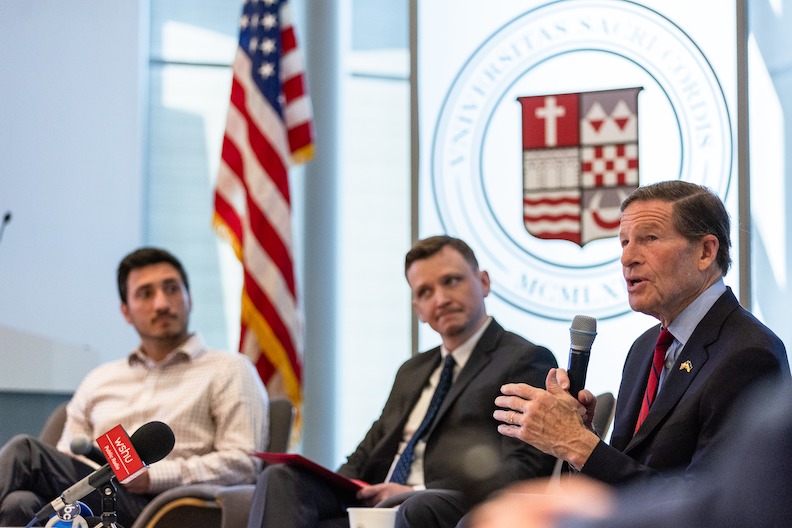
Adiletti was one of three SHU sports media and communications students who sat on a panel sponsored by that department May 5 at Martire Center for the Liberal Arts building. She was joined by Coffey, a senior undergraduate, and Zach Seymour, a graduate student.
The Roundtable Discussion with U.S. Sen. Richard Blumenthal was led by professor Andrew Miller, SHU Director of Sports Communication and Media Graduate program, and included Jeff LaBella, SHU director of counseling and collegiate recovery and Seamus McNamee of Great Blue Research, co-author of the 2026 Sacred Heart University Nationwide Sports Gambling Poll.
That poll, which was released this winter, found that 63% of respondents are concerned that college athletes may be pressured from gambling activity and 62% expressed concern about gambling advertising on young viewers, according to McNamee. The poll was conducted Feb. 2–5, among 1,500 U.S. adults.
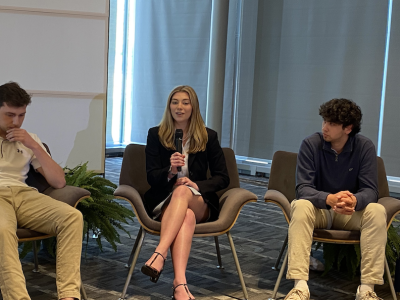
What concerns Adiletti even more is how often college students are gambling on teams they watch on a regular basis.
“I think there is pressure, especially with college athletes because they are sports fans,” she said. “Now, it’s happening more often and at bigger levels like in the pros. It’s not just players involved. It’s coaches and college students who are betting on their own teams. It’s not a new concept but it’s much worse now.”
For Coffey, his experience with betting on sports teams is a personal one.
“When I turned 18, I downloaded an app – Underdog Sports – the summer before I went to college,” he said. “I found out very fast it was not a very good idea. It’s very scary to see some of my friends fall down that hole.”
The targeting of young students, specifically men, by sports book companies that bring sports betting right to their smart phones is a problem that disturbs him.
“Very recently, there is an app called Kalshi,” Coffey added. “They say it’s an investment app. It’s not an investment app. It’s a sports gambling app.”
Kalshi is the first regulated U.S. exchange that allows people to buy and sell “event contracts” based on real-world outcomes, such as economic data, weather, or political events. While it is regulated as a financial exchange by the U.S. Commodities Future Trading Commission, over 90% of its activity in early 2025 was tied to sports.
“What I have learned in the past few years is that young people are a target for the gambling companies,” said Sen. Blumenthal. “They are the predominant target for gambling corporate giants, not just DraftKings and FanDuel. We see a whole new collection of companies in the prediction market. They are gambling, even though they say they aren’t.”
Blumenthal, who has proposed two pieces of legislation to rein in the sports betting and prediction market apps, described how the DraftKings and FanDuels go after young fans to feed their addictions.
“What I know about these companies is that they target people, they track people,” Blumenthal said. “They use algorithms and AI to target the bets that you place, the prop bets and all of the others. The technology has so advanced what they can do.”
The senator representing Connecticut has proposed the Gambling Addiction Recovery Investment and Treatment (GRIT) act, which would take some of the sports betting excise tax and devote it to treatment and research for addiction. Another piece of legislation he co-sponsored is the Supporting Affordability and Fairness with Every Bet (SAFE Bet) Act, legislation that would create nationwide consumer protections and standards for the mobile sports gambling industry.
Sacred Heart University decided to hold the panel discussion because it believes the sports gambling issue is affecting the lives of their students and those at other NCAA schools with sports teams.
“At the counseling center, we know the population least likely to reach out for help is young men, who are the most affected,” SHU’s LaBella said. “It’s a challenging population to outreach for and educate and encourage to come in. By the time someone actually comes through our doors it’s often at that point of problematic gambling with relationships destroyed, anxiety and depression as well as suicidal ideation.”