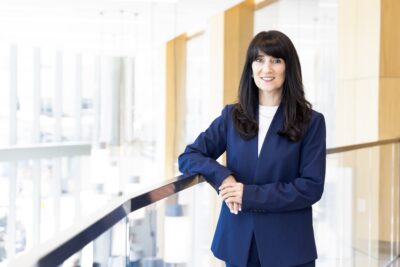
It’s been six months since Erika Berman Rosenzweig, M.D., an expert in pulmonary hypertension, became chair of the Department of Pediatrics at the Valhalla-based New York Medical College (NYMC) School of Medicine; and director of the Department of Pediatrics at the affiliated Westchester Medical Center, the flagship hospital in the Westchester Medical Center Health Network (WMCHealth), whose Brenda Fareri Pavilion will be launched in 2026. (See related story on here.) At that time, she also became the William Russell McCurdy physician-in-chief at WMCHealth’s Maria Fareri Children’s Hospital.
In treating pulmonary hypertension – a life-threatening condition that affects children and adults – Rosenzweig serves in leadership roles in the Pulmonary Hypertension Association and the Pediatric Pulmonary Hypertension Network of North America; and had a 24-year tenure on the faculty of Columbia University Irving Medical Center/NewYork-Presbyterian Hospital, rising to professor and vice chairman for clinical and translational research of the Department of Pediatrics and director of the Adult and Pediatric Pulmonary Hypertension Comprehensive Care Center.
Rosenzweig has authored or co-authored more than 250 scientific publications and has been editor-in-chief of the journal Advances in Pulmonary Hypertension. She has also led more than 50 clinical trials developing novel therapeutic approaches for the treatment of the condition. A Rye Brook resident, Rosenzweig continues to care for patients with pulmonary hypertension referred to her from around the world.
Recently, she took time from her schedule to answer some questions from the Westfair Business Journal:
Dr. Rosenzweig, what attracted you to New York Medical College and Westchester Medical Center?
“When I was initially approached about the opportunity to lead Maria Fareri Children’s Hospital, I wasn’t actively looking for a career shift. However, after only a few conversations, I was pleasantly surprised at how I was immediately drawn into the opportunity to lead the region’s advanced care pediatric center.
“Having lived my adult life in this region, I was shocked at how little I really knew about this hidden treasure. What I did know, however, was that most families with an ill child do not want to have to travel all the way to a big city for their child’s care, whether routine or complex, acute or chronic.
“As I researched more about the teams, specialized programs and opportunities, I was deeply impressed and frankly intrigued. Maria Fareri Children’s Hospital stands uniquely in New York as an academic children’s hospital on a campus with a medical college (NYMC) and nestled within the WMCHealth Network, which delivers a community feel to the highest-level care. I saw a combination of programs of excellence that are or have the potential to be nationally recognized and some that will flourish and grow with some nurturing.
“It was clear to me that Maria Fareri Children’s Hospital had all the ingredients for success, ranging from Level I pediatric trauma and critical care to the highest-level neonatal ICU, to name just a few. I was particularly inspired by the hospital’s commitment to innovation and its strong academic partnership with New York Medical College, which creates an environment where clinical care, research and education intersect to advance the field of pediatrics. I had many leadership roles previously, but this one had the potential to fit like a glove.
“For me, I knew that the opportunity to raise the bar in Westchester and the Hudson Valley for pediatric care could be transformative in elevating children’s health across the entire region and well beyond.”
Pulmanory hypertension is an unusual field. Tell us about the condition and how it is treated.
“Most people don’t know what pulmonary hypertension is. To put it simply, pulmonary hypertension is a potentially lethal disease that affects the circulation of the lungs, which sits between the right and left sides of the heart. When the pressure goes up, as in pulmonary hypertension, patients suffer from right-sided heart strain and, in the worst case, right-sided heart failure. It can affect people of all ages but is seen most commonly in children with congenital heart disease and premature infants.
“For children, this can equate to difficulty breathing, frequent respiratory infections and inability to perform usual day-to-day activities due to shortness of breath. I have been fortunate to have been in the field since its inception when there was only one drug in the form of a continuous infusion available for both children and adults. I have been involved in most of the clinical trials that have prompted FDA (U.S. Food and Drug Administration) drug approvals for pulmonary hypertension, and I’m very happy to say that after two and a half decades in the field, we now have 14-plus medications available to treat pulmonary hypertension.
“Of note, most of the research has been done in adults, and we are required to treat children off-label with these medications, which is why it requires a very high level of expertise at a program suited to care for pediatric pulmonary hypertension patients, like Maria Fareri Children’s Hospital and Westchester Medical Center.
“The good news is that while pulmonary hypertension remains a serious and potentially lethal disease, we have many treatments available. I even have patients I manage at Maria Fareri Children’s Hospital that I have been treating for over 25 years.
“I am so delighted to bring this expertise and our new pediatric pulmonary hypertension center here to Maria Fareri Children’s Hospital as the very first and only pediatric pulmonary hypertension center in Westchester County and the Hudson Valley and one of only a handful across the country.
“I am also extremely proud to join my adult cardiology colleagues in expanding the adult pulmonary hypertension center at Westchester Medical Center substantially. To be able to provide this level of care and service in this region is truly exciting for me and the team as we aim to save many precious lives.”
What plans do you have for the Maria Fareri Children’s Hospital?
“I have many goals….Most importantly, every goal that we set is carved around the core mission to provide the very best care for all children and their families in the Hudson Valley and beyond.
“Every single opportunity and program that we build will be around that mission, set 20 years ago and inspired by Maria Fareri’s wish of wanting to heal all the children of the world. This is a promise that fills the walls of this amazing children’s hospital and one that is woven into our plans to innovate and shape the next 20 years.
“We will expand upon the existing excellence in the areas of critical care medicine, cardiac, neurology, trauma, gastroenterology, hematology and oncology, neonatal and more, plus all of our inpatient services. We will use digital science to help us innovate, using the latest technology to provide the most advanced care to our patients and ensure we are reaching them where they are. Our digital footprint will expand so we can partner with our communities even more meaningfully as we address the current children’s health crisis.
“Maria Fareri Children’s Hospital has top academic excellence in a community-facing, warm and patient-centered environment. Our teams are experts at caring for some of the most complex and critically ill children. As I come to know Maria Fareri Children’s Hospital, I feel very confident letting people know that there is no need to go anywhere else for their child’s care. Here, we will be with families every step of the way.”
Tell us about your path to becoming a doctor: Was medicine always in the picture?
“…I grew up in Long Island, New York, in a family of five. I knew at a very early age I wanted to be a doctor. First inspired by my ophthalmologist with frequent visits when I was just 5 years old, I developed over the years a deep passion for helping people and a love for science.
“At a time when not many women were going into medicine, it was my father’s encouragement that also inspired me. My dad tells the story about us being on a dock in Montauk when the fisherman pulled in a shark. I was mesmerized by the beating heart that was visible, and he predicted then I was destined for medicine and, ironically, pediatric cardiology.
“I attended undergraduate school at the University of Michigan and then returned home to New York, where I attended Mount Sinai Medical School. I spent the next three decades at Columbia University in New York City. It was there that I found my mentor, Robyn Barst, M.D., the field of pulmonary hypertension and built my career as a pulmonary hypertension expert throughout the years….
“A long journey and many experiences have shaped my passion for ensuring that children receive the very best.”