The United States turns 250 on July 4, and already states like New York and Connecticut – two of the original 13 colonies that signed the Declaration of Independence on that day in 1776 in Philadelphia – have begun marking the occasion.
While it’s hard to predict the precise boost to area tourism, New York City may offer a clue. The Big Apple alone, a British stronghold during the American Revolution – which began formally with the Battles of Lexington and Concord, Massachusetts, on April 19, 1775 and ended Oct. 19, 1781, with the British surrender at Yorktown, Virginia – is anticipating six million visitors over six days for events like the International Parade of Tall Ships and the Naval Review, as well as fireworks and aerial demonstrations, all set to the economic tune of $2.85 billion. Greenwich will be getting a piece of that action, with a Tall Ships visit June 27 and 28 when the Netherlands’ 160-foot Oosterschelde docks at the Delamar Greenwich Harbor hotel.
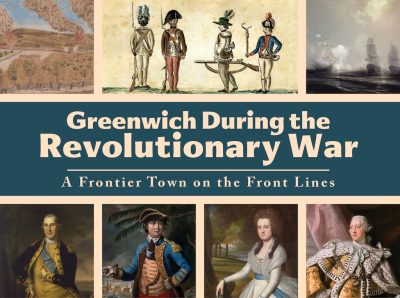
Recently, Fairfield County has had two major exhibits – last year’s “Greenwich During the Revolutionary War: A Frontier Town on the Front Lines” (at Greenwich Historical Society), plumbing the war’s effects on the town’s diverse communities; and “For Which It Stands…,” (through July 25), Fairfield University Art Museum’s exploration of the American flag, beginning with “Italian Day,” a 1918 work by Cos Cob Art Colony member Childe Hassam and moving through 75 works by such artists as Jasper Johns, Faith Ringgold and Robert Rauschenberg. It’s part of the university’s “America 250: The Promise and Paradox” initiative exploring the American Experiment.
Meanwhile, Westchester’s “Rooted in Westchester 250” website offers resources on all things Revolutionary in the county, including such events as an evening with Founding Father Benjamin Franklin (Saturday, Jan. 24, at the Port Chester Senior Community Center); a program on universal suffrage and Founding Father Thomas Paine, whose “Common Sense” pamphlet (1776) galvanized the colonies (Jan. 31, The Thomas Paine Historical Association, New Rochelle); and a “Rev Fest 250” reenactment of the Battle of White Plains at Ward Pound Ridge Reservation (Oct. 24-25).
Civic and cultural leaders in both counties are betting on an appetite for such celebrations.
“I think broadly there’s a group of people that loves these big moments. They don’t happen very often,” said Carey Mack Weber, the Frank and Clara Meditz executive director of the Fairfield University Art Museum, who described the “For Which It Stands…” show as “a moment to reflect upon the ways we’ve used the flag for patriotism and for protest.”
Added Westchester County Executive Kenneth W. Jenkins: ““Crucial to Westchester’s identity is its place at the crossroads of American history.”
Desperate determination
It’s fitting that Westchester and the larger Hudson Valley as well as Fairfield should get a good slice of the America250 pie. Our region not only played a key role in the Revolution but suffered greatly for it.
Yet we cannot understand what happened here unless we first draw back the lens to consider the Revolution as a transatlantic war involving not only the colonies and Great Britain but France, Spain, the Dutch Republic and Hanover (Germany) in encounters from Canada to the Caribbean and as far west as what is now the Midwest. As depicted in filmmaker Ken Burns’ latest PBS series, “The American Revolution,” it was also the fledgling United States’ first civil war, American against American in a zero-sum struggle for identity and independence with echoes for our own time of partisanship and violence, courage and resilience.
The war may have begun as a fight with Parliament for socioeconomic equality (“no taxation without representation”), with about one-third of the colonists chaffing under British rule, a third or less loyal to that rule and another third neutral. But once the rebels, or Patriots, realized that there could be no economic freedom without political freedom – around the time of the Second Continental Congress, which began in 1775 – the focus of ire shifted to King George III as a perceived tyrant, and the fight became more savage, visceral and existential as the Patriots went all in, even if that meant pushing the Loyalists and neutral parties like the Quakers out by any means possible.
“You’re fighting a desperate war,” said local historian and tour guide Stephen Paul DeVillo, author of four books on local history, including “The Battle of White Plains” and the recent “Westchester County in the American Revolution: A Neutral Ground” (The History Press/Arcadia Publishing, 143 pages, $24.99). “if you’re not for us, then you’re the enemy….In the end, all conflicts are us versus them.”

The not so ‘Neutral Ground’
That desperation played out in the “Neutral Ground” of Westchester, so called for the formidable array of rocky ridges, hills, plains, valleys and waterways, formed by the Ice Age 22,000 years ago, that made it difficult for either side to hold territory. Indeed, even perhaps its most famous conflict, the Battle of White Plains (Oct. 28-Nov.1, 1776) – with British Commander in Chief William Howe advancing on Chatterton Hill (what is now Battle Hill), where some of Continental Army Commander in Chief George Washington’s forces were situated, the rest being entrenched between what is now the Bronx River and West Harrison – was a draw, DeVillo said, as British forces quit the field, and the Continental Army headed north to Fishkill and ultimately New Jersey.
Far from becoming insulated, however, Westchester and The Bronx – which formed one of the wealthiest counties in the 13 colonies – became a devastated no man’s land of skirmishes, espionage and raids, with residents terrorized by both the pro-Patriot Skinners gang and the pro-British Cow Boys, a pejorative term, DeVillo said, that marked the first appearance of “cowboy” in the American lexicon.
In “The American Revolution: An Intimate History” (Alfred A. Knopf, 581 pages, $80), the companion to Burns’ series, Geoffrey C. Ward writes: “Timothy Dwight, a Continental Army Congregational chaplain and future president of Yale, never forgot what he saw there: ‘The unhappy inhabitants were exposed to the depredations of both (armies)…They feared everybody who they saw and loved nobody.’”
And yet, out of this traumatized wasteland would come some of the key contributions to the Revolutionary cause – including the July 9, 1776 approval of the Declaration and formation of New York state at the Fourth Provincial Congress of New York in White Plains; the 1780 capture near Tarrytown of British Major John André, who carried plans for West Point from the traitorous Patriot Gen. Benedict Arnold that might have struck the death blow to liberty; and the fateful 1781 decision, made at the Odell House in Greenburgh, in which French Gen. Rochambeau persuaded Washington to forgo trying to retake New York in favor of trapping the British at Yorktown, thus ending the war.
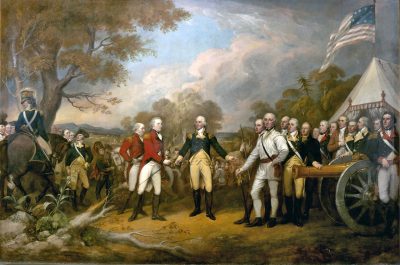
Similarly, Fairfield County experienced tremendous loss, including the burning of Fairfield and Norwalk in 1779, but remained in the thick of Patriot activity. Two years earlier on April 27, Connecticut militiamen under Arnold – a brilliant, charismatic field commander who had not yet betrayed the Patriot cause — had mobilized support for that cause by taking a heroic stand against the British as they fought their way back to their ships after taking supplies in Danbury at the Battle of Ridgefield. It would be the last time the British would attempt a Connecticut invasion, freeing the Connecticut Militia to play a significant part in the turning point of the war, the Patriot victory in the Battle of Saratoga, New York, (Sept. 19 and Oct. 7, 1777).
Fairfield and its strategic Long Island Sound Shore location would also prove vital as Patriots gathered information from the Long Island-based Culper Ring, Washington’s spy network, and raided British supply ships at Black Rock Harbor.
In telling the story of the Revolution that spawned a new country based on democratic ideals for all, local leaders have stressed the need to remember the contributions of Native Americans and enslaved and free Black Americans, who fought on both sides in an attempt to secure an advantage for themselves and their people; and of women, who raised funds and nursed the sick and wounded while tending to children and home.
“History is a lesson,” Westchester County Executive Jenkins said. “To try to erase it or manipulate it is doing a disservice to all those folks who worked hard to be included in that ‘more perfect union.’”
A living legacy
In a way, the Revolution in Westchester and Fairfield counties was a microcosm of the larger war, a brutal, bloody enterprise that meandered from New England through the middle Atlantic states to the South, with the British winning many battles but never striking the decisive blow. It’s one of the lasting questions of the Revolution: Why did the British lose North America? When I posed this to British historian Simon Schama after the publication of his 2006 book “Rough Crossings: Britain, the Slaves and the American Revolution,” he said, “Because they never understood it. And you can’t hold what you don’t understand.”
DeVillo also pointed to 18th-century Britain as the world’s preeminent naval power but with a much smaller army, an empire that built itself “from the sea out rather than the sea in.” Having led British troops to victory in the Battle of Bunker Hill (actually Breed’s Hill, June 17, 1775) and seen the casualties the Americans could inflict, he added, British Commander in Chief Howe may have been reluctant to expend so much blood on a cause that the British believed would somehow favor them in the end.
“The British overestimated the number of Loyalists,” DeVillo said, a hubris that along with an ignorance of the tough American climate and terrain would prove particularly fatal and fateful at Saratoga, convincing archenemy France to enter the war on the Patriot side.
The French contribution cannot be underestimated but neither can the Patriots’ willingness in the face of British brutality to double down, give as good as they got and endure.
Yet what if the Patriots hadn’t won the Revolution? DeVillo said we probably would’ve become a country like Canada, part of the British Commonwealth. That might’ve had profound implications for World Wars I and II, in which our independence enabled us to build up the manpower and industrial might to enter those wars late but decisively.
Was that a blood debt we owed Continental Europe for its help in the Revolution? Aaron Q. Weinstein, Ph.D., an assistant professor of politics at Fairfield University and faculty liaison to the “For Which It Stands…” exhibit, said that it’s not about blood debt but birthright.
“America has a birthright of democracy,” one that has had a stake in seeing people live freely around the world. The origins of that birthright, he added, are not that far removed from us, a mere 10 to 12 generations.
“It’s a living story.”