FAIRFIELD – Affordable or not, it is a given that the town needs more housing options for senior citizens who are looking to downsize their homes. At the same, there needs to be fewer tall buildings and less housing density in neighborhoods.
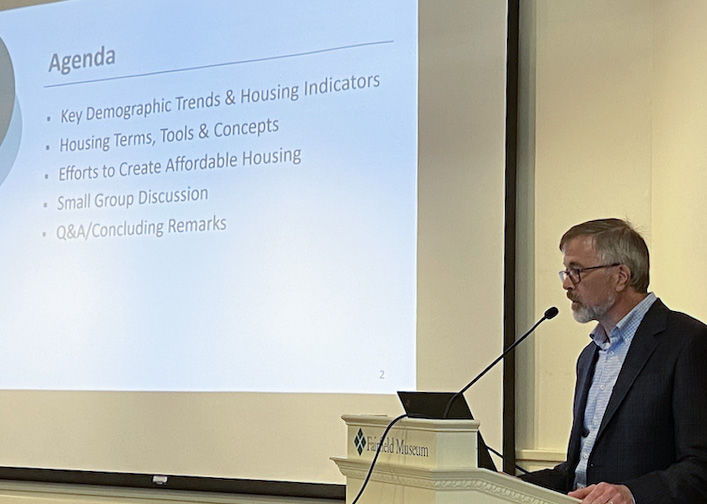
That was the consensus of a small group of residents who took part in a workshop sponsored by the town Affordable Housing Committee and led by town Community & Economic Development Director Mark Barnhart on April 29 at the Fairfield Museum.
“Overall, we think Fairfield is not quite on track but that it is getting there,” said one of the residents speaking for her group at the workshop. “There is not enough senior housing. There are a lot of opportunities for seniors here, with the Bigelow Center (for Senior Activities). Yet, there aren’t a lot of housing options to accommodate this big percentage of the population.”
In fact, all of the five groups of participants agreed about a shortage of affordable places for senior citizens (62+) to live in Fairfield as renters of owners of ranch-style homes in the $300,000 range.
To guide the participants in conversation, Urb Leimkuhler, chair of the Affordable Housing Committee, gave them three questions to ponder:
- Is the town on track to achieving the right mix of homes?
- If we’re not on track, what changes in direction are needed?
- Do you think this approach contemplates the type of housing that you and/or your family might need? If not, what’s missing?
“Senior housing of all types is needed,” another participant said. “Otherwise, we are going to lose the seniors to other communities. There needs to be an initiative to help them with the ownership of housing units. There also needs to be support for two- and three-family homes.”
Another participant said his group focused on the density issue and housing for those who might not yet be considered seniors.
“Larger and expensive homes that are close to each other (is a problem),” the participant said when referring to the mix of homes. “There doesn’t seem to be any rhyme or reason for this housing goes. Maybe there needs to be a more structured approach like TODs (transit-oriented development).
“(Also,) there is a big need for 55+ housing communities. We talked about some of the challenges of those and why they haven’t worked. As far as desired type of housing, rentals and ranch-style, which would be suitable because (senior) people don’t need bigger homes. Good rentals that are not sky high.”
Barnhart described the housing situation for elderly residents in Fairfield as one in need of help.
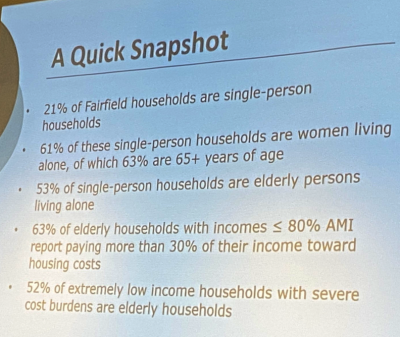
“We have about 20,000-22,000 households in Fairfield,” he said. “Of that 21% are single-person homes. Sixty-one percent of these households are women living alone, of which 65% are 65+ years of age. Fifty-two percent of extremely low-income households that have severe cost burdens are elderly households.”
Regarding affordable housing overall, another big issue is the rollout of Statute 8-30 (g) housing developments. 8-30 (g), enacted in 1989, sets a goal that 10% of each municipality’s housing stock qualify as “affordable” housing. If the 10% target is not met, developers may propose projects that are not subject to local zoning regulations. But the law allows for towns to file for a moratorium of 8-30 (g) projects if a municipality reaches a certain number of affordable housing developments. Those moratoriums are for four years at a time.
What has been frustrating for Barnhart and town Plan and Zoning Commission officials is that about half of P&Z denials of such large affordable housing developments are overturned on appeal. And to make matters worse, some are even abandoned as the property owner finds another less risky, more profitable use for the land.
“We see a fair number of 8-30 (g) projects that do get abandoned – about 20%,” Barnhart said. “They have been abandoned because they (the owner) found something better. For example, the medical office cancer center building (on Black Rock Turnpike near the Merritt Parkway) was approved for a 100-unit under 8 30 (g). Hartford Health Care decided it wanted to use that for medical office space. The owners decided that was a much better bet.”