These are not the best of days for the media, either social or professional, what with Dobbs Ferry-raised Mark Zuckerberg, co-founder, chair and CEO of Meta Platforms, parent company of Facebook, Instagram and What’s App, announcing an end to fact-checking on the sites; the Jeff Bezos-owned Washington Post, once among the pride of national newspapers, continuing to drift on a sea of layoffs and controversial editorial moves; and a newly litigious atmosphere in which President Donald J. Trump – who returns to office today, Monday, Jan. 20, as only the second person, after Grover Cleveland, to serve two nonconsecutive terms – has sued ABC and The Des Moines Register for defamation and consumer fraud respectively.
In the ABC case, the network agreed to pay $15 million to Trump’s presidential library, along with legal fees, and apologize after George Stephanopoulos, host of “This Week With George Stephanopoulos,” mischaracterized the sexual assault the president was found liable for at the E. Jean Carroll trial. As for The Register, Trump is suing it, parent company Gannett Inc. and pollster J. Ann Seltzer for a Nov. 2 poll that put former Vice President Kamala Harris, the 2024 Democratic presidential nominee, about three percentage points ahead of Trump when he actually won the state by more than 13 percentage points. Trump’s suit – and a second similar one filed by the Center for American Rights, a Chicago-based nonprofit law firm, on behalf of some Register subscribers – claims fraudulent disservice that attempted to sway the election.
What will all this mean for consumers of information and for American democracy? “Well, nothing good,” said Bill Yousman, Ph.D., a professor in the School of Communication, Media & the Arts at Sacred Heart University in Fairfield, whose work includes research on media and the construction of ideology and the relationship of media and democracy.
First and foremost, however, Yousman said he sees a through line in all these disparate examples, and that is what he called “the myth of the liberal media.”
It is true, he said, that most journalists vote Democratic rather than Republican. But, he said, how journalists vote is moot in considering the mission of a media company, which is to succeed as a business. The overriding tendencies of the billionaire media boys’ club – the Elon Musks, Mark Zuckerbergs and Jeff Bezoses of the world – “is not to identify left or right. Rather they will do what they have to do to generate a profit.”
And that may mean blowing with the wind. Bezos’ Amazon and Meta each reportedly gave $1 million to Trump’s inauguration, along with Apple, antitrust litigation-challenged Google and Microsoft. Bezos yanked The Washington Post’s endorsement of Harris, sending 250,000 readers to cancel their subscriptions. (The Post rejected a cartoon by Pulitzer Prize-winning cartoonist Ann Telnaus that depicted a kneeling Bezos, Zuckerberg and OpenAI CEO Sam Altman, who also donated to the inauguration, offering money bags to a statue of Trump, leading Telnaus to resign from the publication. Post Opinions Editor David Shipley said the cartoon was repetitious.) Recently, Amazon announced a $40 million deal for a documentary on first lady Melania Trump.
Would that money be flowing to Harris had she won? Not necessarily, Yousman said. In a divided government, the Republicans in Congress would still see any fact-checking guardrails at companies like Meta as tantamount to censorship. One bipartisan exception is a law banning TikTok as a Chinese security risk. TikTok had theoretically until Sunday, Jan. 19, to separate from Chinese parent company ByteDance before it was shut out of U.S. app stores, as per the United States Supreme Court’s Friday, Jan. 17, ruling upholding the ban. However, the outgoing Biden Administration was not going to enforce the ruling, and Trump announced on Truth Social Jan. 17 that he needs time to resolve the situation.
Yousman said he views TikTok — a primary source of income for some small businesses and influencers — just like any social media platform, collecting data to monetize. (Rival Facebook, he added, has been the primary mover behind the quest for a ban.)
Though extremely popular with young people, including the 18 and 19 year olds whom Yousman teaches in his “Introduction to Media and Culture” course, TikTok, with one and a half billion actively monthly users, is not the most popular platform. Worldwide, Facebook has three billion active monthly users; YouTube, two and a half billion; and Instagram and What’s App, two billion each; while Musk’s X, formerly Twitter, is down the line with 600,000.
TikTok scrutiny notwithstanding, fewer brakes on social media and more restraints on professional media can contribute to misinformation (getting the facts wrong) and disinformation (doing so deliberately) while enhancing the dissemination of individual “truths,” which are really just opinions — all of which can harm democracy.
“The No. 1 thing you need in a democracy is an agreement on the facts,. If we can’t agree that (President Joe) Biden won the 2020 election, then you end up with Jan. 6.”
But Trump didn’t create the landscape of misinformation and disinformation. Rather, Yousman added, he gamed it:
“it’s not like democracy before Trump was flawless. The founders left us with a hugely flawed system. What Trump has done is to exploit those fissures… to turn the unwillingness to accept basic facts into the basis for his power.”
What should the media and consumers of media do?
“In an environment so polarized, fact-checking is ineffective anyway,” Yousman said. You are never going to persuade someone to a viewpoint he or she doesn’t want, he added, noting for example that many people think Anthony Fauci, M.D., the controversial former director of the National Institute of Allergy and Infectious Diseases (NIAID), lied to them about Covid, not accounting for the rapidly changing scenario of the novel coronavirus and scientific research in general.
“The upshot is simple fact-checking is not the solution. More effective is media literacy education mandated in the elementary schools.”
Yousman said he realizes that he speaks from a prejudiced viewpoint when it comes to the subject he teaches. But it is critical in a country where the average American reads at a seventh- to eighth-grade level to start at a young age to develop nuanced, critical thinking skills. Of course, the people against social media guardrails are also the ones who are apt to oppose media literacy, he said.
Nonetheless, Yousman added, “we need a social transformation. We need to deal with underlying causes of disinformation, which include conditions of inequality.”
Meanwhile, local news organizations – which Americans still value in the shift to digital consumption – must keep plugging away.
“Journalists have to fight against the headwinds,” Yousman said.
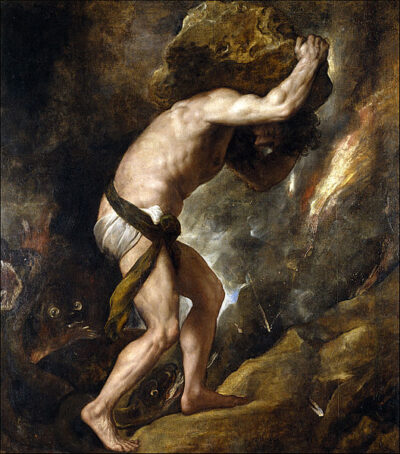
He likened them to Sisyphus, the Greek mythological figure forced in Hades to roll an immense boulder up a hill that fell back down as it reached the top, requiring Sisyphus to try again and again for all eternity.
For the next four years and beyond, Yousman said, journalists are going to have to keep making that climb.