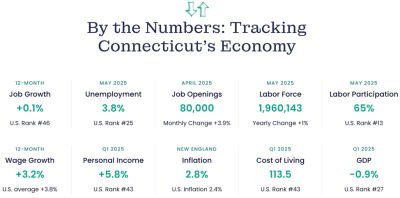
Connecticut’s economy contracted for the first time in more than three years in the first quarter of 2025 amid tariff concerns, slower consumer spending, and ongoing volatility in the state’s jobs market, according to a June 27 report by the CBIA.
The state’s real GDP declined 0.9% – 27th in the country – after growing 1.8% the previous three months and 2.6% in 2024. Connecticut’s quarter-over-quarter growth ranks eighth in the Northeast, behind Pennsylvania (0.3%), Delaware (0%), New Hampshire, Rhode Island, Vermont, Maryland (-0.5%), and New York (-0.7%).
New England’s economy shrank 0.8%, with national GDP down 0.5% as just 10 states saw growth, according to a June 27 U.S. Bureau of Economic Analysis report. New Hampshire’s economy performed the best in the region, contracting 0.1%, 13th among all states.
Rhode Island’s GDP declined 0.2% (13th), followed by Vermont (-0.3%; 18th), Connecticut, Massachusetts (-0.9%; 28th), and Maine (-1.2%; 32nd).

Tariffs, job growth
CBIA president and CEO Chris DiPentima said that businesses imported critical goods ahead of scheduled April tariff hikes and seesawing federal trade policy impacted productivity during the quarter.
“I don’t think this is a slowing down in the economy, but it’s showing the volatility in the economy on a month-to-month basis,” he said.
“There were a lot of businesses trying to get ahead, so they brought in a lot of inventory from overseas before those products and services increase in price, based on whatever is the end result of the tariffs.”
DiPentima also noted that the state’s labor market challenges — year-over-year job growth is just 0.1%, seven-tenths of a point behind the national rate — were also affecting GDP growth.
Sector performance
Connecticut’s $295.9 billion real GDP accounts for 24% of New England’s $1.2 trillion economy, and is the second largest in the region behind Massachusetts ($636.9 billion).
Just eight of the 23 industry sectors that the U.S. BEA tracks posted productivity gains in the first three months of the year, led by the real estate sector, which expanded 0.7%. Information grew 0.64%, followed by state and local government (0.12%), professional services (0.09%), military (0.07%), administrative services (0.04%), durable goods manufacturing (0.01%), and federal government (-0.01%).
Finance and insurance — a key component of the state’s economy —saw the greatest decline of any sector, contracting 0.64% after expanding 0.4% the previous quarter.
“The wild swings in the jobs market this year make it clear that Connecticut’s labor market struggles are holding back our economic potential,” DiPentima said.
“Key factors driving Connecticut’s stagnant economy — such as the high cost of living—went unaddressed once again by policymakers during the legislative session.”
DiPentima pointed to the CBIA Foundation’s long-term economic action plan and its recommendations to improve regulatory processes, create new career pathways, and make Connecticut a more attractive place to live and do business.
“Improving the state’s business climate, addressing our workforce needs, and enhancing the quality of life are critical to driving and sustaining economic growth in Connecticut,” he said.