With the federal government vowing to return to the U.S. Supreme Court to fight a lower court order to pay SNAP recipients the full November benefit, New York and Connecticut are among the 20 states that have already begun making the payments.
Gov. Ned Lamont (D-Connecticut) has said the SNAP recipients received their full benefits as of Saturday, Nov. 8. Gov. Kathy Hochul (D-New York) said she directed state agencies to issue full federal SNAP benefits, which New Yorkers were expected to be able to access as of Sunday, Nov. 9.
This comes after more than a week of legal wrangling and maneuvering that began Oct. 31 when U.S. District Judge John J. McConnell Jr. ordered the Trump administration to continue funding SNAP benefits. A Friday, Nov. 7, administrative stay of McConnell’s ruling by U.S. Supreme Court Justice Ketanji Brown Jackson gave the U.S. Court of Appeals for the First Circuit time to review the proceedings and reject the administration’s bid to block the full payments.
The administration is now seeking the entire Supreme Court to weigh in and demanding that the 20 states rescind the payments they made to SNAP beneficiaries, although U.S. Solicitor General D. John Sauer acknowledged the potential mootness of that action if the government reopens. A bipartisan Senate deal to do just that is now in the works.
New York and Connecticut were among the states that had anticipated the SNAP crisis. On Thursday, Oct. 30, Hochul declared a state of emergency and committed “an additional $65 million in new state funds for emergency food assistance that will reinforce New York’s network of vital food bank and pantry partners… to help the three million New Yorkers losing food assistance….”
A press release from her office noted that the total amount of state funds allocated to emergency food assistance reached $106 million. Hochul also said she would deploy Empire State Service Corps and SUNY Corps members “to support local food banks during this emergency period of increased need and continue to explore food hubs at schools.”
The State University of New York (SUNY) system has hundreds of students who serve as “peer navigators,” helping with food assistance. Empire State Service Corps typically helps with a variety of initiatives, including tutoring, disaster relief and supporting food banks.
Meanwhile, Lamont, who has announced a bid for a third term as governor of Connecticut, had directed his state to provide $3 million in emergency funds to Connecticut Foodshare, a nonprofit that supports food banks.
“While this $3 million in emergency funding will not fill the entire gap left by the federal government, it represents our state’s commitment to supporting our neighbors during this crisis,” Lamont said in a statement.
About 360,000 Connecticut residents have been affected by SNAP delays, according to Connecticut Department of Social Services Commissioner Andrea Barton Reeves.
Local organizations have also leapt into the breach. Feeding Westchester has shared the third episode of its Hunger Report, continuing to detail the worsening effects of the situation for federal employees in our area and some 77,000 Westchester SNAP recipients as the federal government shutdown, which began Oct. 1, moves deeper into its second month. This all comes after Feeding Westchester experienced a loss of nearly $4 million in government funding.
Nevertheless, the Elmsford-based nonprofit set an initial goal of funding 20,000 emergency meals and has put out an SOS for community support.
On Oct. 30, the day before Halloween, Empire State Voices partnered with the Tarrytown Community Opportunity Center and the Peekskill Housing Authority to donate canned goods, nonperishables — and, of course, candy — to local families in need. More than 66,000 Hudson Valley residents rely on the benefits.
On Monday, Nov. 10, students at Maria Regina High School in Hartsdale announced they had raised more $700 for Hillside Food Outreach, a regional nonprofit.
In Bethel, the Note Restaurant Group — which includes Notch8; Shakedown Street Eats; Fat Tony’s Deli & Pizzeria; Tipsy Tailgate; and Fire & Slice – has begun providing meals for five to 10 families each day. To participate, fill out the confidential request here.
B.I.B. (Better in Bethel Restaurant) is donating food bags for people in need. They’re available at 186 Greenwood Ave. (475) 289-3620.
Various sectors are also taking care of their own. One Fair Wage has launched the Service Workers SNAP Emergency Fund to provide immediate relief to the workers who are among those hit hardest — restaurant and service workers.
According to One Fair Wage research, service workers rely on SNAP at twice the rate of other workers, a reflection of poverty wages across the industry.
“The people who feed us can’t afford to feed themselves,” said Saru Jayaraman, president of One Fair Wage. “This isn’t just a story about food assistance. It’s a story about poverty wages. Forty-two million Americans rely on food stamps, and millions of them are working. That reveals the crisis for what it really is – people working full time and still going hungry, because wages are too low to live on. The solution isn’t half benefits or emergency patches: It’s living wages. Blue states have both the opportunity and the responsibility to lead by passing laws that ensure no one who works for a living ever has to depend on food stamps to eat.”
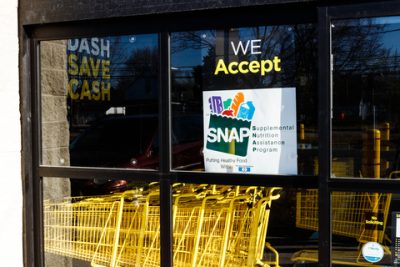 SNAP, or the Supplemental Nutrition Assistance Program, grew out of the first Food Stamp Program in the Great Depression (1939). In fiscal 2023, 39% of its recipients were children, 42% working-age adults (18-59) and 19% elderly and/or disabled adults 60 and over. Among SNAP beneficiaries, 89.4% are U.S.-born citizens.
SNAP carries work requirements for “able-bodied adults without dependents ages 18 to 54” and most who can work do. But as One Fair Wage’s Jayaraman observed, it’s just not enough to make them food secure.
The effects of the program are profound, not just for recipients but for the community and beyond, as 73% of households had a gross monthly income at or below 100% of the federal poverty level in fiscal year 2023. SNAP benefits lifted 17% of participating households above the poverty line in FY 2023.
Indeed, every $1 spent yields $1.50 in economic activity.
“SNAP benefits are a crucial part of the revenue necessary to keep grocery stores open and functioning, especially independent grocers and stores in rural areas,” said Jack Lynch of BerlinRosen, a public relations and marketing firm representing some New York grocers. “With looming cuts, many stores will need to cut back on hours, limit their offerings or may be in danger of closing entirely.”
In related news, the federal government announced Friday, Oct. 31, that it would use $450 million in customs revenue to buttress the Special Supplemental Nutrition Program for Women, Infants and Children (WIC). According to The New York Times, some 67 million women and small children participate in WIC, including 41% of all infants born in the United States.
Westfair’s Pamela Brown contributed to this report.