When it comes to the the Hudson Valley, all roads lead to Stewart Airport. Or they will if the Metropolitan Transportation Authority”™s ambitious plans to remake the region with a web of transportation improvements can get in gear and stay there.
The MTA held a public hearing at the Hilton Garden Inn on December 8 to present its $5.4 million “West of Hudson Regional Transit Access Study” for improving mass transit in Orange County. A federal grant paid for part of the undertaking started in mid-2008; the remaining $3.5 million was split between MTA and the Port Authority, which has owned Stewart International Airport for 13 months. The MTA, its consultants from AECOM, representatives of the Port Authority and the state Department of Transportation were on hand to answer questions from nearly 80 people who turned out to hear the overview of the study.
The goal is to better connect central Orange County to Manhattan. While many are hoping that one-seat ride will be over a new Tappan Zee Bridge, the tunnel being built under the Hudson River between New Jersey and Manhattan (Access to the Region”™s Core) will more than likely be the fastest and most economical way to make that one-seat ride happen for west-of-the-Hudson commuters. Also key is connecting Stewart to all forms of public transit, whether by rubber or rail, the study said.Â
Not only has the MTA been reviewing how better to serve customers in Orange, but Elisa Van der Linde, MTA project manager, said changes in the federal government”™s structure will broaden the agency”™s mass transit base to include Dutchess and Ulster. Although it will take several years, the MTA and partner agencies will create an inter-county and intra-county, transit system, she said.
That notion has attracted other stakeholders to the growing list of agencies and municipalities that want to see public transit become more than just talk.
“People are looking for transportation options to Bergen, Rockland and Westchester,” said David Church, Orange County”™s planning commissioner.Â
Connectivity is the key ”“ a massive undertaking that will be years in the making, “but must be done,” said Van der Linde. Â
“Any transit solutions that benefit commutation markets will broaden the economic base of the entire area.”
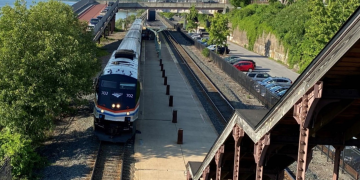
Two major goals are to create better commutation for central Orange County and to bring rail service from the Port Jervis line to Stewart, a concept in the talking stages since the 1970s, said Van der Linde. Improvements need to be made to the Port Jervis line immediately, including more track, faster trains and more cars. “Some improvements can be made quickly,” she said. “Others will take much longer ”“ in some scenarios, between 10 and 20 years.”
There is broad agreement on a number of issues revolving in the Stewart orbit:
Ӣ With the Port Authority running Stewart until the 22nd century, bringing passengers and cargo in and out via mass transit is essential for it to be a strong airport and transit hub.
Ӣ With the highway connection from I-84 directly into the airport now a reality, and the linkage of the state Thruway with I-84 to make trucks roll smoothly through the area nearly complete, Stewart is becoming a more attractive cargo destination,
Ӣ Those same highway fixes will bolster the airportӪs appeal for passenger airlines.
Ӣ Public transportation isnӪt a want; itӪs a necessity.
The study area boundaries include a catchment area serving the airport as far north as Kingston, east to Connecticut, west to Port Jervis and eastern Pennsylvania and south to Westchester and even New York City. But the “project limits” define the area where infrastructure improvements and associated environmental impacts will be considered. That is a more focused area within the study area that extends from Stewart to Suffern and from Campbell Hall”™s train station to the MTA station in Beacon.
With so many stakeholders and so many opinions, is the Port Authority or MTA frazzled by the abundance of opinions and comments coming from the public? “Not at all,” said the PA”™s Patty Clark. “In fact, when the ”˜train to the plane”™ was proposed in Queens several years ago, we had tremendous public input. We want to do what makes the most sense and is the most cost efficient. Sometimes, when you are so close to a project, other eyes can see things we don”™t. We don”™t underestimate the power of public opinion ”“ or the help it brings.”
The project”™s Web site is www.mta.info/mta/planning/whrtas.
Public comment will be accepted through the end of December, 2008.