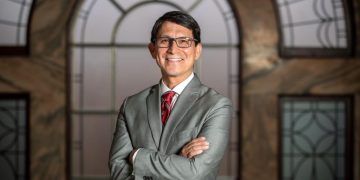
The Elisabeth Haub School of Law at Pace University has appointed Michael Hamersky to serve as the executive director of the Pace Energy and Climate Center. In addition to leading the center, he will teach Natural Resources Law at the law school. Over nearly four decades, the Pace Energy and Climate Center has established itself as a national leader working at the intersection of energy and the environment.
Prior to this role, Hamersky served as the climate change and land use policy fellow at Pace Haub Law where he focused on the clean energy transition and the various barriers to, and incentives for, renewable energy deployment. Specifically, he has advised the United States Department of Energy, as well as end-users and municipalities, on how to best implement on-site distributed energy resources in the New York/New Jersey region considering the economics in light of regional energy markets. Hamersky has also developed recommendations to the New York State Research and Development Authority (NYSERDA) to update New York’s battery storage and wind energy, systems model laws and has prepared resources related to large renewable energy project siting and permitting process, which is used by NYSERDA to educate municipalities throughout the state. Hamrsky has also produced scholarship related to conservation in Indigenous communities and ocean governance.
“During his time at the Law School, first as an LLM student, and more recently as a Climate Change and Land Use Policy Fellow, Michael has established himself as a forward-thinking leader in the field of environmental law,” said Dean Horace E. Anderson Jr. “Our Pace Energy and Climate Center has established itself as a trusted Center and thought leader, frequently engaging government decision makers and key stakeholders with objective research and analysis in law and policy. I am confident that with Michael serving as the executive director of the center, our center will continue to serve as a model and leader in the field.”
Prior to joining the Haub Law community, Hamersky practiced corporate restructuring litigation for over 15 years in New York City, and was an adjunct professor at the Fordham University School of Law. He received his Juris Doctorate from Fordham University School of Law and his LLM in Environmental Studies from the Elisabeth Haub School of Law at Pace University, with a focus on energy law and climate change.
Over time, the Pace Energy and Climate Center has grown from its initial focus on energy regulatory law and policies, expanding its focus to encompass transportation and fuels as well as climate change mitigation and resilience. Through the analysis and advancement of critical policies engineered to improve energy efficiency, accelerate renewable energy and distributed generation, reduce greenhouse gas emissions, and make communities more resilient in the face of climate change impacts, the center has continually reconfirmed its position at the leading edge of finding solutions to our energy and climate challenges on the local, state, regional, national and international levels.
The Pace Energy and Climate Center was founded in 1987 as the Pace Energy Project by Dean Emeritus Richard L. Ottinger upon his retirement from the US Congress. Ottinger recognized early on the significant environmental impacts of our supply and use of energy in the United States. From the very beginning, under Ottinger’s leadership, the center provided cutting-edge research and analysis of energy production alternatives’ social and environmental costs and benefits. Through careful and consistent engagement across communities, the center was among the first organizations to highlight the benefits of energy efficiency and renewable energy as alternatives to conventional electricity generation.
In addition to being a force for legal and policy change, the center also trains the next generation of smart energy leaders. Students from the Elisabeth Haub School of Law at Pace University are actively involved in the center’s projects.
Students who participate in the center’s work have gone on to careers at institutions central to the energy discussion, such as the Federal Energy Regulatory Commission, the US Environmental Protection Agency, the Energy Foundation, the California Independent System Operator, New York State Energy Research and Development Authority, the New York Power Authority, the New York Public Service Commission, and the New York Independent System Operator, to name a few.
Pace University’s Elisabeth Haub School of Law offers JD and Masters of Law degrees in both environmental and international law, as well as a Doctor of Juridical Science in Environmental Law. The school, housed on the university’s campus in White Plains, New York, opened its doors in 1976 and has more than 10,000 alumni around the world. The school maintains a unique philosophy and approach to legal education that strikes an important balance between practice and theory. Haub Law launched its Environmental Law Program in 1978, and it has long been ranked among the world’s leading university programs, with a current No.1 ranking by “U.S. News & World Report.”