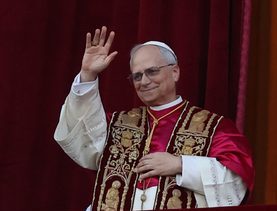
The election of Chicago-born and raised and Villanova-educated Cardinal Robert F. Prevost as pope at a time when the United States’ role on the world stage has never been more divisive has been nothing short of stunning for many if not most of the world, who clearly did not have him on their bingo card.
And yet it may be perceived as a truly divinely inspired choice, precisely because of the U.S.’ shifting role in the world order, experts said.
“Leo’s significance as an American pope at this moment is someone who clearly understands the challenges and stakes of the Trump Administration and its actions.” said Dan Rober, Ph.D., associate professor and chair of Catholic Studies at Sacred Heart University in Fairfield, a systematic theologian specializing in Vatican II — which brought so many changes to the church in the second half of the 20th century — and the relationship of Roman Catholicism to politics and culture. “His combination of diplomatic background and American upbringing (but significant time spent abroad) will equip him well to deal with the challenges ahead.”
Rober — who has been participating in “From Francis to the Future: A Papal Discussion” — a three-part round-table that concludes today — told the Westfair Business Journal to look to the new pope’s name choice for a key to what his papacy would offer.
“His name is likely inspired by Pope Leo XIII, who was pope in the late 19th century and was known as systematizer of Catholic social teaching on issues such as wealth, poverty and labor.
Indeed Leo XIII’s encyclical “Rerum Novarum” is considered a classic defense of workers’ rights amid the rise of both capitalism and socialism. Leo XIII (1810-1903) — who sought to make the Church resonate in the everyday world in a century that saw the loss of the papal states and thus secular authority and the birth of modernism — was also known, for his devotion to to the teachings of St. Augustine of Hippo and St. Thomas Aquinas. From 2001 to 13, the new Leo, an Augustinian friar, served as the general of the Order of St. Augustine, which characterized by its intellectualism and missionary outreach.
Both Leos shared a commitment to social justice and a global outreach, with Pope Leo XIV’s work as a parish pastor, diocesan official, seminary teacher and administrator ultimately leading him to become Bishop of Chiclayo, Peru (2015-23). A dual American and Peruvian citizen who speaks fluent French, Italian, Spanish and Portuguese and reads German as well as Latin, Leo was made a cardinal by Pope Francis in 2023, the same year he became prefect of the high profile Dicastery for Bishops and president of the Pontifical Commission for Latin America.
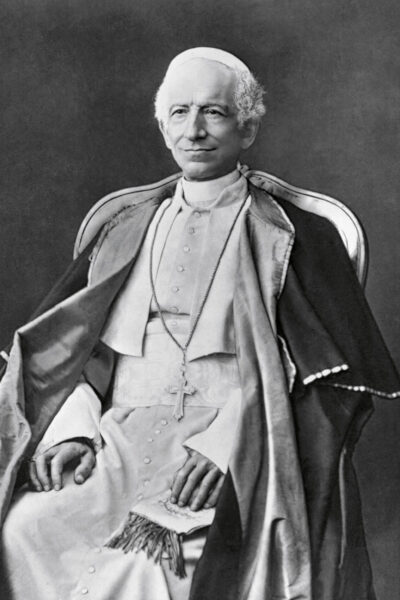
Pope Leo XIII, one of the longest serving popes.But the the elegant, diplomatic Leo XIII (1810-1903) was not just “the Workers’ Pope” but “the Rosary Pope” for his many encyclicals on the Rosary, which Catholics use to commemorate events in the lives of and to pray to Jesus and his mother, the Virgin Mary. When the Jewish Museum in Manhattan presented a 2005 exhibit on Sarah Bernhardt, the French actress who was proud of her Catholic and Jewish heritages, it include Leo XIII’s gift to her, a floor-to-ceiling wooden rosary whose beads were the size of golf balls.
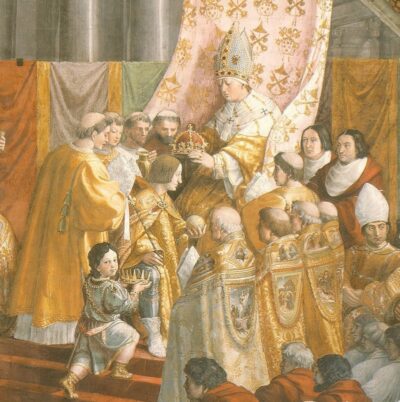
It’s a reminder that the papal Leos — possessors of a regal, leonine name — have also always been willing to use the symbols of the church’s authority, status and power, as in the cases of Leo I (the Great, 410-461), the Roman aristocrat and doctor of the church who affirmed the integrated humanity and divinity of Jesus and persuaded Attila the Hun to retreat from Italy; Leo III (pope from 795 to 816), who crowned Charlemagne Holy Roman Emperor on Christmas Day 800; and Leo X (1475-1521), the cultured Medici pope whose lavish spending on the arts, including the decoration of St. Peter’s Basilica, helped stoke the Protestant Reformation.