© Rokas Tenys
| Dreamstime.com.
(Editor’s note: One day shy of Pope Leo XIV’s first anniversary as pontiff, he met with Secretary of State Marco Rubio amid continued criticism from President Donald J. Trump over Leo’s vocal opposition to the Iran War. Here we look back at a pontificate that is as unlikely as it is inevitable:)
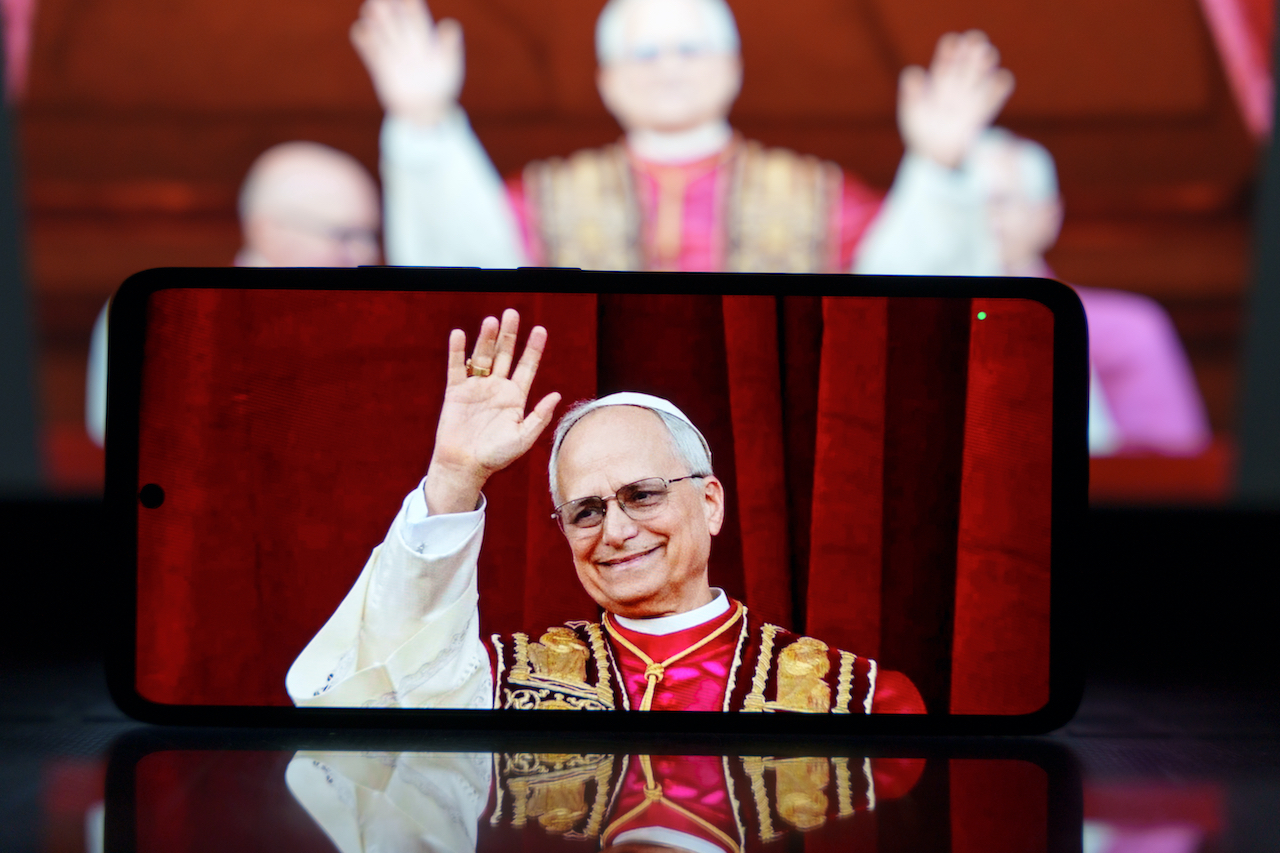
On Friday, May 8, Pope Leo XIV marks the first anniversary of a papacy that gives new meaning to the phrase “God moves in a mysterious way.”
When the white smoke plumed from a special copper chimney atop the Sistine Chapel roof almost a year ago to the day, signaling a new pope had been elected after the death of Pope Francis almost three weeks earlier, few imagined it would be Cardinal Robert Francis Prevost, the mild-mannered, Chicago-born Augustinian missionary who served as prefect of the Dicastery for Bishops, a top Vatican post with a hand in selecting bishops worldwide. The United States was considered too dominant, the smart money said, for there ever to be an American pope.
Yet there Leo – who took his name from Pope Leo XIII, pontiff during another Gilded Age (1878-1903) of sweeping contrasts – and we were.
And while the new pope has since spoken out clearly but carefully in support of migrants and the victims of wars in places like Gaza and Ukraine, few could’ve imagined, too, that he would emerge as the passionate leader of not only more than 1.4 billion Roman Catholics – representing about 17.8% of the world’s population and growing — but those longing for direction to a life beyond war, materialism and alienation.
And yet, here Leo and we are.
Improbable? Perhaps not to the faithful, who, after all, believe in miracles. But perhaps not also to others who see Leo XIV’s particular brand of American equanimity as making him a man of and for our time.
The pope has a net favorability rating in the U.S. of +34, significantly higher than other public figures and a worldwide rating of +24. A Gallup International End of Year Survey (October–December 2025) found that Leo is the only contemporary global leader with a positive net reputation worldwide.
“Pope Leo’s first year shows us the next step for the church – a commitment to prayerful conversation in continuity with Pope Francis, bold statements against war and the importance of the pope as a unifier for a polarized church and world,” Charles A. Gillespie, Ph.D., assistant professor of Catholic Studies at Sacred Heart University in Fairfield, said recently on TribLive.
| Dreamstime.com.
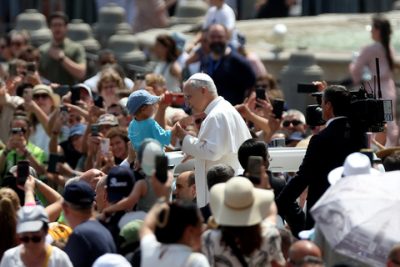
The bridge builder
Leo often wears the mozzetta – the short red cape – favored by the conservative, scholarly Pope Benedict XVI and eschewed by the liberal, galvanizing Pope Francis. He has eased restrictions on the Traditional Latin Mass (TLM) – which has also endeared him to conservatives. (It should be noted here that the church never entirely abandoned Latin in the liturgy. For example, the seasonal cycle of Marian Antiphons, sung before the final hymn, are in Latin.)
At the same time, Leo has kept faith with mentor Pope Francis, advocating for the environment, the rights of migrants and refugees and synodality, a greater role in the church for laymen – and particularly laywomen, who nonetheless cannot become deacons or priests. (In an extraordinary gesture, Pope Leo XIV — who last October prayed with King Charles III, head of the Church of England, and Queen Camilla — prayed on Monday, April 27, with the Most Rev. Sarah Mullally, the first woman to lead the Anglican Communion as archbishop of Canterbury. It’s a reminder that the world “pontiff” — from the Latin “pontifex,” the name of Leo’s X handle — means “bridge builder.”
“Pope Leo XIV’s first year set a clear vision rooted in unity, peace and social justice,” said Michelle Loris, Ph.D., Psy.D., professor of Catholic Studies at Sacred Heart. “From the start, he emphasized a missionary, synodal Church grounded in dialogue, listening and bridge-building. His message of ‘Peace be with you’ became a defining theme, calling for ‘unarmed and disarming’ peace. This vision shaped his actions, including outreach to Orthodox Christians and a focus on unity within the global Church.
“His Apostolic Exhortation ‘Dilexii Te’ highlights concern for all forms of poverty – material, social, cultural and spiritual – continuing the legacy of both Pope Francis and Leo XIII.”
And yet, these very qualities – springing from the teachings of Jesus and the Gospels, experts have stressed – put him on a collision course with the Trump Administration. As an Augustinian, with a Bachelor of Science in mathematics from Villanova University outside Philadelphia, a Master of Divinity from Catholic Theological Union in Chicago and a Doctorate in Canon Law (JCD) from the Pontifical University of St. Thomas Aquinas in Rome, Leo is well-versed in St. Augustine’s advocacy for a life lived in community with others in which war is justifiable only under certain conditions..
“War divides; hope unites,” Leo noted in his reflection from the worldwide Prayer Vigil for Peace on April 11, which included the antiwar sentiments of other recent popes. “Arrogance tramples upon others; love lifts up….My dearest friends, all it takes is a little faith, a mere ‘crumb’ of faith, in order to face this dramatic hour in history together – as humanity and alongside humanity.”
Amid pushback from President Donald J. Trump and Vice President JD Vance, a Catholic convert, for his condemnation of the Iran War, the pope stood firm while also speaking out against tyrannical leadership around the globe and the use of religion for political gain. In Cameroon, part of a four-nation African tour that included Algeria, Angola and Equatorial Guinea, the pope said:
“The world is being ravaged by a handful of tyrants, yet it is held together by a multitude of supportive brothers and sisters.”
He added: “Woe to those who manipulate religion and the very name of God for their own military, economic and political gain, dragging that which is sacred into darkness and filth.”
Leo later told the papal press corps that he had written that speech weeks before the Trump contretemps that exploded at the outset of the African tour, Monday, April 13. Still, he might’ve modified the homily. He chose not to.
A native son who belongs to the world
Ever the pacifist – though not a pacifier – Leo also said that while he was “not afraid” of the Trump Administration, it was “not in my interest” to get into a fight with the president.
The disagreement has dented Trump’s approval among Catholics – the largest Christian sect in the country (20% to 22% of the adult population) and a key group of swing voters that helped him win in 2024 – but only slightly. As of late April, Trump’s approval rating among American Catholics had fallen from 55% to 51%, rebounding nonetheless from a low of 48%. In contrast, Leo has an 84% approval rating among American Catholics.
Still, the first U.S.-born pope will not be celebrating the 250th birthday of his native land in his native land. Contrary to recent reports that said the pope decided against the visit after a “contentious” January meeting only recently made public between Christophe Pierre — then papal nuncio, or ambassador, to the U.S. — and Elbridge A. Colby, a Pentagon undersecretary and Catholic convert, it was never Leo’s intention to come here for the special Fourth, said Dan Rober, Ph.D., associate professor of Catholic Studies at Sacred Heart, where he, Charlie Gillespie and Michelle Loris take part in the “Cor Ecclesiae” podcast with professor emeritus and moderator Michael W. Higgins.
Instead, the pope will receive the Liberty Medal from the National Constitution Center in Philadelphia in a virtual July 3 ceremony recognizing, the center said, “his lifelong work promoting religious liberty and freedom of conscience and expression around the world.”
On the actual Fourth, he’ll visit Lampedusa, the Italian island that serves as a gateway for migrants seeking entry to Europe. Migrants have been close to Leo’s heart. So are this former math and physics teacher’s concerns about the uses and abuses of AI..
“Leo’s forthcoming encyclical ‘Magnifica Humanitas’ (May 15) should give us some insight into his expressed concerns about artificial intelligence in relation to human dignity and the dignity of work in particular,” Rober said. “This is an area where his insights may break through outside the church, given the rising levels of concern in this area. Like his namesake Leo XIII with the Industrial Revolution, Leo clearly sees the church as having something important to offer in an era of what may turn out to be epochal technological change.”
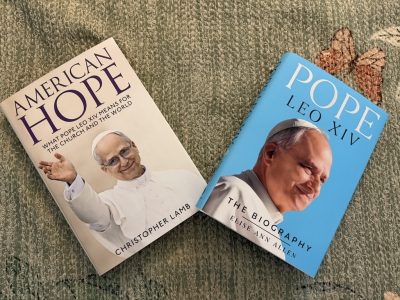
On Wednesday, May 6, the “Cor Ecclesiae” podcast will host Christopher Lamb, CNN Vatican correspondent and author of the new “American Hope: What Pope Leo XIV Means for the Church and the World” (Headline Publishing Group Ltd., $32, 284 pages).
Also just out is Elise Ann Allen’s “Pope Leo XIV: The Biography” (Penguin Random House Christian Publishing Group, $28, 290 pages).