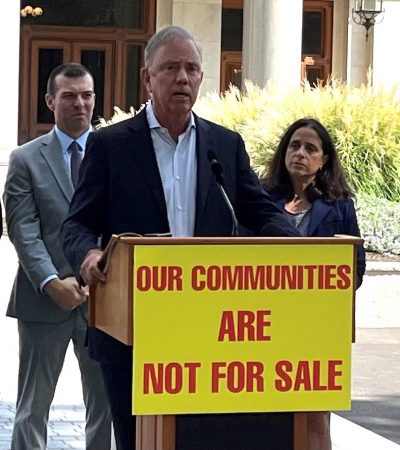
HARTFORD – Gov. Ned Lamont told a large crowd of Fairfield and Bridgeport residents and businesses Tuesday, Sept. 16 that he has asked United Illuminating to delay the planned Connecticut Siting Council vote Thursday on the plan to install monopoles in the Congress Street substation area.
The governor joined the gathering of nearly 100 rallygoers to give them the news that he asked UI to request a delay in the vote to consider other alternatives to the relocation and rebuild of its existing 115kV electric transmission lines along 7.3 miles of Metro-North Railroad corridor located east of Sasco Creek in Fairfield and UI’s Congress Street substation in Bridgeport.
A Sept. 4 Siting Council straw vote recommended that the plan to install monopoles be returned to the southern route along the Metro-North Railroad tracks, a plan that the Council itself previously rejected as unfit and that ignores private property rights and critical religious and historical institutions.
“I want a delay to see a better way to do this,” Gov. Lamont said, adding that the goal is to have as little disruption to our communities as possible, and that “we’re not going to let UI rush into a bad decision. \We did talk to United Illuminating. They said they would not oppose the delay.”
First Selectman Christine Vitale thanked the governor for interceding with what she had called a “tainted process” when the Siting Council took the straw vote that inexplicably reversed their earlier stance.
“Gov. Lamont has heard the voices of the people of Fairfield and Bridgeport and has offered both our municipalities and UI an opportunity to start again, this time with a plan that takes our concerns into account,” Vitale said. “Now I call upon UI to finally sit down with us to meaningfully evaluate alternatives that will minimize disruption to the precious resources in our community.”
UI’s plan also calls for rebuilding of two existing 115kv lines along 2.3 miles to facilitate the interconnection between UI’s Ash Creek, Resco, Pequannock, and Congress Street substations.
A joint Fairfield/Bridgeport press conference is scheduled for Wednesday, Sept. 17 at 11 am at the Barnum Museum in Bridgeport to outline the municipalities’ concerns.
“Today’s rally at the State Capitol showed the strength of Fairfield and Bridgeport standing together in solidarity against United Illuminating’s destructive transmission project through our communities,” said Steve and Andrea Ozyck, co-founders of Sasco Creek Neighbors Environmental Trust, Inc. (SCNETI), aka Empowering Fairfield. “We thank all who traveled to Hartford to ensure their concerns were heard, and the many speakers who gave voice to the profound impacts this project would bring — lost homes and businesses, forfeited economic development opportunities, damage to historic landmarks, and desecration of cherished churches.”.
Vitale reiterated that the Town of Fairfield has been an involved intervenor in the process from the beginning, when the late First Selectman Bill Gerber applied for that status. Overwhelming opposition from residents, small business owners, preservationists and religious leaders has been heard.
Vitale stressed that Fairfield has consistently advocated for placing transmission lines underground along public roadways, a proven, safer, and modern solution that is regularly utilized by states throughout the nation and countries around the world.
A significant legal victory for the residents, businesses and property owners, and grassroots organizations in Fairfield and Bridgeport was won when [New Britain] Superior Court Judge Matthew Budzik reversed the CSC’s decision to approve overhead monopoles north of the Metro North train tracks. Judge Budzik ruled that the CSC “exceeded its statutory authority and violated principles of fundamental fairness” and remanded the matter back to the CSC “for proceedings consistent with [the court’s] memorandum of decision.
A June 12, straw vote of Siting Council members to reconsider UI’s original proposal to install overhead monopoles to the south of the Metro North train tracks resulted in four votes to deny the application, two votes to approve, and one abstention. Although the straw vote was technically non-binding, as a result of the straw vote, acting Chair John Morrisette instructed Siting Council staff to draft a formal opinion and decision denying UI’s application, Vitale said.