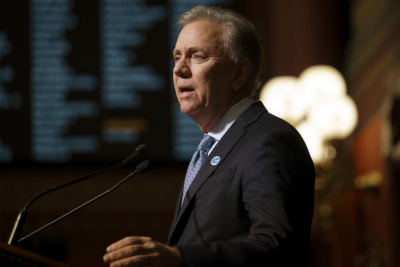
HARTFORD – The Connecticut Democratic leadership announced late last week it is prepared to “exercise emergency powers” to counter President Trump’s revocation of more than $150 million in health care grants.
“No state can restore every cut that comes from Washington or ignore the effects, especially on public health,” according to a statement Friday from Gov. Ned Lamont, Senate President Pro Tempore Martin Looney, and Speaker of the House Matt Ritter. “However, sound fiscal practices have positioned us better than most states in the nation. If this pattern of devastating cuts continues, we will be prepared to exercise emergency powers.
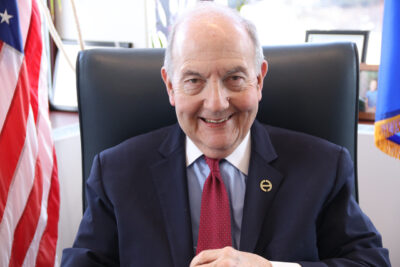
“Although we hope that Washington reverses course, we must plan for the inevitable or unpredictable. Over the coming weeks, we will be meeting to collaboratively plan how to best protect our state’s values during this chaotic period in Washington.”
The state Republican leadership response to the Trump administration’s pulling back of the more than $150 million in health care funds?
“CT Democrats say we must ‘plan for the unpredictable’” said state GOP Senate Leaders Stephen Harding. “CT Democrats talk about creating ‘emergency powers’. Yet CT Democrats do absolutely nothing to address the waste, fraud and abuse happening throughout CT government. CT Democrats oppose any spending restraint. They are steering CT toward a tax hike train wreck.”
On Thursday, March 27 Gov. Lamont reported that his administration was notified by the Trump administration through the U.S. Department of Health and Human Services that it is immediately terminating a number of grants estimated to total more than $150 million that had been allocated to Connecticut for a wide range of essential public health, mental health, and addiction services, such as disease outbreak surveillance, newborn screenings, childhood immunizations, and testing for viruses and other pathogens.
“Drastic reductions were always going to impact our own state budget and now we’re beginning to see the unfortunate effects,” Lamont said Thursday. “Since the beginning of this new administration, we have been modeling out potential outcomes and monitoring funding for critical programs. We will review these on a case-by-case basis to understand the impact and protect our most essential programs.”
The grants were largely committed to the Connecticut Department of Public Health (DPH) and the Connecticut Department of Mental Health and Addiction Services (DMHAS). The agencies are analyzing the impact of these cuts and as more information becomes available will notify providers in Connecticut that were expecting this funding.
These cuts are part of more than $11.4 billion in public health grants that the Trump administration announced this week it is rescinding from states nationwide. Congress has long recognized that public health begins at the state and local level and appropriated these funds to strengthen the nation’s ability to respond to disease outbreaks and other public health emergencies.
The revocation of grants to Connecticut are part of a reorganization of the U.S. Department of Health and Human Services that calls for eliminating 10,000 positions, closing offices and clawing back about $11.4 billion in that the Centers for Disease Control and Prevention had awarded states following the Covid pandemic.
“The COVID-19 pandemic is over, and HHS will no longer waste billions of taxpayer dollars responding to a non-existent pandemic that Americans moved on from years ago,” HHS spokesperson Andrew Nixon said in a statement.
“HHS is prioritizing funding projects that will deliver on President Trump’s mandate to address our chronic disease epidemic and Make America Healthy Again.”
Some of the hardest impacts will be felt by DPH’s Infectious Disease Branch and the Connecticut State Public Health Laboratory. On Wednesday, March 26 dozens of projects and all work being done by vendors and consultants funded by these grants were ordered to stop. Grants are also being eliminated that fund immunization activities and address health disparities. DPH is also being forced to cancel 48 contracts with local health departments and other providers for immunization services.
“This is a dark day for public health,” said DPH Commissioner Dr. Manisha Juthani. “These grants fund many of our core public health functions. While we are still assessing the impact to our agency, we know that these cuts will severely hamper our ability to respond to any future infectious disease outbreaks, childhood immunization programs that we fund must now end, and critical work we have done to strengthen and increase our capacity to protect the public health of Connecticut’s residents must stop.”
Dr. Juthani admitted COVID-19 may have been the catalyst for those grants but, as Congress intended, these funds were being used to modernize systems, strengthen the workforce, educate the public, protect children all to prevent or mitigate the damage to human lives caused by future disease outbreaks.
DMHAS, which oversees Connecticut’s behavioral health needs in the areas of mental health treatment and substance abuse prevention and treatment, cautions that the cuts could impact services related to housing and employment supports and many others.
“Let there be no doubt that this unanticipated and sudden cessation of these block grants will be immediately and consequentially disruptive to the behavioral health system in Connecticut,” said DMHAS Commissioner Nancy Navarretta said. “Now, our clients and providers are put at risk due to an unwarranted and uninformed decision. The services at risk include housing and employment supports, regional suicide advisory boards, harm reduction, perinatal screening, early-stage treatments, and increased access to medication assisted treatment.
Funding cuts will also extend beyond DPH and DMHAS. Funding is being eliminated for the Family Bridge Program, which is administered by the Connecticut Office of Early Childhood and provides up to three at-home visits from registered nurses and community health workers for families of newborns to help with the transition from hospital to home.