NEW BRITAIN – In yet another confusing virtual meeting Thursday, the Connecticut Siting Council apparently agreed to schedule yet another meeting to amend its original opinion so that it aligns with its October decision to reject United Illuminating (UI) monopole project for Fairfield and Bridgeport.
The Council, in a 4-3 vote (one member was absent), agreed to approve a petition from UI to reconsider its 5-3 Oct. 16 vote to reject the utility’s application to install 190-foot monopoles as part of its project to rebuild the 115kV Congress Street power transmission lines.
Now the Council has 90 days to issue the opinion, but as Vice Chair John Morissette pointed out during Thursday’s special meeting that vote does not necessarily mean the council is reconsidering its October decision.
“Just to be clear, at a future date we will have an opportunity to review the documents that will be revised specifically on the opinion that will reflect the denial vote,” Morissette said after council member Quat Nguyen voiced his confusion about the vote.
Some of the confusion was brought about after the council voted twice during the Nov. 20 meeting on the petition. The first vote, which seemed to a preliminary one, was meant to gauge council members’ stance on the reconsideration of the Oct. 16 vote. The confusion stemmed from the fact Morissette asked members to give opinions on reconsidering the vote before making a final vote on the motion by council member Khristine Hall to deny the petition.
“Before we move to discussion, please indicate your vote on the petition for reconsideration and the reasons why you’re voting the way you’re voting,” Morissette said. “Please note that no substantive changes should be made to the findings of fact depending on how we vote and only revisions to the opinion will be considered.”
During the first vote on Nov. 20, 5 members voiced their opinion to back Hall’s motion to deny UI’s petition for reconsideration.
However, during the second and final vote two members decided to change their votes leading to the 4-3 decision. Those members were Nguyn and Dr. Scott Williams.
The deciding vote was Nguyn’s as he twice voiced his confusion about what he was actually voting on and the point he wanted to make.
“The applicant should return to the Siting Council with an application that provides a vetted transparent cost accounting of the proposal and its alternative so that the Siting Council and stakeholders could have a concrete and transparent view of the most of the appropriate transmission solution,” Nguyn said during the first Thursday vote. “I vote to deny the petition for reconsideration.”
By the second vote, he explained his thinking behind his change in his vote.
“The way I interpreted is that the final decision, in some way, does not reflect the majority that voted to deny the application,” he said. “I support that we could back to decision to reflect that. My vote has not changed on the application.”
The response by UI and the Town of Fairfield – one of the official intervenors in the siting application case – reflects the happiness of Fairfield and Bridgeport homeowners that would be affected by the monopoles and the frustration of the utility to get its project completed.
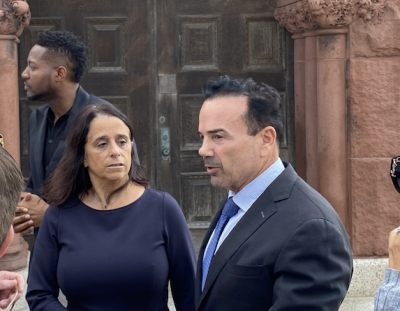
“What we know from the meeting today (Thursday) is that the Siting Council does not intend to overturn their vote from several weeks ago, and Council members articulated their desire for United Illuminating to come back to the table with a plan that takes into account the community’s needs,” said Fairfield First Selectman Christine Vitale. “This is another victory for the Town of Fairfield and the City of Bridgeport as it affirms the council’s original desire to see UI present a new plan that addresses our concerns.”
UI was not happy at all at the final vote.
“The Siting Council’s failure to offer any explanation for their denial of UI’s project on Oct. 16 is not aligned with Connecticut law,” said Sarah Wall Fliotsos, UI spokesperson. “But worse, it left us with no path forward for rebuilding our 60-year-old transmission infrastructure atop 110-year-old railroad catenaries in Fairfield and Bridgeport, which the Siting Council has already agreed needs to be replaced for the benefit of customers across Connecticut and throughout the region.”
“We encourage the Siting Council to move quickly to resolve the lack of clarity in their October decision so that we can work to finish the essential 25-mile transmission replacement program as cost-effectively as possible on behalf of the customers we serve,” she added.