This story has been updated to correct the amount of money Budderfly invested in OEM Controls.
SHELTON – When renewable energy was growing in popularity in the mid-to-late 2010s due to climate change worries, Al Subbloie had his mind on a very different part of the energy model – the meter.
His thinking is that the meter utilities install at businesses and residences is the one place where efficient electric use can be measured. In the case of high electric use businesses such as fast-food restaurants and manufacturers saving money on one of its most costly overhead items is essential for survival.
So, the economics major from Trinity College in Hartford, decided what better way for a third-party company to create a revenue stream by helping companies cut out the average 30% in wasted power. That is the model that Subbloie deployed in 2017 when he created the unique energy-as-a-service provider company Budderfly, which is located at 2 Traps Fall Road, Suite 300. He is CEO of the company.
“I was really building a demand-side virtual utility because I have this vision,” Subbloie told the Westfair Fairfield County Business Journal. “There should be a company that owns these endpoints, like the technology. What’s an endpoint? It’s a HVAC unit. We built everything on the other side of the meter.”
He explained that most energy customers – especially businesses – look at the monthly utility bill as just one of those costs of doing business in a state with among the highest electric rates in the nation. With a little innovation, he saw a business model where his company could literally become the utility customer for his clients. And by doing so he could not only reduce his clients’ utility bills but make them run more efficiently.
“We created a model where we outsource it (measuring electricity usage),” he said “Outsourcing means we take over the meter as the customer of record, which you are allowed to do. The utility says, ‘Great, send me a deposit.’”
The best way for Subbloie to describe Budderfly’s mission is one word – negawatt, which is unit of saved energy. Budderfly prides itself on achieving a largen amount of negawatts for its customers and itself. Those are the units that can be sold back to the utilities when they are in need of some extra power.
“It’s the watt you don’t have to use,” he said. “I asked myself the question, ‘Why?’ It came down to friction. People don’t do it because to capture that 30% you have to do 25-50 different things. A lot of them are expensive, and to do that (the different things) you have to measure it.”
Budderfly, which didn’t have its first customer until 2017, now is doing business in 50 states and 8,000 facilities today. In the first eight years, Subbloie said the company – with about $250 million in business – is the fastest growing company in the energy space in North America. For a third consecutive year, it was recognized as one of the Deloitte Technology Fast 500 companies.
Among its customers are such franchises as McDonald’s Burger King, KFC and Subway. One of the newer and larger clients is OEM Control in Shelton. It also does business in the college and university sector, serving University of Connecticut, Union University and the educational space with Kumon, Otter Learning and the YMCA as customers.
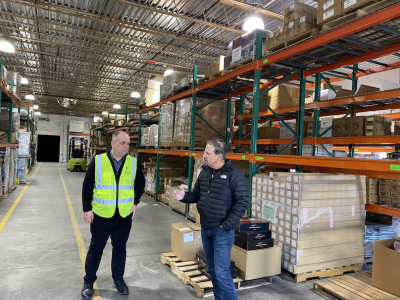
Budderfly has invested about $1.5 million+ at OEM in what Subbloie calls “stuff” all related to making the four legs of the stool to make the industrial joystick controller maker’s plant more efficient.
The process
Subbloie described in layman terms how his company operates after they sign up a customer.
“We take it (the meter) over and build a software billing system,” he said.” We send them a bill for the power by using the utility data. We take a baseline of their use before we met them. We bill them with a rate pass-through, give them a discount. Then we buy them everything – HVACs, lighting, controls, all the toys.”
Some of those toys include customized meters that measure the HVACs and other large industrial infrastructure needed to operate warehouses, manufacturing plants and fast-food restaurants and universities. They even include thermostats that are linked to Budderfly headquarters.
Client and utility relationships
“Budderfly is our energy-efficiency partner,” said Sam Simons, president, OEM Data Delivery. “They came in, evaluated our facility, and took on all the upgrades — everything from lighting to HVAC optimization to advanced monitoring. Like many manufacturers, we’re focused on designing products, shipping products, and taking care of customers.
“That often means the facility itself becomes a lower priority and can become neglected. Budderfly steps in and handles that entire piece for us. They modernize the building, keep it running efficiently, and help us reduce energy costs without pulling our internal teams away from day-to-day operations.”
While OEM signed on only months ago, financial savings is not the only thing driving their relationship with Budderfly.
“We are midway through our implementation and expect excellent savings over time,” Simons said. “But for us, it’s not just about the financial savings. The new lighting alone has made a huge difference — our production floor and offices are brighter, clearer, and better for our employees.”
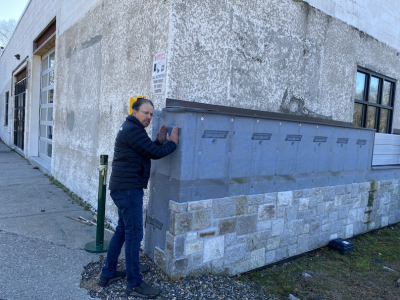
Another key cog to Budderfly’s energy efficiency process is its relationship with the utility companies. In Connecticut, those include United Illuminating and Eversource. Budderfly has worked with UI since 2022, according to a spokesperson.
“Budderfly is an energy-as-a-service provider, meaning that they install, monitor, and manage energy efficiency upgrades and other resources primarily for small- to medium-sized businesses and their facilities,” said Sarah Wall Fliotsos, a UI spokesperson. “Upon determining the energy efficiency upgrades that businesses within the UI/SCG/CNG territory can implement, Budderfly then contacts our Conservation & Load Management team to apply for incentives for these upgrades.”
Through a program called EnergizeCT, businesses and residences receive state government incentives by making upgrades that can be provided by companies like Budderfly.
Budderfly’s financial support
To continue its climb to being the fastest growing energy-as-a-service provider, Budderfly has dipped into the debt finance and equity market. It has raised $500 million from multiple debt facilities from Nuveen Energy Infrastructure Credit and $500 million in an investment from Partners Group.
“This milestone – surpassing $1 billion in capital – is more than just an achievement for our company–it’s clear validation of the importance of energy efficiency in the built environment,” Subbloie said. “Especially in today’s increasingly complex macro environment, businesses need resilient, market-driven solutions, and our model delivers just that: energy savings at zero cost.”