Now that the controversial FX series “Love Story: John F. Kennedy Jr. and Carolyn Bessette” has moved on to streaming (see related story on Page ?), we draw your attention to a different kind of love story – one between the Kennedy family and Manhattanville University in Purchase, which six family members attended.
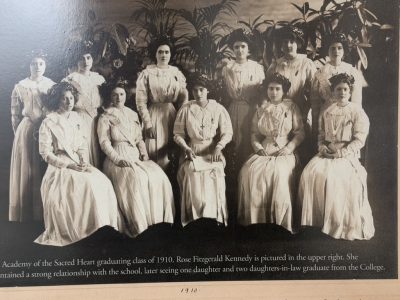
It begins with future Kennedy matriarch Rose Fitzgerald’s graduation from the school’s forerunner, The Academy of the Sacred Heart in Manhattan, in 1910, and continues with youngest daughter Jean (Manhattanville College of the Sacred Heart Class of 1949) and future daughters-in-laws Ethel Skakel (Class of ’49) and Joan Bennett (Class of ’58) – not to mention Rose’s third daughter, Eunice, who attended Manhattanville from 1939 to ’41 before transferring to Stanford University and her daughter, Maria Shriver, who attended Manhattanville from 1973 to ’75 before matriculating at Georgetown University. Over the generations, the Kennedys and Manhattanville have shared a history that has seen the evolution of not only the institution from a Roman Catholic finishing school to a secular coed university but the role of women in society.
It’s a story that endures in Manhattanville’s partnership with the Robert & Ethel Kennedy Human Rights Center in Manhattan, whose president is their daughter Kerry Kennedy, a human rights lawyer and activist; the partnership’s two-year-old Young Women’s Leadership Summit for area high school students, which will be held April 27; and its five-year-old Ethel Kennedy Human Rights Leadership Award, which will be presented May 16.
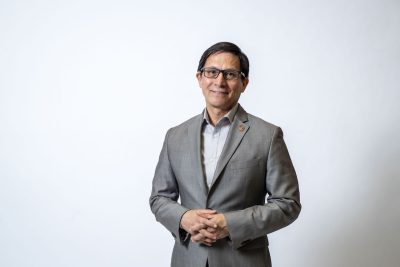
“The thread in the storyline is a school where education is on the cutting edge,” said Manhattanville President Frank D. Sánchez, Ph.D. This includes such innovations as the 4+1 accelerated degree programs that since last fall have provided students with the opportunity to earn a bachelor’s and a master’s degree in five years and a three-year bachelor’s degree program that begins this fall.
But while much has changed at Manhattanville, Sánchez added, much remains the same, including its core value of social justice, which ties it back to the Kennedy family.
Change agents
Indeed, our conversation with Sánchez – held at Reid Castle, the university’s administrative building, over spring break – and a visit to its historical exhibit yielded surprising insights into just how involved the school has been in human rights, almost since its founding.
Manhattanville’s story begins with the Society of the Sacred Heart, an international community of Roman Catholic women founded in France in 1800 by St. Madeleine Sophie Barat. (Its order of nuns, the Religious of the Sacred Heart, is known as RSCJ, for the French Religieuses du Sacré-Cœur de Jésus.) The society in turn founded The Academy of the Sacred Heart in 1841 in Lower Manhattan as a boarding and day school for girls. Six years later, the academy moved to Manhattanville Village on the Upper West Side, where the nuns would also run a parochial school.
Academy students had a particularly wide-ranging education in the humanities, studying philosophy and foreign languages and cultures among other subjects. By the time Rose Fitzgerald, daughter of Boston Mayor John F. “Honey Fitz” Fitzgerald, arrived at the academy – after studying piano at the New England Conservatory of Music and being accepted at Wellesley College, which her father refused to let her attend – Sacred Heart was regarded as the last stop before young Catholic women took their place in society.
Reading her autobiography, “Times to Remember” (Doubleday & Co., 1974), you get the sense that Rose, who always regretted not going to Wellesley, was marking time at the academy.
“My school year at Manhattanville passed peacefully and productively,” she wrote. “In June of 1910, I received my graduation certificate, listened to the advice of the saintly nuns and then departed, at last, for Boston” – and marriage to Joseph P. Kennedy in 1914.
A school archival photograph shows her as a sort of gravely beautiful Gibson girl, dressed in white like her 10 other classmates – young women on the brink of life.
In time, however, Rose would come to see the academy as providing her with the religious bedrock that sustained her through triumphs and tragedies, for the nuns were not just saintly creatures. Those sisters were real “change agents,” Sánchez said, meeting life’s challenges and making opportunities. In 1917, the school received a provisional charter to grant undergraduate degrees as the College of the Sacred Heart, with the first bachelor’s degrees awarded the next year. The school became Manhattanville College of the Sacred Heart in 1937, a watershed moment.
That same year, President Grace Dammann, RSCJ, hosted students from area Catholic colleges in what led to the formation of the National Federation of Catholic College Students (NFCCS) to foster social justice. The following year, Dammann delivered her “Principles Versus Prejudice” speech – called “the Magna Carta of desegregation” – in defense of admitting the first African American student to Manhattanville, “which pushed the limits, even in the Catholic Church,” Sánchez said. (The student is, however, not identified in school records. Mary Louise “Mamie” Jenkins is reported to be the first Black graduate of the school.)
Over 30 years, as a founding member of the NFCCS, Manhattanville produced publications, led events and participated in demonstrations, with the Aug. 28,1963 March on Washington for Jobs and Freedom and the March from Selma to Montgomery, actually three marches in Alabama in 1965 to support African American voting rights, among the high points.
Eunice, Ethel and Joan
The future Eunice Kennedy Shriver’s time at Manhattanville (1939-41) bridged the activist ’30s and the industry of the ‘40s as enrollment swelled – including “a large contingent of married women,” Sánchez said – to take advantage of new science, engineering and nursing courses and meet World War II workforce demands. (Eunice would go on to a Bachelor of Science degree in sociology from Stanford University and a lifetime of work on behalf of the disabled that included nationalizing the Special Olympics.)
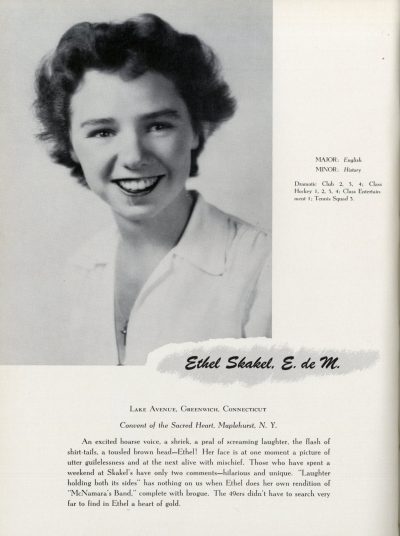
Among the 1940s enrollees at Manhattanville was Eunice’s youngest sister — the future Jean Kennedy Smith, U.S. ambassador to Ireland — and her athletic roommate from Greenwich, Ethel Skakel, who despite her mischievousness thought she might become a nun.
That would ultimately become the road not taken as during a ski weekend Jean introduced Ethel to her older brother Robert. They married in 1950, a year after Ethel and Jean graduated from Manhattanville.
Two years later, Manhattanville moved to a new 250-acre campus on what was the Purchase estate of diplomat and editor Whitelaw Reid and his wife, the former Elisabeth Mills. Among the students who’d be studying in the suburban locale was Bronxville’s Joan Bennett, who despite her good looks and aptitude for the piano saw herself as something of a wallflower.
But “while in college, Joan emerged.”J. Randy Taraborrelli wrote in “Jackie Ethel Joan” (Warner Books).”Her beauty and personality began to shine.”
Still, the day in 1957 when the Kennedys arrived at the school en masse to inaugurate the new Kennedy Gymnasium, Joan was busy with term papers and thus missed the speech by the youngest of the Kennedy siblings, the future Sen. Edward M. “Ted” Kennedy. But afterward she attended the tea, where acquaintance Jean once again played Cupid. According to Taraborrelli’s book, Manhattanville not only served as Joan’s introduction to her future husband, but it would provide a bond with her mother-in-law, who shared her love of music, which had deepened at the school.
The ’60s and 60
The 1960s would prove a turbulent, transformative time in higher education. In a move toward secularism, Manhattanville College dropped “of the Sacred Heart” in 1966, which shook many of its Catholic supporters. Declining enrollment everywhere led the school to admit men in 1969, the same year that 18 African American students took over its Brownson Hall for six days, seeking greater support and inclusion.
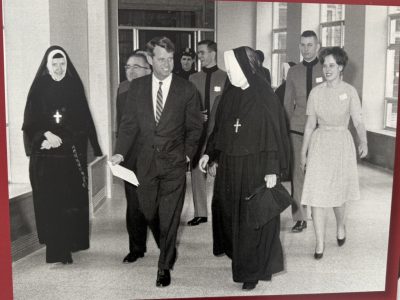
The ’60s saw a visit from Attorney General Robert F. Kennedy, who gave a speech at the International Relations Club Conference on Southeast Asia in March 1963. It also brought a new wave of feminism to the campus. By the time Maria Shriver arrived at Manhattanville in 1973, the feminist movement was in full swing, and she used her two years there to propel her to a Bachelor of Arts degree in American Studies at Georgetown University and a career in broadcast journalism, mostly at NBC News, that was interrupted by her tenure as first lady of California when then-husband Arnold Schwarzenegger served as governor (2003-11). Her Emmy Award-winning “Alzheimer’s Project” was inspired by her diplomat father Sargent Shriver’s battle with the illness.
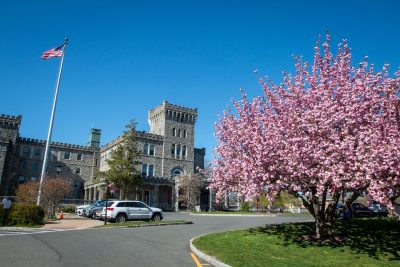
Over the last 60 years, Manhattanville has continued to grow – revamping its curriculum to deliver a more personalized approach to education with its Preceptorial, or First Year Program, and Portfolio System (1973); renovating and expanding the campus, beginning in 1991; inaugurating an Ed.D. degree in its School of Education (2010); opening The Center for Design Thinking (2019); adding a School of Nursing and Health Services (2020) to accompany the School of Education and the School of Arts and Sciences; received designation as a Hispanic Service Institution by the U.S. Department of Education ( 2021); and changed its name to Manhattanville University (2024).
From 2022 to ’ 24, U.S. News & World Report hailed Manhattanville as “the number one private nonprofit institution in New York among Top Performers of Social Mobility in Regional Universities North.”
The Kennedys have been there every step of the way. Among the family members who have visited the school to receive honorary doctorates are Rose (1953); Eunice (1963:, Ted (1970, the year he delivered the commencement address); Joan (1984, when she delivered the commencement address); and Maria Shriver (1992, when she delivered the commencement address). When Ethel received her honorary doctorate in 2021, daughter Kerry delivered the commencement address.
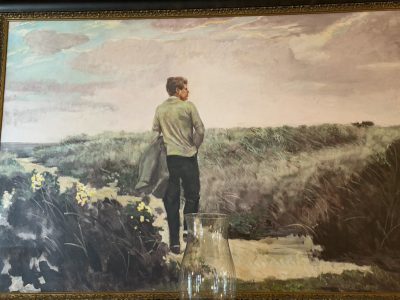
As for the late President John F. Kennedy, he is a fixture at the school as well. His portrait – which depicts him walking on a beach, presumably in Hyannisport, looking to his right past the dunes – hangs in Reid Castle. (The original is in the Kennedy Gymnasium.)
Sánchez said he is lobbying to get the copy moved upstairs to his office.
The Kennedy-Manhattanville love story continues.