“How much of ourselves do we allow in the room?”
It’s a question that moderator Chelsea Blancato, a partner in Citrin Cooperman, posed during the 2026 “Women in Power” panel discussion, presented by Citrin Cooperman and Westfair Business Journal on Thursday, Jan. 29, at Manhattanville University in Purchase.
Judging from the panelists’ responses, the answer was “everything.” Indeed, this was one of the frankest, most poignant “Women in Power” events we’ve covered as Lola Gazivoda, founder and CEO of the Bota Consulting Group in White Plains; Fran Pastore, founder and CEO of the Women’s Business Development Council (WBDC) in Stamford; and Maria Trusa, co-owner and CEO of Formé Medical Center and Urgent Care in White Plains, shared intimate, often searing details about the challenges they’ve encountered in their quests for professional and personal success.

Pastore, whose nonprofit helps women launch and scale their businesses, offered an overview of what these struggles have been for American women historically, with women being treated as chattel prior to the 20th century. Even then, they did not attain the vote until 1920; credit cards without a male co-signer until 1974 (the passage of the Equal Credit Opportunity Act, or ECOA); and commercial loans without a male co-signer until 1988 (the Women’s Business Ownership Act).
Pastore’s own narrative took her from a traditional Italian-American family in Brooklyn — in which women made pasta sauce on Sunday mornings and she, a single Connecticut mother with two daughters, was expected to come home to live in a basement apartment and get a job – to an entrepreneurial epiphany.
“Entrepreneurship is born when it fills an unmet need,” Pastore said of her own need to be an entrepreneur—and aid other women entrepreneurs. “Empowered women empower women.”
In this, she said, she was surrounded by “a lot of women and a few good men” who believed in her ability to fulfill that dream. And despite anxieties and sleepless nights, she never stopped believing in “the power of education and knowledge” to make it a reality.
Pastore began with a $120,000 grant and two employees. Today, she added, the 30-year-old organization has 40 employees and a budget of $10 million.
The trajectories of Gazivoda and Trusa, both immigrants from poor countries, contained more obstacles and even trauma.
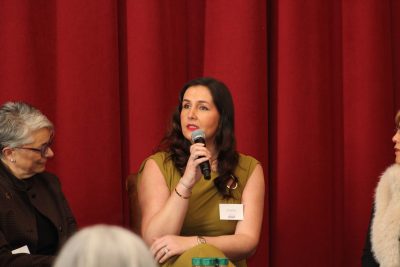
Gazivoda grew up in a small village near the city of Shkodër, Albania, while the country was still communist. (It became a parliamentary democracy after the fall of the Soviet Union and the collapse of the People’s Socialist Republic of Albania in 1991-92.) But even when she came to the United States at age 14, life was still a struggle. The family lived on 233rd Street in The Bronx amid the violence of gangs like the Bloods and the Crips. She entered high school without a word of English.
“What influenced me the most was the culture,” she said of an Albanian community in which “a good woman keeps her mouth shut and cooks and cleans.” Gazivoda married at 18.
Having mastered English, however, she also excelled academically, ultimately earning a degree in finance from Pace University. She served as a loan portfolio manager and empowerment zone director for the city of Yonkers, overseeing federal funds and economic development initiatives, then entered the corporate world. Gazivoda spent almost 20 years in executive roles at JPMorgan Chase & Co., Capital One and M&T Bank, where she led high-performing teams and managed extensive business banking portfolios.
Still, she told the audience of 180, that she wanted more out of life than just constantly building a banking career. She created Bota as an offshore recruiting, consulting and management firm that connects U.S. businesses with talent from her native Albania. The company also partners with onshore organizations to drive revenue growth, streamline project management and provide strategic consulting services.
It’s also enabled her to make time for herself – for yoga and meditation as well as her husband and three children in Bedford.
“If you don’t love your true self and focus on it, you’re going to break,” she said.
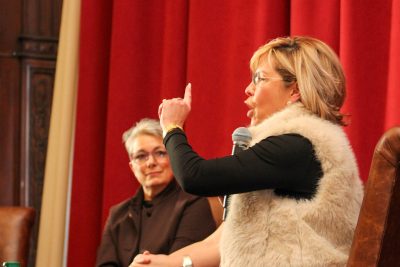
Trusa knows all about that. Her earliest memories were of carefree innocence, running barefoot on the island of the Dominican Republic. That innocence ended when she was raped at age 9. It’s a story she tells in her autobiography, “Yo Digo No Más” (“I Say No More”), which is also the name of the nonprofit she founded to help protect children from sexual predators.
“We get to be creators, or we get to be victims,” Trusa said. She dreamed of being a doctor. While that was not possible, she remained focused on health care. For 26 years, she served as executive director of Scarsdale Medical Group, growing the practice from six physicians and 35 employees to more than 45 physicians and 200 employees.
But a near-death experience at age 50 brought the clarity, she said, of wanting something else, something more, out of life. In September 2015, Trusa joined Formé as co-owner (with founder Gina Cappelli )and CEO, serving more than 25,000 patients a year. She also holds healing retreats on her 12-acre property in Vermont.
That healing extends to herself. She trained for an Ironman competition – without knowing how to cycle or swim in the beginning – while caring for her daughter as she spent seven weeks in a hospital.
“The hardest thing is putting yourself first,” said Trusa, whose mantra is “as within so without.” “But It’s me first for my daughter….It’s me first for family, business, community and the world.”
Trusa said she begins her day with a kiss for the face in the mirror and an acknowledgement of its beauty.
“The No. 1 thing is confidence,” Pastore added, “and knowing your value.”
But what if the “me” doesn’t think she belongs in the room where it all happens? In the question-and-answer session that followed the panel, one questioner brought up the imposter syndrome that disproportionately affects women.
“Own it,” Pastore said until the day that confidence comes.
Earlier in the panel discussion, Gazivoda spoke about the difference between the woman she sees in her mirror, sporting red lipstick and high heels, and her inner life.
“I work to show up day to day as this powerful woman.” While inside she may feel less powerful, she said, “I have the ability to deal with what’s inside.”
Surveying the panel and the audience at the end, she was still struck by the setbacks she had overcome and the company in which she now found herself. Her conclusion: They all had to be confident women.
“We’ve got this, right?” she said. “I mean, why not?”

“The No. 1 thing is confidence and knowing your value,” she said. And if you feel you’re the aforementioned imposter? “Own it,” she added, until the day when you no longer feel that way.
Added Trusa, “I have a saying: As within, so without.”
Gazivoda has seen that transformation. “I work to show up day to day in heels and red lipstick as this powerful woman.” While the inner woman may not be quite so powerful, she said, “I have the ability to deal with what’s inside.”
And looking around the room, not quite believing where she was – on a panel with other CEOs in a university setting – she concluded that they all must be pretty confident to attain what they have achieved.
“We’ve got this,” she said. “I mean, why not?”