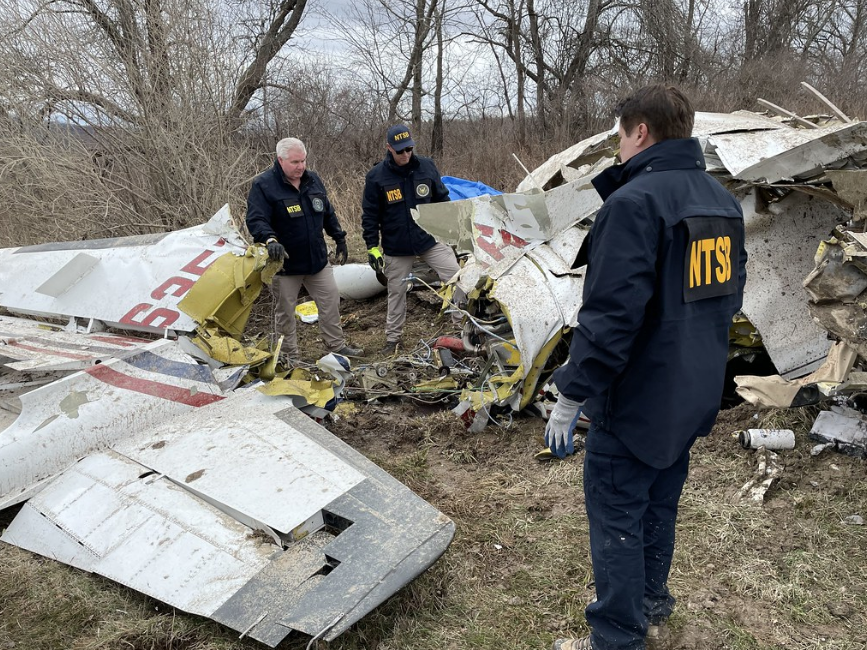
Investigators for the National Transportation Safety Board plan to remove the wreckage of the Mitsubishi MU2B airplane that crashed on April 12 while on a flight from Westchester County Airport to Columbia County Airport in Hudson, New York, to a secure location in Massachusetts for detailed examination.
According to NTSB Board Member Todd Inman, the two engines from the airplane will be shipped to Phoenix, Arizona, where they will be torn down and examined by a team including representatives of the engine manufacturer Honeywell.
The twin-engine turboprop airplane crashed in Copake, New York, about 10 miles from the Columbia County Airport in the community of Hudson. All six people on board were killed in the crash.

According to Inman, the airplane had been flown from Norwood, Massachusetts, into Westchester on the morning of the accident. It had taken off at 9:30 a.m. and arrived at White Plains at 10:19 a.m. It then departed White Plains at 11:34 en route to Columbia County Airport.
“Weather at Columbia Airport was reported four minutes prior to the actual accident,” Inman said. “There could be a slight variance between the airport and what was experienced at the crash scene but it would be fairly consistent.”
The airport’s automated weather observation equipment found a cloud ceiling of 400 feet above the ground, wind from 010 degrees at 8 knots, temperature 37 degrees F., dew point 36 degrees F., relative humidity 93%.
Inman said that clouds beginning at 400 feet above the ground would be the lowest ceiling for an instrument approach at the Columbia County Airport. The pilot had made one approach but was unable to land an executed a missed approach. He had asked for radar vectors from the air traffic controller who was handling the flight in order to position the airplane for another approach to attempt to land.

The accident occurred at about 12:06 p.m. as the airplane was making the second approach. The weather conditions required the pilot to use the airplane’s instruments to maintain situational awareness rather than being able to look out the window and see the horizon and ground. Inman said that it appeared as if the pilot was fully qualified to be flying the airplane.
He said there did not appear to be evidence of the airplane breaking up while in flight, but asked anyone in the area finding aircraft parts to immediately get in touch with the NTSB.
“This type of plane required additional training beyond a normal FAA private pilot’s license,” Inman said. “The training was completed and the pilot was proficient. It was completed on October 8 of 2024.”
Inman said that the investigation team did not plan to hold more daily on-site briefings and would not be speculating about what may have caused the accident. He said that a preliminary report should be ready in about 30 days. He said that it likely would take from 12 to 24 months to complete the investigation and determine the probable cause of the accident.