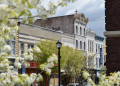
Tuckahoe possesses a mix of small, independent retailers including restaurants, hair salons and clothing stores. There are no “big box” retailers, although there is a Starbucks on Metro-North property at the Tuckahoe train station.
“I think that every community is trying to get the right mix of successful business,” said Mayor John Fitzpatrick.
“Nine months ago, we were having a problem where before a business could even get a sign up they were already out of business, and I can”™t have new businesses coming in not being able to be recognized and be up and running right away, so we tried to streamline the sign process,” Fitzpatrick said.
Tuckahoe possesses two distinct business districts next to a pair of Metro-North train stations Tuckahoe and Crestwood. A couple of years ago, there were a number of vacant storefronts on Main Street near the Tuckahoe train station. “Now there”™s a whole bunch of them in Crestwood that have now popped up,” Fitzpatrick said.
Fitzpatrick said the retail rent is cheaper on Main Street section by the Tuckahoe station than it is in the Crestwood section.
Chase bank came in and replaced Great American Video, a small video store. Salerno”™s, an anchor restaurant in the village for decades, has closed.
“Parking is always an issue in Tuckahoe,” Fitzpatrick said. “I happen to like the Bronxville model of retail, and I”™ve always been an advocate for the fact that you don”™t want to be able to park right in front of every store that you shop in because they pull in, they shop, they get in their car and they leave. I prefer that they have to take a stroll through some of the shops and often they”™ll pick up something.”
Fitzpatrick would like to see Marbledale Road, an industrial area with patches of vacant land, re-zoned.Â
“I think that a commercial business zone could be supported there,” Fitzpatrick said. “I really want it to be an open canvas for people to come in and pitch their ideas because there”™s some vacant land there.”
Fitzpatrick said resident have expressed a desire for a drugstore on the Main Street end of the village and a small supermarket.
Other projects are under way; a new cooking oil law requires the dozen-plus restaurants to have a 55 gallon drum to pour this oil in. One of the village”™s garbage trucks now operates solely on the vegetable oil collected from the restaurants.
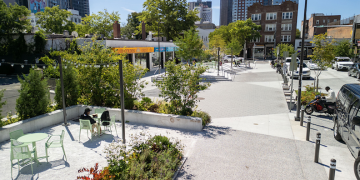
After the New Year, in the Crestwood business section, the village will begin the process of taking overhead power and phone lines and moving them underground. This was done in the Depot Square area next to the Tuckahoe train station already.
“Tuckahoe is probably the most underrated village in the whole county,” said Al Cower, who just celebrated the 80th anniversary of his business, Tuckahoe Paint and Glass. “It”™s just a great place to be.”
Terrence J. Burd, president of Empire General Contracting Corporation and RLMW Development, bought a vacant lot at 115 Main St. and developed it into 36,000 square feet of medical space.
The building has been occupied by Central Imaging, a radiology group that took 13,000 square feet of it, and a pediatric group, for the past 6 months.
The medical building is about 60 percent occupied at the moment.
At 100 Main St., site of the old Salerno”™s restaurant, Burd plans on constructing 22 apartment units with 4,000 square feet of retail space on the ground floor. Construction will begin spring 2009.
A troubled economy has effected restaurants in the commuter village.
“We don”™t see a lot of people stopping for happy hour like we used to, and we don”™t see a lot of people on off-nights having dinner,” said Shannon Manges, owner of Thomas Stone Restaurant & Piano Lounge on Main Street, which offers live jazz music, a magician during happy hour and authentic stone cooking. “We”™re struggling through and we hope that by next year after the holidays with a new president that the economy will change.”
Philip Raffiani, vice president of Mirado Properties Inc., plans to develop 2.5 acres of vacant land on Main Street bordered by Midland Avenue and Washington Street into 90 residential apartment type units with 18,000 square feet of commercial space.
The project is currently before the Planning Board, but Raffiani is not sure if it will be built because of rising construction costs.
“Steel was $100 a ton when I built the first building in 2003, now it”™s $800 a ton,” Raffiani said. “Everything”™s gone up. This year is going to be tough on everybody.”
Raffiani said there isn”™t a lot of room for possible future development in Tuckahoe, in part due to a rule that buildings cannot be more than 3 stories high (although there are a few exceptions) and which prevents them from using a wider footprint on the land.
“I think there”™s a lot of plans floating around for Marbledale, but it”™s got challenges,” Raffiani said. “You”™ve got some really old industrial businesses there that are not likely to go away easily. There”™s a lot of vacant land but it”™s zoned for industrial use.”
Raffiani said possible uses for the space could be office space or hotel/ convention type space, which is scarce in lower Westchester.
The name Tuckahoe is of Indian origins, tuckah reportedly being a native food. The natives of the area included the Mohican and the Aquehung tribes, but it was Italian stone masons who came to hew marble from nearby quarries ”“ marble that found its way to the U.S. Capitol, among other buildings ”“ who gave the town its strong Italian heritage.
The Westchester Italian Cultural Center is housed in the same Depot Square building as the philanthropic Generoso Pope Foundation. Evelyn Rossetti, executive director of the cultural center, said, “We are the largest cultural center here in Tuckahoe. We host a large number of receptions and events and held a business Italian-style networking event geared specifically to area in June. We are holding another on Oct. 29 from 6 to 8 p.m.”