For Seth Kaller – a White Plains-based expert in acquiring, authenticating and appraising historic American documents and artifacts – Thursday, June 26, was a good day as two documents he was involved with sold at auction at Sotheby’s in Manhattan for a combined $18,139,500.
A copy of the 13th Amendment to the U.S. Constitution, abolishing slavery and signed by President Abraham Lincoln, sold for $13,697,500; a copy of the Emancipation Proclamation — an executive order ending slavery, also signed by Lincoln — for $4,442,000. The discrepancy in prices is “purely a case of rarity,” Kaller said, adding that 48 signed copies of the Emancipation Proclamation were sold for $10 each to benefit the United States Sanitary Commission, a private relief agency that supported the Union Army’s sick and wounded. But there were only 16 signed copies of the 13th Amendment. “In both cases, the official original documents are in the National Archives.”
With the 13th Amendment document, Kaller represented the seller and advised two of the bidders. (While that may seem too close for comfort, he said that as long as the appropriate disclosures are made, there is no conflict of interest.) In the case of the Emancipation Proclamation, he had sold it to the person who put it up for auction.
The market for historic documents is a profitable but small one, he said, adding that an individual could sell one painting that was worth more than all the documents sold in a year. But Kaller isn’t just interested in buying and selling historic American books, manuscripts and documents – of which he has several thousand — or representing buyers and sellers. He also wants to educate the public.
“Most Americans have lost sight of the ideals and aspirations of what it means to be an American.”
Kaller has strived to change that, building collections, giving talks and now displaying documents in two new and upcoming gallery/museum projects.
In a joint venture with Manhattan’s Arader Galleries – which deals in maps, prints, rare books and watercolors from the 16th through 19th centuries – Kaller has set up a complementary space in the galleries’ 4,500-square-foot 29 E. 72nd St. locale called Seth Kaller Inc., Historic Documents & Legacy Collection, with some 100 works. Among those on display in its “Conceived in Liberty” exhibit are:
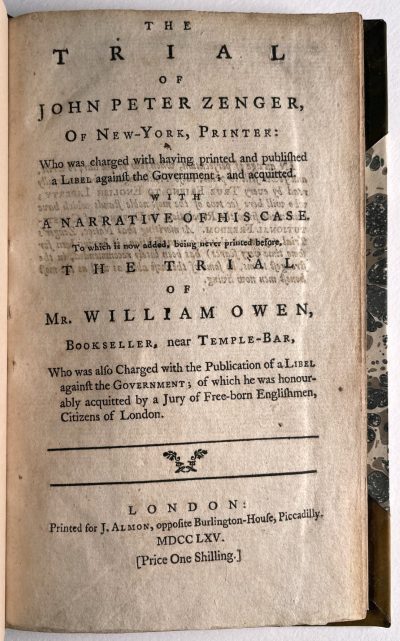 A book on the 1735 trial of printer John Peter Zenger, establishing freedom of the press (1765) – Two years before the trial, New York’s royal governor, William Cosby, had tried to rig an election at what is now St. Paul’s Church National Historic Site in Mount Vernon. German printer Zenger was on hand to cover the misdeeds for his publication, The New York Weekly Journal, whereupon Cosby had him arrested and tried for libel, even after a grand jury had refused to indict him. Despite pressure from the judge to convict, it took the jury just 10 minutes to acquit Zenger, establishing the precedent of truth as a defense against libel, jury independence and freedom of the press. $3,500.
 Thomas Paine’s “Common Sense” (1776) — The pamphlet by the New Rochelle resident, which considers the advantages of democracy over one-man rule, is widely regarded to have helped spark the revolution and thus independence. $38,000.
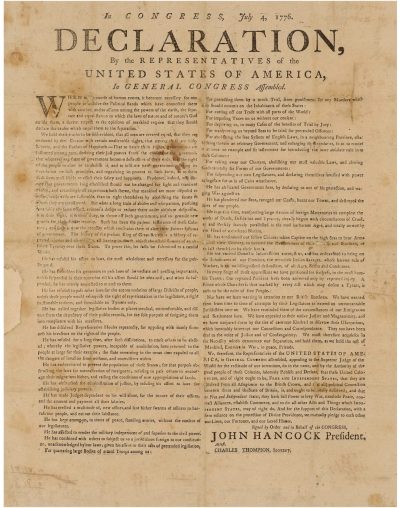
A rare July 1776 broadside of the “Declaration of Independence” – A broadside was a publication printed on one side so it could be easily read, passed hand to hand or nailed to a church or tavern door, spreading news of events like the American Revolution. Kaller said this document may be more “original” than the signed “National Treasure” document, which was not actually penned and signed in July 1776. (It was signed that August after New York, which had abstained in the vote on the declaration, changed to a “yes,” making the document unanimous.) This broadside was printed in New Hampshire around July 16th, once the news reached it from the Second Continental Congress in Philadelphia. Only 10 copies are known to survive. Price — $3,120,000.
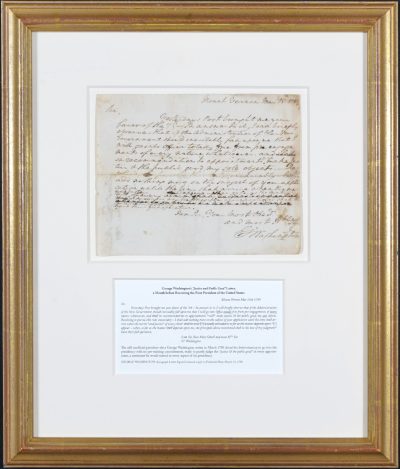 George Washington’s “Justice and the Public Good” letter (1789) — In a letter written just weeks before his inauguration on April 30 of that year in New York City, a letter that nonetheless still resonates today, Washington emphasized judgment, character and devotion to the public good in selecting officers for the new government. $650,000.
A rare book printing of Washington’s 1790 letter to what is now the Touro Synagogue National Historic Site (1796) – Kaller said this is a favorite of his, quoting Washington as writing, “to bigotry, no sanction; to persecution, no assistance.”
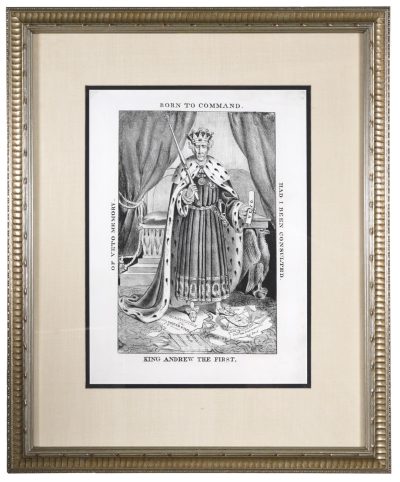 “King Andrew the First” anti-Jackson cartoon (1832) – This rare mezzotint shows President Andrew Jackson crowned and cloaked like a monarch, trampling the Constitution underfoot. Despite his fierce partisanship and personality (“I was born for a storm, and a calm does not suit me” was how Jackson once described himself), Kaller said, “he was a (War of 1812) hero and did have the country’s good in mind.” $20,000.
Kaller knows that some people have soured on these documents, often written by men who were slaveholders. Others want to see such documents and their sentiments preserved in aspic. The “originalists” argue that the Constitution should be interpreted today as it would’ve been back then. But Kaller sees these works as fluid, aspirational. To him, the Constitution is “not history but technology in the sense of a system that organizes knowledge to solve problems,” one that is open to interpretation as befits the context and situations of the times. Washington himself said as much in a letter dated Sept. 17, 1787 – the date the Constitutional Convention finished its work. And while the Constitution accommodated slavery, it was meant to become a document of liberty, Kaller added, echoing Frederick Douglass, the statesman, abolitionist, writer and orator, a former slave who emerged as the leader of the 19th-century’s African American civil rights movement.
As for the “Declaration of Independence,” Kaller said he often discusses it – as he will in at a 2 p.m. Fourth of July talk at Fraunces Tavern Museum in Manhattan – in the context of the Rev. Martin Luther King Jr.’s “I Have a Dream Speech,” delivered in front of the Lincoln Memorial on Aug. 28, 1963, in which King talked about the promise of the declaration as a promise still to be fulfilled.
No doubt that is why Kaller calls his 250th anniversary exhibit the “Promise of Liberty.” This partnership with the multidisciplinary Peoria Riverfront Museum in Peoria, Illinois, featuring filmmaker Ken Burns (“The American Revolution,” PBS, Nov. 16) as the guest curator, will open early in 2026 and contain historic documents, objects and art on loan from private collectors, including Alice Walton’s Art Bridges Foundation, Seth Kaller Inc. clients and other private and institutional lenders. Bloomberg Connects will provide the gallery app. Among the tour stops are New York City and Norfolk, Virginia.

Kaller never intended to go into historic documents though he might’ve known it was his destiny. Born on Long Island, he moved with his family to New York City after a stint in New Jersey. (He didn’t move to Westchester County until the second of his three children was born. He called putting them through the Scarsdale public schools “a bargain.”)
Kaller’s family was long known for a business building collections of rare stamps and coins. Still, when he left the University of Pennsylvania armed with a Bachelor of Arts degree in political science, he was law school bound. The only problem was he missed the date for the LSAT, or Law School Admission Test. Thinking of what to do in the year interim until the next exam, he approached Lewis E. Lehrman, the businessman, economist and historian, about building a collection of his historic documents. Today The Gilder Lehrman Institute of American History, housed at The New York Historical in Manhattan, contains more than 87,000 diaries, maps, photographs and other works spanning 500 years. It is used by 35,000 schools nationwide and every AP (Advanced Placement) American history course.
Among the other collections Kaller has built are those on the foundation of Israel, Albert Einstein, science and European royals. But it is the American experiment that has his heart. With the help of his work, he said, “we’re taking the basic idea of liberty and applying it to more people more effectively.”
And, he added, “I’m hoping to use 2026 to revisit what it means to be an American, what made America great, what would make America great.”