Photograph © Bohdana Havaleshko
| Dreamstime.com.
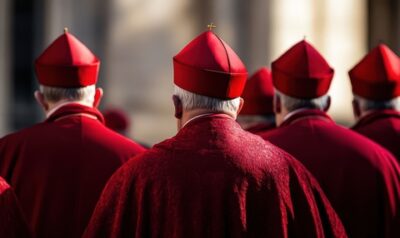
The papal conclave to elect the successor to Pope Francis, who died April 21 of a stroke and cardiac arrest at age 88, begins Wednesday, May 7. Some 135 cardinals under the age of 80 are eligible to vote for the next pontiff, a process that begins with general congregations, or meetings, at the Vatican. For the conclave itself, the cardinals move to the Sistine Chapel, where they take an oath of secrecy before the doors are sealed.
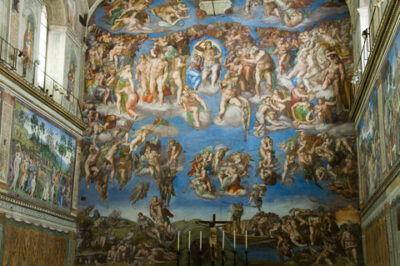
According to the United States Conference of Catholic Bishops’ website, four rounds of voting will be held every day, with each cardinal taking his twice-folded selection up to Michelangelo’s “Last Judgment,” saying a prayer and dropping the ballot into a large chalice. If no one receives the necessary two-thirds of the vote, the ballots will be burned with a chemical to produce a black smoke, signaling to the outside world that a pope has not been elected. The process continues until a new leader for the world’s 1.4 billion Roman Catholics is chosen.
Once the new pope is elected, he will be asked by the dean of the College of Cardinals, Giovanni Battista Re, if he accepts. When he does, the new pope will select a name and don the white papal robes, while the ballots will be burned to produce a white smoke, signaling that there is a new pope.
| Dreamstime.com.
All this is portrayed with more or less accuracy in the 2024 multiple Oscar-nominated thriller “Conclave,” whose streaming viewership has risen 3,200% in the wake of Francis’ passing and the anticipation of the conclave.
“It is quite possible, even likely, that aspects of the politics of the conclave will resemble some of what went on in the movie,” said Daniel Rober, Ph.D., associate professor and chair of Catholic Studies at Sacred Heart University in Fairfield, who specializes in in theological developments around the Second Vatican Council (1962-65) as well as Roman Catholicism in relation to culture and politics. “Its representation of various factions in the Church and the way candidates serve as avatars for them (offer) a reasonable if broadly drawn facsimile of reality.
“Similarly, the technical process of voting is represented well. What would be quite different is the sorting process. The vetting of candidates and revelations about them will have taken place ahead of the actual entrance into the conclave and with plenty of press participation (not in the conversations but in feeding what goes into them. Candidacies cannot live in the press but can certainly die there.) While the public will not know it, there will likely be a reasonable short list of viable candidates – perhaps quite different than the names being bandied about in the media — once the conclave actually begins.”
What has everyone wondering in our politically divisive times – a backdrop of the movie and of the Robert Harris novel (2016) on which it was based – is will the new pope hew to a more conservative line or will he continue in Francis’ liberal tradition? It’s a question we posed to Rober in an email interview:
“I would caution against setting overly simple categorizations. Vatican-watchers with good information seem to think that the more conservative cardinals are going to have a hard time getting a candidate through, but the chances of a more ‘institutionalist’ candidate than Francis are quite reasonable. The choices as I see them are 1. someone who seeks to build on Francis’s achievement through a more structured consolidation and less freewheeling approach; 2.someone who embodies the kind of witness and persona for the papacy that Francis did but in his own kind of way, reflecting his own nationality, background and priorities; and 3. someone who seeks to dial back (likely moderately) the reforms of Francis and make peace with movements such as the rising authoritarianism that he steadfastly opposed.”
Of the standouts so far, Rober said, “certainly Pietro Cardinal Parolin (Vatican secretary of state) has emerged as a strong contender for the ‘continuity with more structure’ lane, though I think there are questions about his charisma. Luis Cardinal Tagle (of the Philippines) would in many ways fit the mold of putting a positive face on the church and continuing the ‘spirit’ of Francis. But there are likely other names emerging in the congregations that we might not be quite aware of yet.”
As for the politicking in those congregations, he added, “It hearkens back to an older era of politics when candidates were expected not to seek office too aggressively, and when ‘favorite son’ stalking horse candidates were more popular at conventions. I would note that the Electoral College portion of the U.S. presidential system (which was based on the old election system of the Holy Roman Empire) is one of the more closely related bodies to the College of Cardinals, even if it no longer functions quite in this way.”
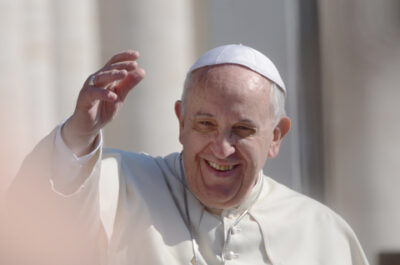
Whatever happens, this conclave is sure to be different from the one in 2013 that saw the election of Francis after the resignation of Pope Benedict XVI, Rober said at a three-part round-table of Sacred Heart University scholars that began Tuesday, April 29, with FRANCIS: A Papacy of the People and continues with a discussion on the conclave Monday, May 5, at 4 p.m. (The round-table concludes with a follow-up once the new pope is elected.)
“It’s really important to think about how we got Francis in the first place, which was partially the open conclave that the resignation of Benedict XVI allowed for, precisely, a conclave where you did not have a papal funeral, did not have the need to heap praises upon the predecessor and thus ensure some kind of continuity in a sense, psychologically.
“But rather you had a resignation that opened space for a break and a new way of thinking … I would also like to point to the first conclave of 1978 and to the election of Pope John Paul I because Albino Luciani, as pope, embodied a lot of the same style and value as Francis did … But I think if you look at the historical pattern, that election is pretty significant and in terms of seeing the ways that it is not unusual for conclaves to play out in these kinds of reforming ways. At this point, we may end up seeing some stabilization….”
The papal selection in “Conclave” moves along a sinuous path until it arrives at a kicker of an ending. What surprises might the real conclave hold?
“Conclaves tend to produce surprises, as the Italian saying ‘he who walks in a pope walks out a cardinal’ gets at,” Rober said. “I think one thing to watch for is what name the new pope takes, which tends to give a hint as to his pastoral approach based on past popes with that name and/or the name of the most famous saint it calls to mind. It seems unlikely we will see Francis II at this juncture, but another new name – Joseph – is a definite possibility, as is a return to names such as Paul.”