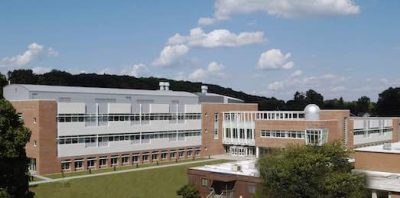
DANBURY – The Science Building at Western Connecticut State University’s midtown campus that was designed by Mitchell Giurgola Architects is a state-of-the-art facility that has served as a beacon for students studying biology, chemistry, physics, and astronomy. Completed in 2005, the university is celebrating the building’s 20-year anniversary with a celebration in April 2026.
“The science building still offers a fantastic place for students to learn and conduct research, even after 20 years. This is due in part to the design decisions made by the faculty,” said Nicholas J. Greco, Professor of Chemistry and Biochemistry and Department Chair.
A focal point of the university’s quadrangle, the 122,000-square-foot building is one of 15 buildings on the midtown campus. The exterior features a two-story main entrance with a glass canopy and roof trellis. The space includes an adjacent lounge with a suspended glass sculpture and an outdoor gathering area amidst a garden landscape.
It serves dual purposes as both a teaching space and research facility for students. In addition to classrooms and lecture auditoria, the building includes the Boehringer Ingleheim Biochemistry Lab that includes gene and cell research and teaching laboratories, tissue culture facilities, shared equipment and glass washing and sterilization facilities, a greenhouse, the WCSU Weather Center, and more. Also, sitting atop the building is the Midtown Observatory, a space used for classes, undergraduate research, and public viewing nights.
“The building gives a bright and positive impression upon entering the large atrium. Lecture halls of all sizes support instruction through the use of the latest technology of projectors/computers that facilitate learning through annotation of slides, viewing of videos and science demonstrations as each lecture hall is equipped with natural gas, vacuum, and water,” said Greco. “The teaching laboratories offer dedicated space based upon each sub-discipline and lie separate from the research laboratories where faculty can work closely with students on novel research projects.”
Outside each office are large chalkboards and bench seating conducive to small groups during faculty office hours, according to Greco. In addition, there are a number of private study lounges and the Boehringer Ingelheim Chemistry Library.
The facility was the University’s first LEED-certified “green” building. It was also the first state-funded building project to seek LEED silver certification from the U.S. Green Building Council. The building has many environmentally-beneficial elements, including a fuel cell power unit, that provides significant energy cost savings and enhanced electricity and heating efficiencies. The unit, originally installed in 2013 as part of a 10-year Energy Services Agreement (ESA) between the university and ClearEdge Power of South Windsor through a federal American Recovery and Reinvestment Act grant arranged through the Clean Energy Finance and Investment Authority (CEFIA) of Connecticut, was replaced with a new one last year.
The system offers a touch point for faculty members to reference the operational fuel cell system, provided by FuelCell Energy of Danbury, in lectures on various science and technology topics, including the environmental impact of integrating clean-energy resources in the power grid and other biological, chemistry, and earth sciences.
In 2021, the science building was equipped with a new Microscopy Lab where student can conduct learning and research. The microscopes allow students to obtain hands-on experience in visualizing cells and learning how to stain for proteins and microstructures.
According to Theodora Pinou, a biology professor, there is a tremendous interest among incoming master’s students in looking at marine ecology, specifically studying the accumulation of microplastics in fish, which directly affects what people eat.
“The beauty of the space is that it allows staff and students to visualize cells and learn how to stain for proteins and microstructures, which is a very important skill that employers are looking for,” she said.
Greco is proud of the building as a valuable space for instruction. “After 20 years, the science building is a place where faculty are excited to work and students are excited to learn,” he said.