


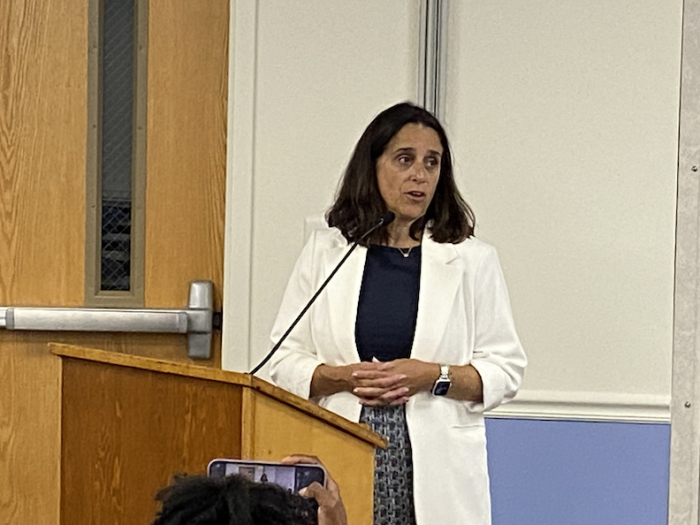
FAIRFIELD – Following the Oct. 29 Board of Selectmen approval to use $570,000 of the Affordable Housing Trust Fund to go toward the development of a $26 million affordable 40-unit assisted living project, First Selectman Christine Vitale wanted to set the record straight.
The Fairfield Democratic Town Committee released a letter Vitale published on Patch.com Oct. 30 “correcting the misinformation” related to the project.
“Fairfield created an Affordable Housing Plan per state law that would cover 2022-2027, and committed to building 50 affordable homes during that time. This project is consistent with the Town’s plan, and is the fruition of bipartisan work across multiple administrations to meet the town’s affordable housing needs,” Vitale wrote.
“At our Oct. 29 meeting, the Board of Selectmen voted in alignment with the Fairfield Affordable Housing Committee (2-0-1, with Vitale and Democratic Selectman Marcy Spolyar voting for and Republican Brenda Kupchick abstaining) who voted on this project in a publicly noticed meeting on Oct. 8, to approve the expenditure of $570,000 from the developer-funded Affordable Housing Trust Fund to the non-profit, Fairfield Housing Corporation, for the development of a 100% affordable 40-unit assisted housing development at 980 High St.”
During the Board of Selectmen meeting, Selectman Brenda Kupchick, a Republican, insinuated the town was not transparent about the process behind approving the transfer of the funds to the Fairfield Housing Corp. She later unsuccessfully attempted to table the decision.
“There’s a lot of questions about it not being transparent,” Kupchick said. “I personally think we should table the item. The Affordable Housing Committee should have a full meeting. It would be in the interest of the town and hold a public meeting of the Affordable Housing Committee.
There is a lot of mistrust. People from around town are whipped up.”

Kupchick echoed the concern of High Street neighbors, some of who were present at the Oct. 29 Board of Selectmen meeting.
“We did receive a tremendous amount of emails and lot of people are thinking this is coming out taxpayer money,” she added. “People may not understand completely that this is 100% affordable and that we are under a mandate by the State of Connecticut. There is a lot of misdirected anger. I’m angry. I tried for 10 years to change the 8-30g law.
“We do have an affordable problem in town. We have seniors that have been on lists for years and years.”
One of those residents who wants more transparency is James Leask, a High Street resident.
“I am firmly on the side of Selectman Kupchick of having a meeting that is public,” he said at the Oct. 29 meeting. “To gain the public’s trust again, we should have a meeting where all members of the community can communicate about this. Progress is made with cooperation. There’s give and take.”
After Kupchick made her remarks on transparency, town Community and Economic Development Director Mark Barnhart corrected Kupchick.
“For the record I want to note the Affordable Housing Committee did have a publicly noticed meeting where this was an item on the agenda,” Barnhart said. “It was videotaped. People were able to see the video of the discussion. We had a quorum. The vote was 4 in favor, one opposed and two abstentions.”
In the Vitale letter, the first selectman laid out the reasons for the board’s actions:
“This project represents what Fairfield does best — coming together to create thoughtful, responsible solutions that strengthen our community,” she wrote. “By supporting quality, permanently affordable housing, we are honoring our commitment to keep Fairfield a place where everyone can belong — seniors who’ve built their lives here, young families starting out, and residents with special needs who deserve to live with dignity and support.
“This is a plan built on collaboration, transparency, and care for our neighbors — a smart investment in Fairfield’s future that reflects our shared values of inclusion, stability, and opportunity for all.”
Vitale included a FAQ, of sorts, on the project in order to “set the record straight.”
- Is the $570,000 taxpayer money?
No, this is not taxpayer money. Developers pay fees into the trust fund when their projects don’t contribute to meeting Fairfield’s affordable housing needs. Funds in the Housing Trust Fund cannot be transferred to cover other line items in the town’s operating budget; they must be used to promote affordable housing in Fairfield. Before the vote, the trust fund was more than $1 million. - Is this project bad for the environment?
This project has been through many changes to address the concerns raised by the Inland Wetlands Committee. The developers worked very closely with the town in a collaborative process to make changes to the design so it would not adversely affect the parcel’s wetlands. - Will it be an eyesore?
The roof line of the buildings will only be 18 inches taller than any newly built houses on the street. The historic Judd homestead building will be preserved and be used as a community center for residents and office space for staff. - Who is developing this project?
The Fairfield Housing Corp., a non-profit developer under the Fairfield Housing Authority.
What impact will this project have on the Town’s 8-30G (a state affordable housing statute) moratorium progress?
We need approximately 191 more housing unit equivalent (HUE) points to achieve our next moratorium. Once completed, the High Street project would contribute 81 HUE points, nearly 42% of the remaining total that is needed. Further delaying construction of this approved project would put the town at risk of not achieving our second moratorium which would enable developers to once again bypass our local zoning regulations.
History of 980 High St.
The Fairfield Housing Corp purchased this property, which is 2.5 acres, in 2018. The corporation then applied for and received town Plan and Zoning Commission in February 2020 to construct the Judd Homestead at Russo Estates. They subsequently received Inland and Wetlands approval in October 2024.
The project consists of five buildings, each of which contain eight rental units. All first-floor units are are barrier-free and wheelchair accessible. (They will remain affordable with restrictive covenants. They will be available to those who with income within 30% and 80% of area median), according to Barnhart.















Vitale’s comments do not address the history, nature or impact of the High St. location. How did a developer even purchase such a property in the first place, without oversight and public comment? There were extensive issues with traffic density, wetlands impact, proximity to a school, and the most important- consistent and strong objections by virtually all citizens involved. Was a financial impact study done on the surrounding neighborhoods, showing how this development would impact all property values within a fixed radius? No. The most glaring defect of this process, driven by Carol Martin, Developers and our local Democrat town reps is the complete negligence and willful dodging of any and all zoning protections of our Town. To pretend that “these issues” have been properly mitigated to permit a successful project is beyond disingenuous Actual taxpayers had little to ZERO input on the ultimate ourcome. Brenda represents the citizens, the other legislators in this article do not. .