CBIA News
HARTFORD – Connecticut’s economy grew 5.6% in the third quarter of 2025, led by strong performances in the finance and insurance, manufacturing, and information sectors, according to federal data released last week.
Only Kansas (6.5%), South Dakota (6.3%), and Arkansas (5.8%) posted stronger growth than Connecticut in the July-September period.
Connecticut’s economy has now grown 3% over the past 12 months, with the U.S. at 2% based on the U.S. Bureau of Economic Analysis’ quarterly GDP report, released Jan. 23.
CBIA president and CEO Chris DiPentima noted the third quarter expansion followed a strong second quarter , with the state’s economy posting six consecutive growth quarters.
“This report underscores the strength and resilience of our businesses and world-class workforce, who are navigating ongoing uncertainty and rising costs and finding innovative ways to boost productivity and drive growth,” he said.
“In addition, the fiscal stability the state has built following the bipartisan 2017 budget reforms is helping give businesses the confidence they need to make important long-term investments.”
Regional numbers
New England’s economy grew 4.2% and national GDP increased 4.4% — after growing 3.8% the previous quarter — with all 50 states posting positive economic numbers.

Connecticut was the region’s best performer, followed by New Hampshire, which had the nation’s seventh fastest economy, expanding 5.5%.
Vermont’s GDP grew 5% (15th), followed by Rhode Island (4.4%; 28th), Maine (3.8%; 40th), and Massachusetts (3.3%; 46th).
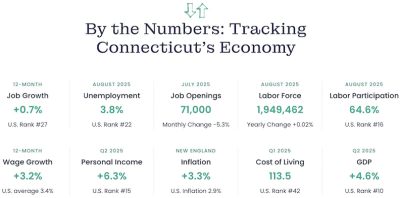
Connecticut’s GDP is growing despite labor force challenges and affordability concerns.
DiPentima noted that businesses were driving productivity gains despite labor force challenges and affordability concerns, which remain significant economic hurdles—particularly for small businesses.
“Now is the time to build on this momentum by advancing policies that strengthen our competitiveness — making this a more affordable and attractive place to live and work,” he said.
“As we head into the 2026 legislative session, policymakers must seize the moment and address the high costs of healthcare and energy while enacting solutions that grow the workforce and expand opportunity across the state.
“It’s then that we will allow small businesses and their employees to truly thrive and unleash Connecticut’s full economic potential.”
Sector performances
Connecticut’s $295.7 billion real GDP accounts for 25% of New England’s $1.2 trillion economy, and is the second largest in the region behind Massachusetts ($648.1 billion).
Seventeen of the 20 major industry sectors that BEA tracks posted productivity gains in the second quarter, led by finance and insurance, which expanded 1.12% after growing 1.59% in the second quarter.
Manufacturing grew 1.05%, with strong gains in durable goods (1.25%) offsetting a 0.2% contraction in nondurable goods production.
Connecticut’s third quarter GDP growth was 4th best among all states.
The information sector expanded 0.81%, followed by professional services (0.62%), retail trade (0.46%), healthcare (0.29%), utilities (0.22%), wholesale trade (0.2%), arts, entertainment, and recreation (0.2%), real estate (0.19%), administrative services (0.17%), other services (0.16%), transportation and warehousing (0.13%), educational services (0.04%), government (0.04%), accommodation and food services (0.02%), and agriculture (0.01%).
Mining was unchanged for the quarter, management shrank 0.01%, and the construction sector posted its first decline in four quarters, contracting 0.1%.
Kansas posted its second consecutive strong quarter to lead all states in the third quarter, with South Dakota, Arkansas, Connecticut, and North Carolina (5.6%) filling out the top five.
North Dakota’s economy was the slowest for the quarter, growing 0.4%, followed by Minnesota (2.7%), Wyoming (2.9%), Hawaii (2.9%), and Massachusetts.
Personal income
Connecticut’s personal income, a key measure of economic competitiveness, grew 2.4% in the third quarter—39th best in the nation—after growing 3.8% the previous quarter.
While wage growth remains strong, growth in dividends, interest, and transfer receipts—which includes government benefits, business liability payments, and corporate philanthropy—was sluggish.
“Employers continue to support their workforces, with private sector wage growth outpacing inflation and the national average,” DiPentima noted.
Personal income growth in the New England states averaged 2%, down from 4.3% in the second quarter, led by New Hampshire at 3.8% — 13th best in the country.
“Employers continue to support their workforces, with private sector wage growth outpacing inflation and the national average.”