NEW HAVEN – A $50.5 million public-private partnership of scientists, biotech companies and a local developer/property manager have laid out Friday what it is being dubbed the New Haven Innovation Cluster located in and around College Street.
“This $50.5 million investment is going to be a catalyst for us,” said New Haven Mayor Justin Elicker. “As folks are aware, there is a significant application to the federal government to invest more in quantum. This could unlock the funding where New Haven is one of the (15) finalists.”
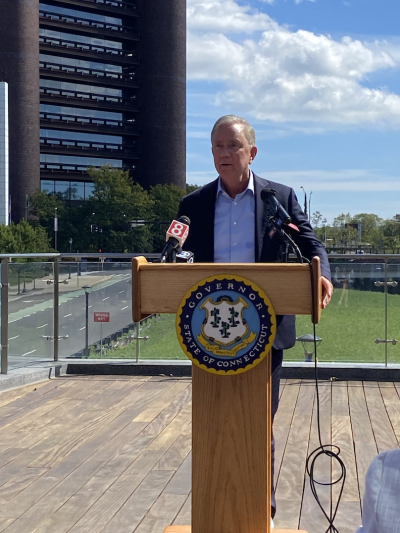
During a press conference at the 101 College St. life sciences building owned by Winstanley Enterprises, Gov. Ned Lamont announced that his administration is making a $50.5 million investment in public infrastructure and facilities in downtown New Haven that are targeted toward propelling growth in the life sciences industry and the emerging sector of quantum technologies.
The idea is to create a new generation of cutting-edge research, innovation, and business and job growth centered around quantum computing in these sectors based in a cluster in New Haven. Quantum computing is defined as a type of computation that uses quantum mechanics to solve complex problems exponentially faster than traditional computers.
The investments are included as part of the first grant award made under the state’s newly launched Connecticut Innovation Clusters Program, which is administered by the Connecticut Department of Economic and Community Development (DECD).
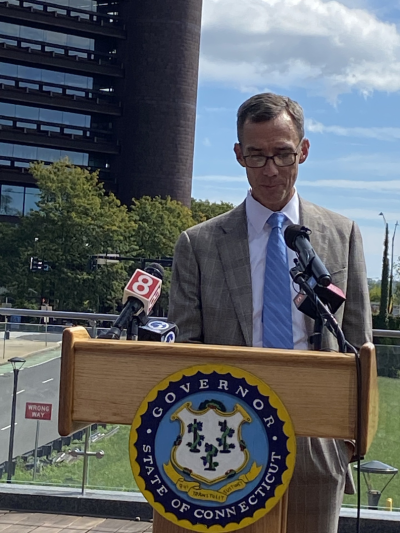
The governor was joined by Winstanley Enterprises founder Carter Winstanley, BioCT President and CEO Jodie Gillon, QuantumCT President and CEO Albert Green, UConn Vice President for Research, Innovation and Entrepreneurship Pamir Alpay, New Haven Mayor Justin Elicker, Lt. Gov. Susan Bysiewicz, U.S. Richard Blumenthal, state Department of Economic and Community Development Director Daniel O’Keefe and his deputy Matt Pugliese at 101 College St.
“We are at the nexus of AI and quantum computing and we have to make sure Connecticut is right in the center of that,” Lamont said. “Matt (Pugliese) described very well how there are states out there that are scraping together some money, throwing some dough at quantum and AI and hope something catches.”
The governor explained how Connecticut has a different strategy.
“We’re really focused – and that’s what this innovation cluster is about – taking advantage of the strengths that Connecticut has,” he added. “No. 1 is our brain power.”
Winstanley pointed to the combination of quantum computing with AI (artificial intelligence) as the foundation that will drive the future economy in Connecticut and beyond. As for his company’s interest in the government-private partnership, Winstanley points to the existence of his life science building at 101 College St., a major part of his company’s building portfolio. Currently, the tenants there include Alexion Pharmaceuticals (an Astra Zeneca subsidiary), BioLabs incubator, the New Haven Public Schools lab classroom space. And now QuantumCT – a public-private partnership accelerating the adoption of quantum technologies in Connecticut.
In September 2025, the National Science Foundation announced that QuantumCT is selected as a finalist in its NSF Engines program. QuantumCT is one of only 15 teams selected nationwide to advance to the next stage of the competition, which would secure Connecticut’s national and global leadership in the quantum economy.
QuantumCT is a new nonprofit organization that serves as the statewide coordinating body for quantum infrastructure, research, and commercialization. The organization is the result of a landmark partnership between Yale and UConn that was launched in response to the National Science Foundation’s Regional Innovation Engines program.
“Imagine for a moment while working in a life science company where you can model chemical reactions too complex for today’s most advanced computers, accelerating the discovery of new drugs and medicines, where clinical trials which typically take years can be completed in a matter of minutes,” Winstanley said.
What the Innovation Cluster includes
The investments being made in this wide-ranging project will seed the next era of growth in New Haven’s downtown innovation district, an existing cluster of world-class expertise in the life sciences that will expand and add new strength in quantum technologies and cross-industry collaborations. Components include:
- New Haven Innovation Center: Create a 4,500-square-foot “early start” activation space within 101 College St. ($1.3 million)
- QuantumCT: Provide critical financial support to this nonprofit that is the statewide coordinating body for quantum computing infrastructure and testbed deployment, convening industry, academia, and startups. ($10 million)
- Public infrastructure: Financing pedestrian-first streetscapes, stormwater management and climate-resilient mobility infrastructure necessary to support Parcel B development. Parcel B is a development parcel created following the removal of the Route 34 expressway located east of 101 College St. ($17.5 million)
- Development fund gap financing: Facilitate the development of Parcel B (200,000+ square feet), owned by the City of New Haven and 265 South Orange St., the Square 10 (former Coliseum) site (277,000+ square feet planned life sciences building). ($14.5 million)
- Arch Street Bridge and Church Street Promenade: Create a multi-modal pedestrian corridor connecting Union Station to Downtown and the Hill neighborhoods, with a signature pedestrian arc bridge and linear park and a pedestrian/bike promenade. ($4.2 million)
- BioCT:Activate the cluster with programming led by BioCT to bring together civic, academic, and business partners within the heart of the district and from across the state. ($3 million)
“Representing 300 member organizations, BioCT’s mission is to foster Connecticut’s burgeoning life sciences ecosystem – building a village around every job seeker, entrepreneur, and company seeking to come, stay, and grow here,” Jodie Gillon, BioCT CEO, said.
QuantumCT CEO Albert Green affirms the central role the company will play as an inaugural member of the state Innovation Clusters Program.
“By bringing together universities, companies, and investors, we are creating the infrastructure, talent pipeline, and partnerships needed to make Connecticut the place where next-generation industries take root and grow,” Green said.
Yale University and UConn are central to the success of the cluster. Yale brings world-class research capabilities in quantum science and biomedical innovation, as well as strengths in accelerating entrepreneurship through Yale Ventures. UConn brings deep expertise in advanced manufacturing, engineering, and translational research, and is a key partner in workforce development and commercialization efforts.
“We envision Quantum CT as something bigger – bigger than Connecticut,” UConn’s Alpay said. “We plan it to be the accelerator for quantum tech of our nation. It goes beyond computing. It touches upon every sector of the state that includes our defense sector, our insurance sector, the fintech sector, the pharmaceutical sector.”