This story has been updated to include state GOP response.
Lawmakers representing the state and federal government returned from the Independence Day weekend with some fiery words for President Trump and Congressional Republicans following the July 4 enactment of the budget reconciliation bill that drastically cuts Medicaid and SNAP while adding $3.9 billion to the federal deficit over the next decade.
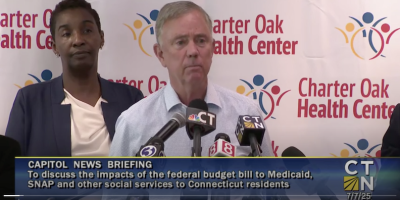
Words like “reckless,” “mean-spirited,” “an abomination,” and even a “pyrrhic victory” were uttered by the likes of Democratic leaders Gov. Ned Lamont, U.S. Rep. John Larson, and U.S. Sen. Richard Blumenthal at a press conference held at Charter Oak Health Center in Hartford today.
“Budgets make a difference. I think this budget the Republicans passed – the Trump budget – was reckless, cynical and mean-spirited,” Lamont said. “As I look at this budget, we talk about all the things we can do to anticipate what’s going to happen to folks in this state. (For) our budget in the state of the Connecticut we try to make life every day a little more affordable to all. And what it comes to affordability, what’s a bigger issue for folks than medical emergencies.”
Meanwhile, state Republican Party Chairman Ben Proto was proud of the “Big Beautiful Bill,” calling it a historic moment in restoring American greatness.
“Today is a great day for the American people,” Proto said. “President Trump has delivered on his promise to put America First and keep us there. The passage of President Trump’s agenda is a testament to bold leadership, common-sense policy, and the unwavering commitment to protect our freedoms, secure our borders, and revive our economy, which President Trump not only promised during the campaign but has now delivered on.
“The increase in the SALT deduction from $10,000 to $40,000 will help millions of Connecticut citizens reduce both their federal and state income tax burdens. Once again, promises made, promises kept. President Trump keeps America on a winning track.”
Among the many things included in the so-called “One Big Beautiful Act” that will have the biggest impact on Connecticut residents is Medicaid and Supplemental Nutrition Assistance Program (SNAP) funding.
The Trump budget reconciliation act calls the cuts to Medicaid and SNAP a way of “strengthening Medicaid by eliminating waste, fraud, and abuse and blocking illegal immigrants from receiving Medicaid.”
The act also extends the 2017 tax cuts, includes increasing the cap on state and local taxes deductions to $40,400 from $10,000, allows no taxes on Social Security, tips and overtime as well as increasing the child tax credit. It also increases funding for permanently securing the borders by finishing the border wall and hiring thousands of new ICE (Immigration and Customs Enforcement) officers and border patrol agents.
Medicaid and SNAP
Connecticut faces a reduction of $1.17 billion in Medicaid funding at a time when state hospitals are financially strapped by already low amount of such funding. As for SNAP, the amount of those cuts has not yet been tabulated although nationwide the program is losing $295 billion. In Connecticut, there are about 391,000 people who receive SNAP.
While the Trump budget includes tax cuts for top 1% of wage earners and large businesses, the Medicaid cuts – most of which are due to kick in 2027 and 2028 – would affect those small businesses that can’t afford to provide health insurance plans. In those cases, their employees have to go on Medicaid.
Another possible outcome from the Trump bill is that the extension of the federal debt limit to $5 trillion would trigger the PAYGO (pay as you go) law. That calls for automatic rescissions to across the board.
“And the first target of those rescissions is Medicare,” U.S. Rep. Joe Courtney said. “That would trigger a 4% across the board cut for all medical providers who have Medicare reimbursements, including right here at Charter Oak.”
When all is said and done, by 2035, 11 million people in the United States will have lost health care coverage because of what has happened under the Trump budget reconciliation act, according to state Social Services Commissioner Andrea Barton Reeves. In the state, there are more than 900,000 people who are on Medicaid, according to Luis Diaz Morales, chief medical officer of Charter Oak Health Center.
“This is a nightmare that has come to pass,” Reeves said during the press conference. “What we know about the state of Connecticut is that we are eminently prepared.”
Reeves laid out a plan for addressing the Medicaid and SNAP funding shortfall. It includes using money from the state’s rainy day fund, helping Medicaid recipients meet the new work requirements, and reaching out to the philanthropic community for aid.
“We have made an $80 million investment in our federally qualified health centers so that when we know that people may lose care due to the changes made to Medicaid and SNAP, we have shored up a critical partner,” Reeves said.
“For months we have been investigating ways to implement the work requirements, without even knowing what they were or understanding what their impact may be,” she added.
And to help provide some kind of services for those Medicaid and SNAP recipients that will booted off coverage the state Department of Social Services has had conversations national and local social service trade associations as well as philanthropic partners.
For those small businesses that can’t afford health care, Lamont said he and Reeves are looking into moving those Medicaid recipients on Individual Coverage Health Reimbursement Arrangement (ICHRA) plans. ICHRA is a health benefit option that allows employers to reimburse employees for individual health insurance premiums and eligible medical expenses on a tax-free basis.
The impact on businesses
Some of the key business tax provisions of the Trump budget reconciliation act, according to Whittlesey consulting, include:
- 100% bonus depreciation permanently restored for eligible property placed in service after Jan. 19, 2025
- Expensing limit for Section 179 increased to $2.5 million with a phaseout starting at $4 million
- Domestic research and development expenses immediately deductible starting in 2025
- Retroactive relief available for small businesses back to 2022
- Employer credit for family and medical leave made permanent
- Child care credit increased to 40% from 25%, with the cap raised to $500,000 ($600,000 for small businesses)
- Opportunity zones and new markets tax credit made permanent
- EBITDA-based interest deduction limit under Section 163(j) reinstated for tax years after 2024
- Special 100% depreciation for qualified production property introduced
- Percentage-of-completion method exception created for certain residential construction contracts
For Rep. Larson, the passage and signing of the budget bill is the start of something even larger and more alarming in U.S. history.
“They’re (Congressional Republicans) saying, ‘No, we’re not touching that (Medicaid),” Larson said. “What we’re doing is stopping the fraud abuse and waste that occurs. What’s the truth. Who will tell the truth? We will.
(The simple truth) “is the middle class is being disassembled before our eyes. Social Security, the nation’s No. 1 anti-poverty program for the elderly and for children is being privatized from within as we speak.”