In recent weeks, headlines have been dominated by large companies, such as Amazon and IBM, laying people off as they shift resources to artificial intelligence. But not all workers are going to be replaced by the robots.
AI is being built into work infrastructure now, especially at major technology companies and financial institutions, including Microsoft, Walmart, Meta and Bank of New York Mellon, and it will affect everything from individual roles to workflows. And it will affect all lines of business.
One business function that will benefit from the AI revolution is human resources. While large companies such as IBM, Walmart and Amazon, are already using AI for HR, only about 40% are using it for that purpose right now, according to report by PwC. But that number is expected to grow, according to Lucy Schott, founder of Unlocked Consultancy, a firm that helps organizations bridge the gap between HR and AI technology.
This is because companies have moved beyond using generative AI to agentic AI, which means they’re using AI as agents to act as digital assistants. This type of intelligence can perform tasks autonomously and mimic human-like behavior such as observing their environments and refining behaviors based on user feedback. Some companies, such as Bank of New York Mellon, have gone so far as to turn their AI agents into digital employees with distinct personas, credentials, and supervisors to take care of routine tasks such as onboarding clients and monitoring transactions and market conditions.
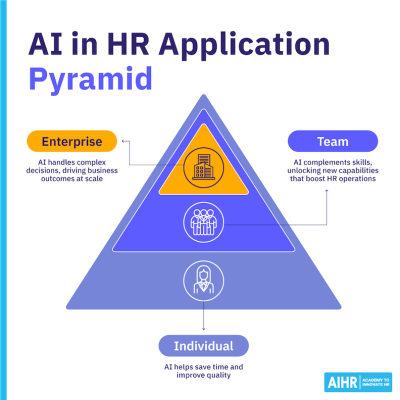
There is a lot of value for HR teams in using AI, according to Schott. For example, AI tools and agents can automate a multitude of HR processes so teams are free to do more sophisticated work. The most popular ways AI is being used in HR include recruitment, performance management, analyzing and summarizing data from employee engagement surveys, performance tracking, onboarding, identifying skill gaps and strengths within the employee pool. They are also used as coaches for learning and development as well as using AI for analyzing data for workforce planning, forecasting and strategy.
However, HR professionals shouldn’t worry about their jobs being replaced by AI, according to Schott. “Instead, they’ll use it as their assistant,” she said. “It’s like turning a team of six into a team of sixty.”
Employees will talk to their AI assistant like they’re talking to a human assistant, she said. “What would you ask your assistant to do? How would you word the request?”
For example, IBM’s AI agent, AskHR, performs a multitude of HR-related functions for the company, including onboarding and answering employee questions about benefits, compensation, leave, and travel and expenses. And in 2025, the company integrated its Watsonx Orchestrate tool enhance its AI agents’ performance so employees can word their questions as if they were emailing the queries to a live human.
Over the past four years, AskHR contributed to reducing operational costs by 40%. In addition, it has had more than 10 million employee interactions per year since 2023 and reduced the number of support tickets by 75% since 2016. And, since last year, it answered 94% of employee questions without having to access human input. One employee said in a company video that with the help of the AskHR agent, a task that used to take 15 to 20 minutes now takes 1 to 2 minutes.
Companies wanting to embed AI into their HR systems need to consider several factors before getting started. The biggest mistake Schott sees companies making is implementing AI without a plan. “You can’t just launch AI and not know how to do it from a compliance, technology, data, and privacy perspective,” Schott said. “And you can’t just expect people to use it. You need to help teams learn how to use and engage with it effectively.”
She said organizations need to think about AI adoption as another change management rollout. Therefore, they will need to consider the stages of change and create a communications plan.
On the technology side, they should think about their compliance and data infrastructure, along with processing power. And they need to think about data compliance rules in other countries if it’s a global organization. Europe is highly restricted about how AI can use data and the tools it uses to learn from that data, Schott said. “For example, Germany has a very robust framework around data privacy,” she added.
Companies will need to work with their technology teams to figure out data security. “Your chief technology officer and chief information officer will need to become your best friends,” Schott said. “Where does your data sit, and how do you track it? They’ll need to figure out sensitive information tracking and set up flagging systems for when sensitive information is leaked.”
HR needs to be particularly careful about sharing benefits and other confidential information with AI systems. Schott recommends that companies scrub all personal data before entering it into AI systems and turn learning tools off.
Data quality is also important. Since AI is based on machine learning, if the data entered is biased or flawed, it’s going to train itself on those flaws, she said.
Organizations also need to evaluate what type of system would work best for them. Will an HRIS bolt-on tool be sufficient? Or will the company need an enterprise-wide system? And take security into account when choosing tools. “Free AI tools won’t have security features. Enterprise-wide AI systems will be more secure,” Schott said.
Another common mistake companies make, according to Schott, is not considering how AI will change the workforce overall, how it will affect someone’s role, and the range of AI knowledge that employees may already have. Younger employees are already using it, while others will need to be upskilled. HR teams will also need to be trained in critical thinking skills, since there still needs to be a human element behind any AI venture, she said.
Organizations looking to adopt AI in their HR departments will also have to factor in team structure and roles. “What will be the AI side of a role and what will be the human side?” Schott said. “And what’s in the middle?”
Management will also need to decide where ownership for policies around AI use and training will sit. “These may sit with HR, but they will need to speak to tech teams about what they think is important to include,” she said.
And finally, building trust within the organization around the use of AI is key, Schott said. Companies can do this by communicating about how AI is being used, what security measures are being put into place, and how it will affect everyone’s role. “Be transparent about who the change will impact,” she said. “Also find ways to incentivize employees to use it.”
Having very strong cybersecurity systems in place to protect the security of HR data is going to be the most essential part of the implementation process. “If you use AI, you’re vulnerable to hacking,” said Douglas K. Chia, president of consulting company Soundboard Governance and a senior fellow at the Rutgers Center for Corporate Law and Governance. “The bad guys are always ahead of the game. And now they’re using AI to automate break-ins.”
This is particularly important due to a lack of oversight in cybersecurity on the federal level right now. Several top cybersecurity roles within the US government remain vacant. Rep. Don Bacon (R-Neb.), chair of the House Armed Services Subcommittee on Cyber, Innovative Technologies and Information Systems, told Face the Nation that the top office for US Cyber Command and the top two positions at the National Security Agency have all been vacant for the past eight months. In addition, he said the Cybersecurity and Infrastructure Agency, which protects private sector businesses and infrastructure, has been cut by about one-third.
And there’s no legislation or regulation on the horizon, according to Chia. “It’s similar to the lack of these in the cryptocurrency industry,” he said. “But there should be regulation, because people don’t really understand the consequences. They don’t really pay attention to the need for regulation until something really bad happens, like with the financial crisis of 2008 or like the Titanic.”
Chia doesn’t expect any changes in this area any time soon. “There won’t be any legislation, regulation, or disclosure rules until the grand leader is gone,” Chia said. “Trump still has influence even when he’s out of office. So, it’s going to be up to companies to manage this themselves,” Chia said. “They need to figure out how to do it on their own.”