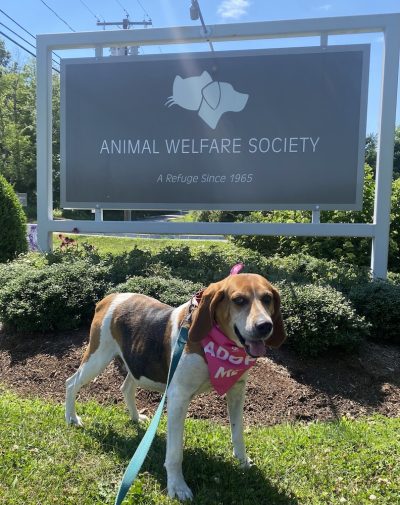
NEW MILFORD – Saving dogs and cats and giving them a home. That’s been the mantra of the Animal Welfare Society (AWS) since it was established in 1965. Now, in its 60th year as an independent, nonprofit, non-destroy animal rescue organization, its mission has expanded.
“We remain dedicated to being a source of support for pets and families in our state despite the financial struggles that come with being a non-profit organization,” said Renee Gardner, shelter manager, who’s been with the nonprofit for 34 years. “We take in many senior pets that require extra veterinary care. Housing costs, pet restrictions in housing, the increase in the cost of owning a pet, and especially the prohibitively massive cost of spaying and neutering have all contributed to the crisis of homeless animals that Connecticut is currently dealing with.”
The mission of AWS is to provide a safe environment for homeless animals where they can receive all the medical care they need before placement in a new home. Its rate of intakes to adoptions are the same, adopting out around 120 dogs and 250 cats per year.
“One of our biggest limiting factors is the cost of vetting,” she added. “All animals we place have received a complete, up-to-date panel of vaccines appropriate for their age, have been dewormed and cleared of parasites, and all cats have been tested for feline leukemia and FIV (Feline immunodeficiency virus). All dogs have been tested and, if necessary, treated for any tick-borne diseases or heartworm.”
Also, AWS microchips and spays or neuters all animals.
The animal society was first established to help dogs in the local animal control facility that served the towns of Brookfield, New Milford, Bridgewater, Roxbury, and Washington. Since then, the shelter has grown significantly and offers services to additional areas of the state.
“Particularly through working with other animal control organizations when there are incidents like a hoarding or cruelty case, but our priority still remains with our immediate community,” Gardner said. “We’ll do what we can for places like Waterbury or Watertown when we have the space and the resources. Fortunately, we have those resources more frequently now than we used to so long as local pets and families are getting the support they need.”
As a nonprofit, AWS is funded by donations with no state support. Gardner noted staff and resources are tighter than ever.
“Being one of the few shelters in the area who will take old, sick, injured, or unmedicated animals without requiring a massive surrender fee from individuals and families that are already in difficult situations means we often end up tight on money, Gardner said. “As the economy has worsened and more people find themselves in unsustainable and uncertain conditions, the need for the support we provide has become greater.
Gardner noted they typically have a waitlist of animals needing to come in and are seeing more animals being abandoned at the shelter.
With six employees and a dedicated group of volunteers, AWS is open 365 days a year. Also, it runs a pet thrift store on the second Saturday of every month during spring, summer, and fall that sells donated pet supplies.
In 2019, AWS was awarded a massive donation that was used to build an addition to the shelter.
“It opened up more space for housing animals, more office space, a conference room, and a spacious area for ‘meet-and-greets’ between adopters and their future pets, all of which has helped immensely in our efforts to find homes for our animals,” said Gardner.
Also, AWS has a Senior-to-Senior program helping senior citizens find a companion without worrying about an adoption fee and ensures its older, ‘less adoptable’ animals spend their last years in a loving home.
“We’re able to work with local food banks by supplying them with pet food that we can’t use at the shelter so nothing is wasted. We try to keep our application process straightforward and simple while still being thorough enough to ensure the best environment for our animals, and we continue to the best of our ability to help our new adopters after they’ve brought their pet home if they need it.”