Westchester County Executive Ken Jenkins on Oct. 15 released his proposed 2026 Capital Budget. Jenkins along with Deputy County Executive Richard Wishnie, Operations Director Joan McDonald and Budget Director Lawrence Soule discussed key points in the budget and then formally presented a budget book to members of the Board of Legislators who had joined them at the county executive’s office.
The budget that was unveiled contains capital spending for the county for the next year, but does not incorporate operating expenditures. The proposed capital budget totals $604.8 million.
The 2025 capital budget proposed by former County Executive George Latimer was just over $385 million and the operating budget was $2.5 billion. The 2025 Capital Budget as passed by the Board of Legislators was $453 million.
In presenting the new capital budget, Jenkins warned that the county could face cuts of up to $700 million in federal and state funding, and he described some economies that have been achieved so far in county operations including a $4 million reduction in corrections department overtime.
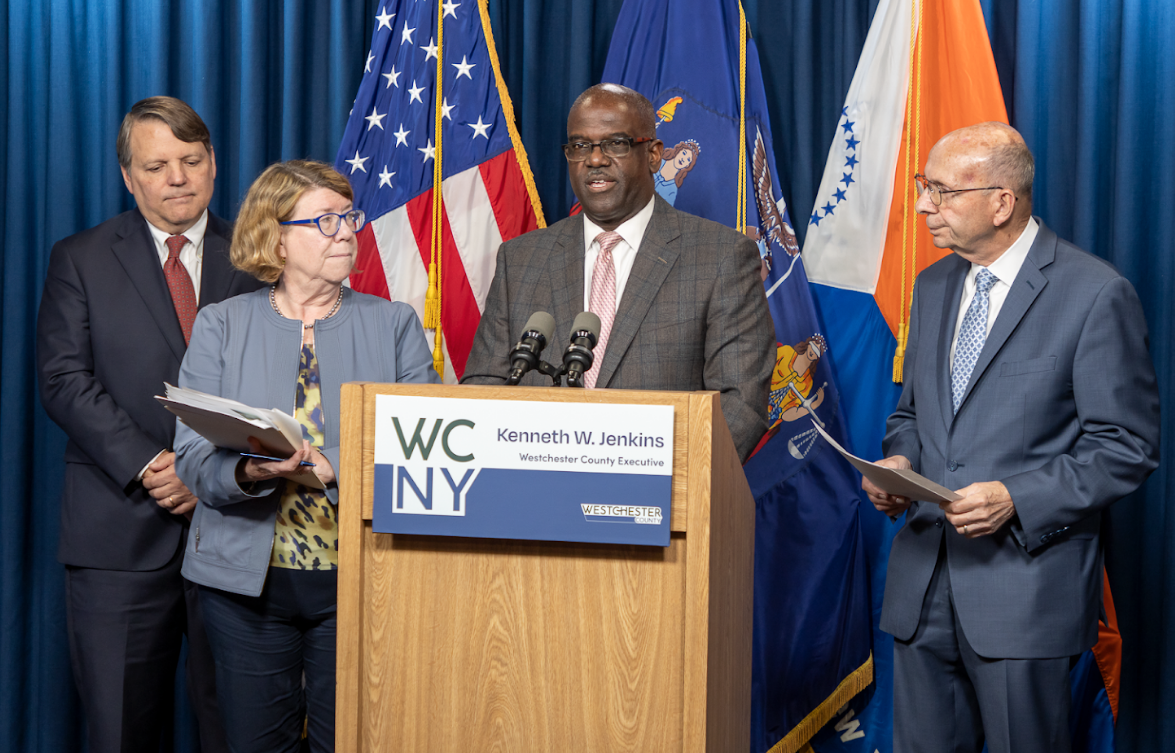
“This is not a year for wish lists — it’s a year for wisdom,” Jenkins said. “We are facing significant financial challenges, and that means we have to make every dollar count. Doing nothing, delaying maintenance, or deferring critical projects would ultimately cost taxpayers more.”
The capital budget adds $25 million to both The Housing Implementation Fund and New Homes Land Acquisition Program, which help in the creation of affordable housing.
The 2026 Capital Budget includes $122.5 million to replace 94 aging hybrid buses in the Bee-Line fleet, ensuring a more reliable fleet while significantly reducing emissions and improving air quality across Westchester. The proposed budget includes $35 million, with an additional $15 million in local matching funds, to expand electric vehicle charging infrastructure, adding more than 650 new chargers across 77 sites in the county.
The 2026 Capital Budget proposes spending $185 million for improvements at the Yonkers Joint Wastewater Treatment Facility. This includes $150 million for major electrical upgrades and $35 million for improvements in the way solid waste is handled.
The 2026 Capital Budget includes $9 million in new funding for flood mitigation projects, including $4 million for improvements to the Lake Isle Dam in Eastchester. An additional $21 million from the New York State Environmental Bond Act will support projects such as bridge and culvert replacements in Rye Brook and Rye.
The 2026 Capital Budget funds a new Fleet and Road Maintenance Facility that is estimated to cost $133.5 million, with $4.3 million in concept funds already appropriated for developing the project.
Jenkins said that the proposed 2026 Capital Budget reflects a mindset of being smarter, more selective, and more determined in uncertain financial times. He described the projects in the capital budget as not being “flashy” but rather being “foundational.”
“They represent safety, stability and sound governance,” Jenkins said. “Every project is designed to make Westchester stronger, greener and more affordable. We’re going to ensure that this county not only weathers the challenges and storms that are in front of us but continues to lead.”