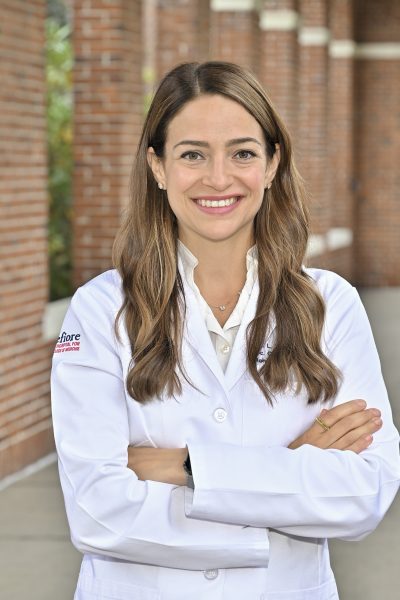
Erika Trovato, D.O., M.S., knows all about how life brings you full circle. When she was a student at the New York College of Osteopathic Medicine, the Yonkers-born Trovato – who grew up in Lagrangeville in Dutchess County – volunteered at Burke Rehabilitation in White Plains, part of the Montefiore Health System. And though she completed her residency in physical medicine and rehabilitation at New York University Grossman School of Medicine’s Rusk Rehabilitation – where the desire to specialize in brain injury medicine kicked in, leading to a Rusk fellowship in that discipline – Burke was in her future.
Today she is associate chief medical officer at Burke, which has the highest readmission prevention rate among the nation’s top-ranked rehabilitation hospitals and is the largest provider of stroke rehabilitation in New York. (Ranked as a top rehabilitation hospital by Newsweek and U.S. News & World Report, Burke has 15 outpatient locations throughout the Bronx, the Hudson Valley and Westchester County,with more sites planned, including one at the former Lord & Taylor in Eastchester.)
At Burke, Trovato directs the Brain Injury Medicine Program, leading a multidisciplinary rehabilitation team of physical, occupational and speech therapists; nurses, neuropsychologists; and other specialists that cares for patients suffering from injuries, tumors, skull fractures, polytraumas (involving multiple organs) and hemorrhagic and ischemic strokes. (She is also program director of the Burke Brain Injury Medicine Fellowship.) Her work there has led her to receive the Marie Ivancich Memorial Award from the Brain Injury Association of New York State (BIANYS), presented at its annual conference, June 11 through 13 at Saratoga Springs, New York.
“Dr. Erika Trovato goes above and beyond for the brain injury community each and every day,” Eileen Reardon, executive director of the 43-year-old nonprofit, said in a statement. “Not only is she a dedicated physician, helping survivors throughout their recovery journeys; she has been an amazing partner to BIANYS, helping with our organization’s events and advocacy efforts. It is for those reasons, and more, that we have awarded Dr. Trovato the Marie Ivancich Memorial Award.”
“I was absolutely thrilled and honored,” said Trovato, who attended her first BIANYS conference in 2017 and has served on the planning committee for the BIANYS Brain Injury Symposium since 2020. “It’s such an important award, named in recognition of a mother and her child, who had sustained a brain injury. It’s an award to recognize people who support BIANYS and are advocates for patients and caregivers.”
Family caregiving, she added, requires “a special person to take on that role.” It’s a difficult, exhausting, often thankless one (earning $12 to $15 an hour through Medicaid.) And it’s one that will be increasingly in demand as doctors see more brain injuries, due to an aging population, Trovato said. (The most common are from falls.)
| Dreamstime.com
Knowing how brain injuries occur is key to the type of rehabilitation, with protocols improving all the time, she added. In the case of concussions, a common brain injury, the treatment used to require “rest in a dark room for weeks on end.” Now the playbook calls for a short period of rest, followed by getting patients back on their feet as soon as possible while monitoring the symptoms.
“Movement and exercise are vital to rehabilitation,” said Trovato, whose training in osteopathic medicine has gone beyond traditional medicine to incorporate the mind, body, spirit connection. This year, her presentation at the BIANYS conference focused on “Exercise – The Lifelong Treatment After Brain Injury.” “Exercise improves cognition….It improves sleep and mood.”
Any physical activity is better than none, she added, with the preferred activities in rehab dependent on the patient’s injury and interests. Similarly, the arts are “a big component in the therapeutic approach,” again depending on the patient’s needs and proclivities.
Safety features also play their part, noting roundabouts as an example. According to the U.S. Department of Transportation, they reduce serious and fatal injuries, including head injuries, at intersections 82% by forcing drivers to slow down and yield to oncoming traffic.
Ultimately, an ounce of prevention really is worth a pound of cure when it comes to brain health. Along with exercise and safety comes knowledge. In partnership with the New York State Athletic Trainers’ Association, BIANYS offers COPE: Concussion Outreach Prevention Education with free in-person sessions and online educational modules geared toward anyone who is engaged with student athletes, be they parents, coaches or school faculty and staff. COPE programs are supported by funding provided by the New York State Department of Health, in collaboration with the New York State Senate.
“A lot of prevention,” Trovato said, “is founded on educating individuals.”