The White Plains Common Council has adopted a $500,000 Vision Zero Action Plan that was created to make changes in the way vehicular and pedestrian traffic circulate in the city with a goal of eliminating serious injury and fatal crashes by the year 2050. The plan includes such things as creating raised crosswalks that would act as speed humps to slow down vehicles, creating protected bike lanes and reducing the speed limit in school areas to 15 miles per hour and imposing a limit as low at 5 miles per hour in special circumstances.
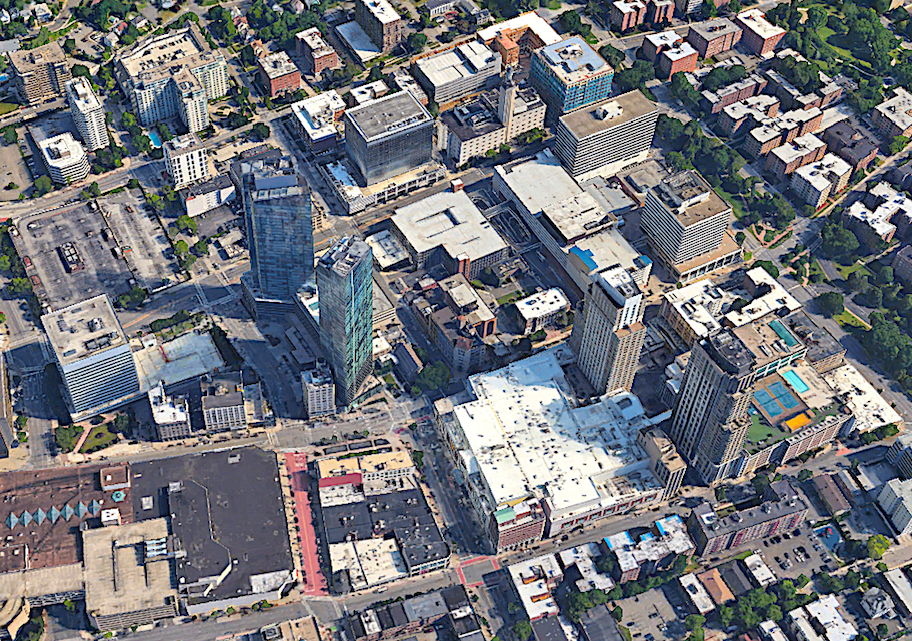 Downtown White Plains. Satellite photo via Google Maps.
Ingrid Richards, senior adviser to Mayor Tom Roach and coordinator of economic development and public information, told the Common Council that the city had been awarded a $500,000 grant consisting of $400,000 plus in-kind services worth $100,000 from the Safe Streets and Roads for All (SS4A) federal program to prepare the action plan.
“In May 2024, the city began to work with the planning and traffic consultant firm, VHB, to develop
a plan that establishes a goal to eliminate serious injury and fatal crashes,” Richards said. “A multi-faceted Plan Advisory Committee was established at the onset, engaged throughout the plan development process, and provided oversight and feedback on the analysis and recommendations. This Action Plan was developed over a year with input from residents, business leaders, health care and not for profit organizations, the school district, neighborhood associations, members of the staff, and Common Council members.”
Richards said that the council’s action in adopting the Action Plan will allow city staff to apply for SS4A grant funding to start doing the actual build-out that will turn the plan into reality. She said that the federal government has $580 million in total funding available for implementation grants and applications for the money are due on June 26.
Vision Zero applies to streets, sidewalks, crosswalks and other features what is called a Safe Systems Approach. The approach originated in Sweden in the 1990s and has been successfully implemented in various European and U.S. cities. The approach brings to the table safer street design, speed management, equitable enforcement, and public engagement to create a transportation network that protects all users and particularly vulnerable groups such as pedestrians, bicyclists, and individuals with disabilities.
The Safe Systems Approach says that while human error on the road or sidewalk is inevitable, road traffic fatalities and serious injuries are not.
One Vision found that each year approximately 30 people all ages and backgrounds are seriously injured or killed while using the roadways within the City of White Plains, which is equivalent to one serious incident every two weeks.
“Through implementation of this Action Plan, the City of White Plains will take significant strides toward reducing and, ultimately, eliminating fatal and serious injury roadway crashes within its boundaries. Through this process, the lives of those who work, live and play within White Plains can be saved,” One Vision said.
While it may be some time before the initial steps are taken to begin turning the recommendations in One Vision into reality, Roach pointed out that the city already has taken steps such as getting New York state to allow it to put a 25 mile per hour speed limit into effect for most streets.
“We have in place red light cameras, we have just received authorization to do school zone speed cameras and we are in the process of school bus stop arm cameras, which means that when you pass a stopped school bus with lights flashing and the stop sign sticking out of the side of it if you don’t stop you’re going to get a $250 fine,” Roach said. “This is serious business and we are serious about it.”
The Action Plan has set a target of attaining a 50% reduction in roadway fatalities and serious injuries by 2035, 75% by 2045 and then 100% by 2050. It wants to begin by targeting four miles of roads in the city that have seen the most serious incidents that it calls the “Priority High Injury Network” and then expand to encompass 11 miles of roads.
Examples of some of some of the projects that are proposed in One Vision include:
- Prohibiting parking spaces within 20 feet of a crosswalk in order to improve sight lines;
- Putting decals on sidewalks to remind pedestrians to look up from their phones, remain aware of their surroundings and obey traffic laws;
- Install better signage to help pedestrians find their way around the city and get to points of interest;
- Convert some roads to pedestrian plazas and others to shared streets with narrower lanes for motor vehicles and wider walkways for pedestrians;
- Install bike racks at key locations and establish a bike sharing program;
- Install bikes lanes that are separated and protected from motor vehicles;
- Convert South Lexington Avenue between Quarropas Street and Maple Avenue from one-way to two-ways;
- Convert Dr. Martin Luther King Jr. Blvd. between Quarropas Street and East Post Road from one-way to two-ways;
- Extend various crosswalks and install high-visibility flashers at various crosswalk locations;
- Install a roundabout at the intersection of South Broadway and East Post Road;
- Convert Ferris Avenue between Hamilton Avenue and Water Street into a shared street that prioritizes pedestrians and bicyclists.