When U.S. Department of Transportation Secretary Sean Duffy was in New Jersey on March 22 to inspect sink holes that had opened up and caused the shutdown of a section of Interstate 80, he reiterated the Trump Administration’s opposition to the New York Congestion Pricing tolls. Duffy pointed out that he had just given New York an extension of the March 21 deadline that was imposed for it to stop collecting the Congestion Pricing tolls for entering the Manhattan Central Business District (CBD) beginning at 60th Street. The federal government had previously approved the project. Donald Trump had promised to end Congestion Pricing if he was returned to the White House and New York Gov. Kathy Hochul was unable to get him to reverse his position during meetings and phone calls.
Hochul went on the offensive, stating that the state would not shut down the toll collections and she launched a campaign to drive home the positive benefits that had been seen since the tolls went into effect in January.
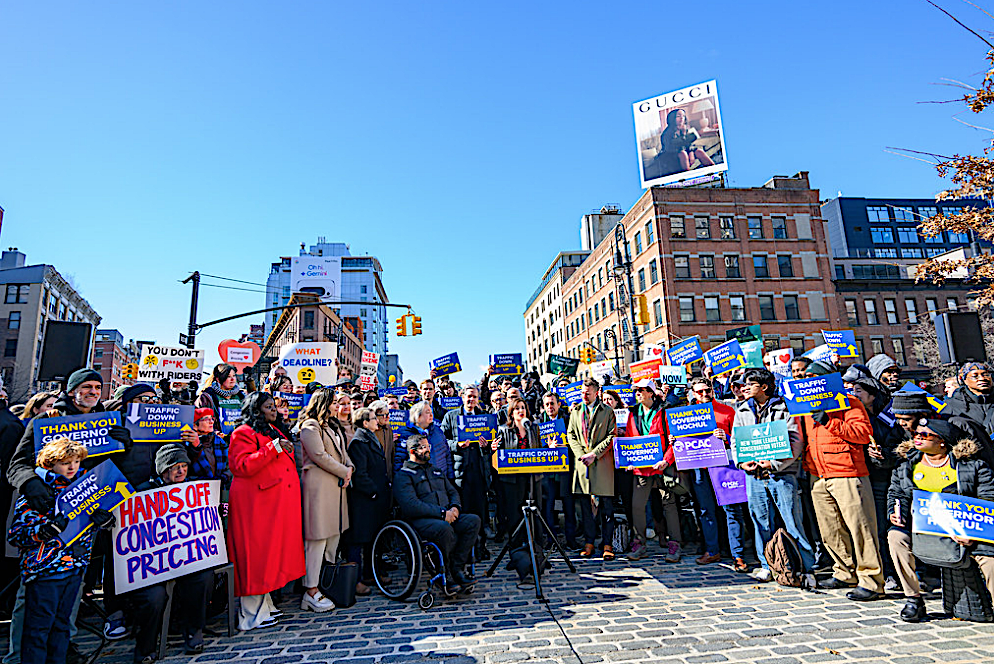
Hochul on March 21 held an outdoor rally with business leaders, transit advocates, other elected officials and New York City residents to tout the tangible benefits of Congestion Pricing that have already been recorded.
The day before the deadline the federal government had issued to shut down the toll collection, Duffy went on the internet and in a post gave the city a 30-day deadline extension because, he said, negotiations with the city would be continuing. Duffy added a threat by noting that the federal government sends billions of dollars to New York and “noncompliance will not be taken lightly.”
Duffy sent a letter on March 18 to Metropolitan Transportation Authority (MTA) Chair and CEO Janno Lieber demanding detailed information on what the transportation system is doing to promote safety and security. Duffy indicated that if the DOT was not pleased with the responses federal funds that could be spent on safety and security matters could be withheld.
Duffy made it a point to underscore that funding sent to the MTA for capital projects can be spent on safety and security projects and, therefore, federal money dedicated to MTA capital projects could be at risk along with money that is earmarked for safety and security.
While there was no direct threat by Duffy that linked failure to shut down Congestion Tolls with the withholding of federal funds, the coincidence of the issue being raised just before the federal government’s shutdown deadline was not lost on many proponents as well as opponents of the tolls.
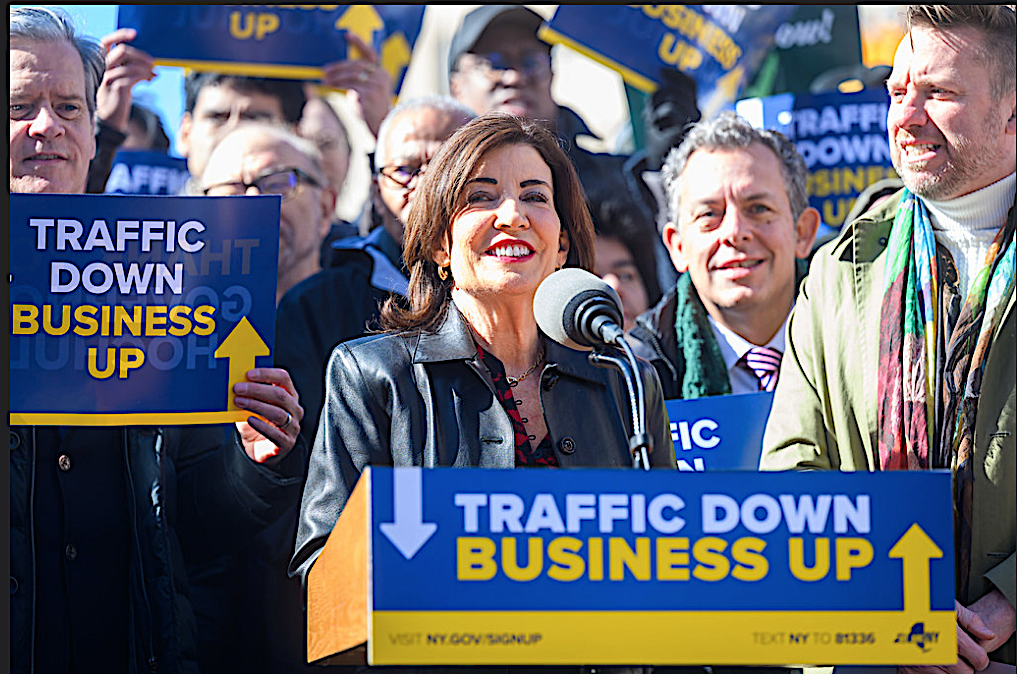
“Traffic is down and business is up,” Hochul said. “That’s the kind of progress we’re going to keep delivering for New Yorkers.”
Statistics cited by Hochul included: traffic being down 11% in the CBD in February compared with February 2024; three million fewer vehicles entering the CBD in January and February compared with the same months last year; traffic moving up to 30% faster on bridge and tunnel crossings in February compared with February 2024; complaints about excessive car horn honking within the CBD being down by more than 70% in January and February compared with the same time last year.
The MTA reported that transit ridership in January and February of this year has grown significantly compared with the same time last year. Metro-North Railroad ridership is up 4%. There are 8% more riders on the Long Island Rail Road. Subway ridership is up 6%.
Businesses are seeing beneficial effects from Congestion Pricing, according to statistics cited by Hochul. Broadway show attendance was up 19% in January and February compared with the same time last year, restaurant reservations in the CBD rose 5% from January to mid-March compared with the same time last year and retail sales in the CBD were on track to be $900 million higher in 2025 compared with last year.
Lieber said, “Congestion relief is working, cars and buses are moving faster, foot traffic is up and even noise complaints are down. That’s why in poll after poll more and more New Yorkers are saying they want those benefits to stay – and they will.”
Hochul emphasized her position that the toll collection cameras are staying on.
“They sure as hell are,” Hochul said. “We have countless lawsuits. People going on television constantly berating this, saying it wouldn’t work. I want them to come here now and feel a very different New York City. That is very alive, and it’s vital. It is not jammed and stuck in traffic.”