There were more than 2,000 “No Kings” protests in the U.S. on June 14 with the overall number of participants variously estimated at from five million to nine million. A number of the rallies taking place in the Hudson Valley attracted crowds estimated at one thousand or more.
The demonstrations were in protest against what participants perceived as harmful Trump Administration policies and Donald Trump’s increasingly authoritarian conduct of the presidency. Hudson Valley events ranged from a march in Newburgh to a large turnout in the area of the Mount Kisco Metro-North train station and the gathering of a few senior citizens on a sidewalk in White Plains.
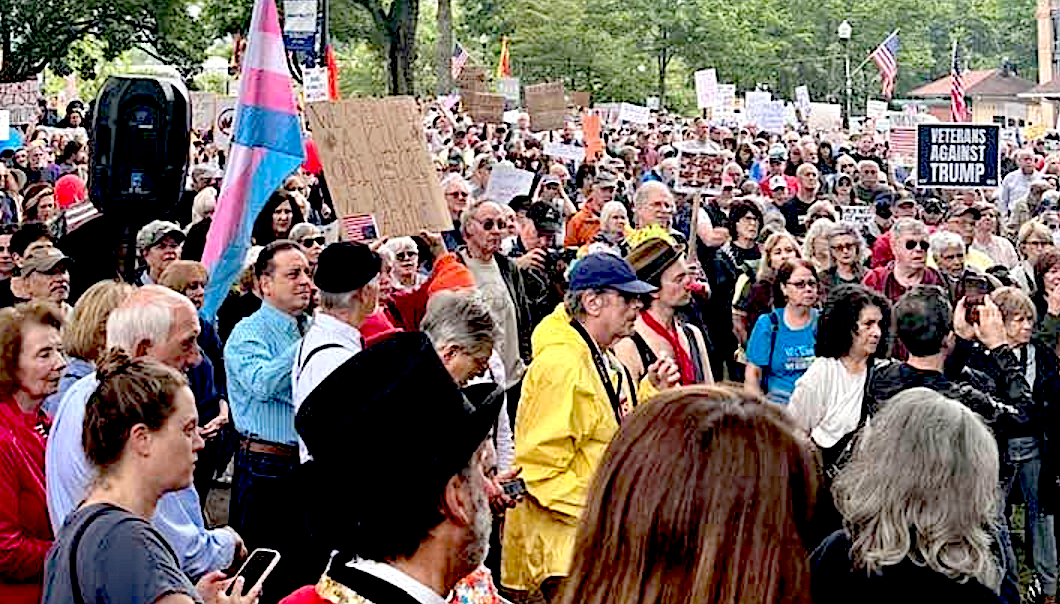
The demonstrations took place under the umbrella name “No Kings,” designed to convey the message that the U.S., which came into existence in order to get out from under rule by the King of England, will not tolerate its president behaving like a king and trying to consolidate power in the executive branch that he controls.
Protests were held at various times during the overcast and drizzly Saturday in Mount Kisco, Croton-on-Hudson, Yonkers, Mamaroneck, Larchmont, Nanuet, New Paltz and Middletown among other communities. A group from New Rochelle traveled into New York City to join an estimated 50,000 people taking part in a “No Kings” demonstration. The organization Indivisible Westchester was involved in organizing many of the protests. There were also thousands of residents who protested throughout neighboring Connecticut, including about 7,000 at the Capitol in Hartford as well the New Haven Green.
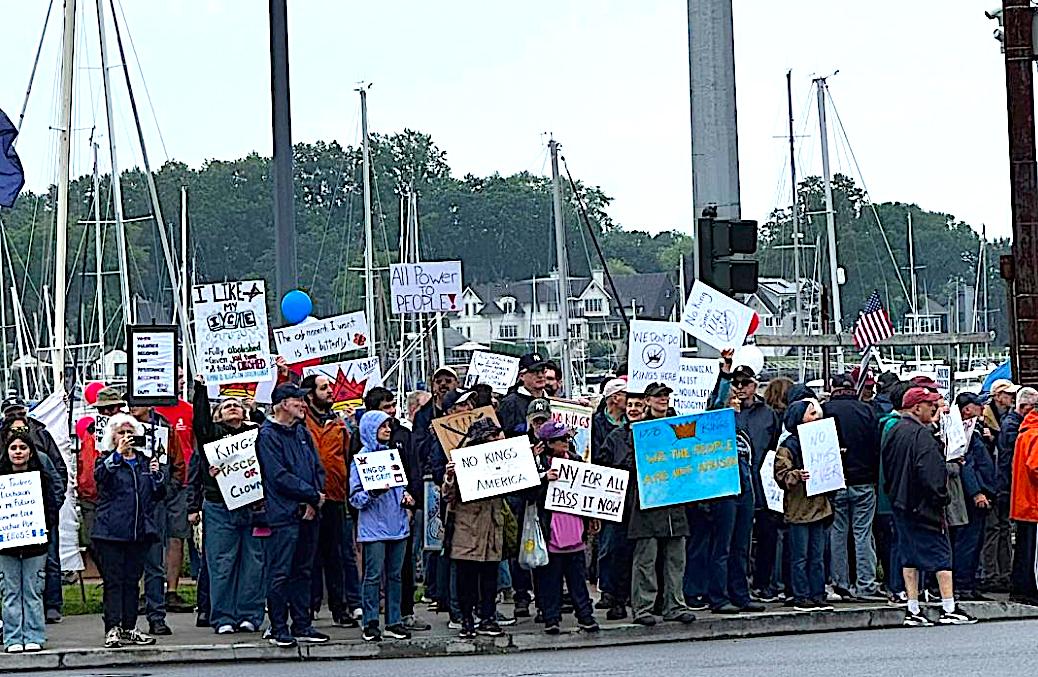
The demonstrations in the Hudson Valley and the vast majority of those nationwide were peaceful. Nationally, there were a few incidents in which police used force when demonstrators became overly demonstrative.
Against the background of Defense Secretary Hegseth suggesting that the order President Trump used to federalize the California National Guard and deploy troops to Los Angeles could be used in other states, Texas Gov. Greg Abbott deployed the state’s National Guard ahead of the “No Kings” protests. In Missouri, Gov. Mike Kehoe activated his state’s National Guard as a precautionary measure
Ezra Levin, co-executive director of the national organization Indivisible, characterized the “No Kings” demonstrations as “historic.”
Because of the parade marking the 250th anniversary of the U.S. Army, Indivisible decided not to stage a “No Kings” rally in Washington, D.C., and instead made Philadelphia the headquarters city for the demonstrations.
New York City Mayor Eric Adams had said in advance that he expected a large number of people to turn out to demonstrate in the city and the 34,000 members of the New York Police Department will be protecting everyone. Adams said he had told the federal government that the National Guard would not be needed in New York City.
In Florida, Brevard County Sheriff Wayne Ivey said peaceful protests are part of democracy, and people are invited to express their opinions but, “If you throw a brick, a firebomb, or point a gun at one of our deputies, we will be notifying your family where to collect your remains because we will kill you.”