Beginning Monday, March 2, Fairfield University’s John Charles Meditz College of Arts and Sciences will host a month-long, interdisciplinary symposium based on one of the most influential authors and books of our time.
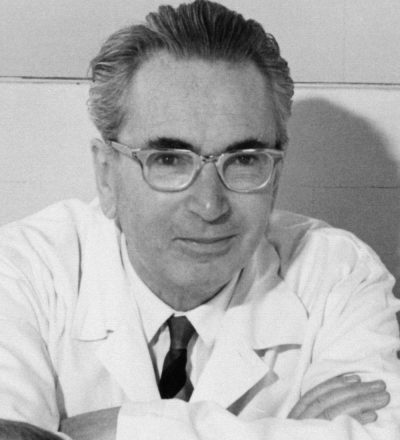
The best-selling “Man’s Search for Meaning” by Austrian psychiatrist, neurologist and philosopher Viktor Frankl (1905-97) and its companion logotherapy grew out of Frankl’s early belief that the quest for a meaning to life was its driving force. But it was his experience in concentration camps in World War II that would test the idea.
In 1942, nine months after his marriage, Frankl and his family were sent to the Theresienstadt (Terezin) concentration camp, where his father died of starvation and pneumonia. Two years later, the Nazis sent Frankl and his surviving relatives to Auschwitz, where his mother and brother were murdered in the gas chambers. (Frankl was never registered at Auschwitz but rather was held there a few days before being sent to Kaufering III, a subsidiary work camp of Dachau. Like Anne Frank, Frankl’s wife Tilly died of typhus in Bergen-Belsen. In all, he spent three years in four camps.
Kaufering and Terezin had the most effect on “Man’s Search for Meaning,” in which Frankl observed:
“There is much wisdom in the words of Nietzsche: ‘He who has a why to live for can bear almost any how.’ I can see in these words a motto which holds true for any psychotherapy. In the Nazi concentration camps, one could have witnessed that those who knew that there was a task waiting for them to fulfill were most apt to survive.”
But after the publication of his book, this theory was criticized by some scholars who saw in it a kind of mind-over-matter facility that did not account for the various reasons that some survived the death camps while many did not.
At the Fairfield University symposium, scholars, medical professionals, religious leaders, artists and students will consider Frankl’s work in relation to contemporary challenges, beginning at 6 p.m., Monday, March 2, when Alexander Batthyány, director of Viktor Frankl Institute, Vienna, will lecture on “Why Frankl Matters Today: Rediscovering Meaning in an Age of Disorientation” in the Dolan School of Business Event Hall. There’s a reception at 5:30 p.m.
Also on March 2, at 7:30 p.m., writer and actor Christopher Domig, artistic director of New York City’s Sea Dog Theater, will present “Man’s Search for Meaning” — An Immersive Theatrical Experience in Media Center Studio A.
Domig, host of the Viktor Frankl Project podcast, is also part of the 5 p.m. March 19 round table “The Many Legacies of Viktor Frankl.”
The panel also features William Breitbart, M.D., The Jimmie C. Holland Chair in psychiatric oncology, Memorial Sloan Kettering Cancer Center; Rabbi Darren Levine, founding rabbi of Tamid and founder of Positive Judaism: A New Vision for Jewish Life in the 21st Century; and Eileen O’Shea, DNP, APRN-BC, CHPPN, director, the Marion Peckham Egan School of Nursing and Health Studies, Kanarek Center for Palliative Care Nursing Education. The event takes place at the Egan School, Rooms 103-104.
The symposium closes at 3 p.m. March 29, with The New York Times columnist and author David Brooks delivering the keynote, “How To Know a Person,” the Philip I. Eliasoph Open VISIONS Forum | 2026 Bennett Center for Judaic Studies Lecture, at the Quick Center for the Arts.
The symposium, with support from Joe and Robin Bennett Kanarek ’96, RN, BSN, is presented by the Humanities Institute, the Bennett Center for Judaic Studies, the Marion Peckham Egan School of Nursing & Health Studies’ Kanarek Center for Palliative Care and the John Charles Meditz College of Arts & Sciences. Registration is requested for each event.