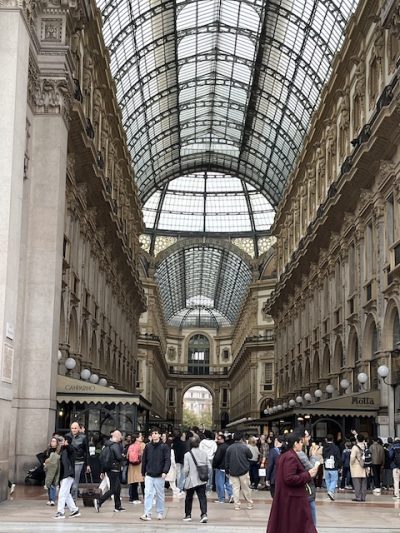
Every 25 years, the Roman Catholic Church proclaims an “Ordinary Jubilee” for the faithful to gather in Rome. This year’s Jubilee, which is expected to draw between 30 million and 35 million people by its end on Jan. 6, is dedicated to forgiveness, social justice and debt relief for the world’s most vulnerable. To prepare for the event, Italy poured roughly $5.8 billion into infrastructure, with most of that going to its political capital, Rome. But while the country hopes to add to its growing tourism sector, which accounts for 11% to 13% of GDP and supports more than three million jobs, not everyone is jubilant, a guide told us as we made our way from Milan, the nation’s financial capital; to Venice, Florence, Assisi and Rome as part of the Church of the Sacred Heart in Hartsdale’s challenging “Pilgrimage of Hope” (Oct.21-30).
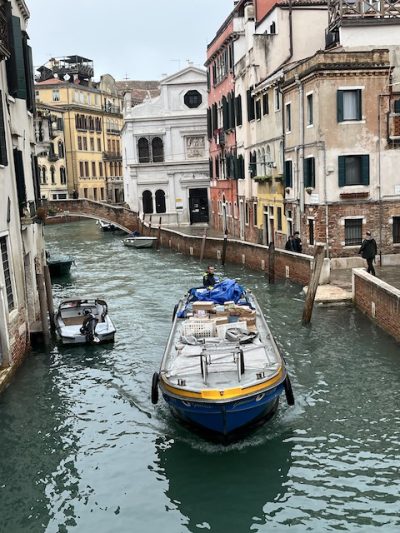
Small business owners in particular worry about getting their slice of the Jubilee pie as secular tourists stay away, yielding the field to tightly scheduled pilgrims with no time to shop or sip latte in cafés, and infrastructure projects add to crowding and traffic woes. Retail lovers that we are, we experienced this painfully at every stop on a tour that required us to walk five brisk miles every day, wait in long lines and drive for hours by bus. Our retail withdrawal was perhaps never more acute than in Venice, where storm Benjamin underscored the Adriatic city’s identity as a pastel waterworld, threaded by teal canals, more than 400 bridges and cozy cobblestone streets lined with shops selling food, leather goods, carnival masks, Venetian scenes and Murano glass – all of which we had to pass by. Given that so many shops seem to sell the same goods, we wondered how they all stay afloat, no pun intended. In Italy, shops don’t go out of business, our Venetian guide told us. Rather, new owners appear.
“Venice is a city lost in myth,” she added. That may be true of Italy as a whole, where the marketing of its fabled culture – the religious as well as the secular – remains a great strength. If some business owners are challenged by the Jubilee, those in communities whose lifeblood lies in a religious identity may see more financial benefit. At Assisi – the birth and resting place of the ever-popular St. Francis, founder of the Franciscan order, who has been adopted by the modern ecology movement – we witnessed not only the transition from the early to the high medieval period in the frescoes on the life of Francis by Cimabue and his student, Giotto, but what it means for a community to have at least three saints present.

At the Church of Santa Maria Maggiore, not far from the Basilica of St. Clare, housing the remains of the Francis-inspired founder of the Poor Clares, young people flocked to the preserved body of St. Carlo Acutis, the 15-year-old computer programmer who died of leukemia in 2006 and was canonized Sept. 7 of this year. Known as “the first gamer saint,” Carlo lies in a transparent case dressed in jeans and a warm-up jacket, his black hair tousled – frozen in time, framed by the past, forever young. At the back of the church, you can buy a poster (two euros) bearing his image that contains this quote from him: “While we are all born originals, many die as photocopies” – a tribute to his place as a rock-star saint for the technology age. At San Giovanni Rotondo, more of the faithful gathered on long lines to view the preserved body of St. Padre Pio (1887-1968), a Capuchin Franciscan priest whose mystical life bore striking parallels to that of St. Francis. Those parallels are explored in the angular, gilt, mosaic Padre Pio Pilgrimage Church built by Italian architect Renzo Piano. Stalls lining the church complex carry devotional objects related to the saint as well as to St. Michael the Archangel, patron of the Roman Catholic Church, who is said to have appeared twice in the area recently. Padre Pio images also grace local hotels. The saint keeps San Giovanni Rotondo thriving, a priest told us.

In Rome, where it was impossible to get to some sites because of the crowds, another guide suggested that we not discount the Pope Leo XIV factor as well. The Chicago-born Leo comes from a country whose church, patrons and foundations are the biggest contributors to the Vatican, which remains highly bureaucratic and financially troubled despite reforms initiated by Pope Francis. Now the quietly charismatic Leo – a math teacher by training and temperament who succeeded the ebullient Francis on May 8 – is the face of the church and its Jubilee, smiling shyly from postcards and calendars in the gift shops of the neoclassical Archbasilica of St. John Lateran, the pope’s church in his role as the bishop of Rome. It’s going to take a lot more, however, than the new Pope Leo Collection of merchandise to fill the Vatican coffers. Indeed, it may depend on a saintly miracle.