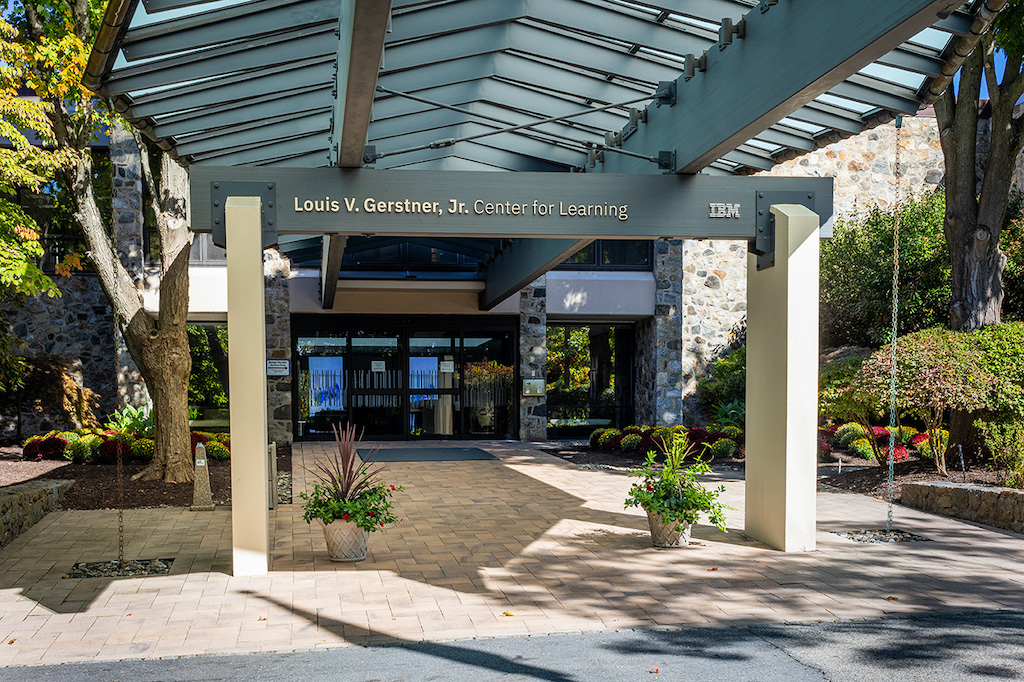
Developed by IBM and originally known as the IBM Learning Center, the Louis V. Gerstner, Jr. Center for Learning in Armonk is a dedicated environment serving the region as a centralized hub for employees and client education.
Gerstner – for whom the center was renamed in 2018 – was a former CEO of IBM and widely credited with transforming the company in the 1990s. Emphasizing leadership, culture and client focus, he cultivated those same principles of bringing leaders together in a setting that was purpose-built for learning, alignment and innovation.
The Westfair Business Journal recently spoke with Tom Spanos, the center’s director of sales and marketing, to learn more.
Asked what gap, if any, the center was designed to fill, Spanos described the gulf between traditional hotels and true learning environments:
“Most venues are built for lodging first,” he said, “(but) we were built for learning first, creating a focused setting where organizations can align, collaborate and achieve stronger outcomes.”
Every detail of the environment is intentionally designed to support learning outcomes:
“From identical guest rooms that remove hierarchy to distraction-free meeting spaces and a campus layout that encourages interaction, everything is aligned to keep participants engaged and connected.”
While hotels are built for volume, Spanos said, the center had been built “for focus.” And that has a direct effect on engagement, retention and overall results.

The center is operated by Flik Hospitality Group, founded in 1971 by Rudiger “Rudi” Flik and wife Julie, who back in the day ran the food service at Sarah Lawrence College in Yonkers. The Flik group is now a division of Compass Group USA, which specializes in premium corporate dining and conference environments. While IBM established the vision, Flik delivers the day-to-day experience, bringing hospitality, culinary excellence and operational expertise to the campus, Spanos said:
“Our relationship is highly collaborative. We work closely with Flik and IBM across all aspects of the guest experience. From program design to execution, ensuring that every interaction aligns with the center’s core purpose of supporting leadership development and focused learning.”
Many of the center’s clients operate in highly regulated industries, so privacy and discretion are essential. To that end, management routinely supports confidential meetings with controlled access, secure environments and flexible space configurations that ensure sensitive discussions remain protected.
Clients also increasingly expect meaningful sustainability practices, not just statements. Consequently, the center concentrates on practical, high-impact initiatives, such as eliminating single-use plastics, sourcing locally and reducing food waste, while maintaining a premium guest experience. The center also aligns with several United Nations sustainable development goals through tangible initiatives.

The last five to 10 years has seen a clear shift toward shorter, more focused programs with higher expectations for engagement and outcomes. At the same time, as Spanos sees it, hybrid capabilities and wellness considerations have become essential components of modern learning environments.
Regarding funding and financing, the center operates as a privately managed conference facility supported by corporate clients, associations and institutional organizations. Revenue is driven primarily by complete meeting packages, which bundle accommodations, dining and meeting services into a single model, including a day meeting package.
An especially interesting finding Spanos shared is that organizations are realizing the environment directly affects outcomes.
“Dedicated campuses eliminate distractions, improve focus and create shared experiences that are difficult to replicate in mixed-use hotels or conference centers that host multiple types of events.
“One of the biggest mistakes I see in hospitality is the belief that a venue needs to say ‘yes’ to everything, when in reality, the most effective environments are designed with a clear and singular purpose.”
The center’s Armonk location, meanwhile, has been a major factor in its long-running success, offering a unique balance of accessibility and seclusion, Spanos said.
“We are six minutes from Westchester County Airport and 35 minutes from Manhattan, set within a quiet, campus-style environment on 26 acres of IBM’s 440-acre campus.
“The center’s continued growth reflects the strength of Westchester as a hub for corporate activity, innovation and leadership development.”