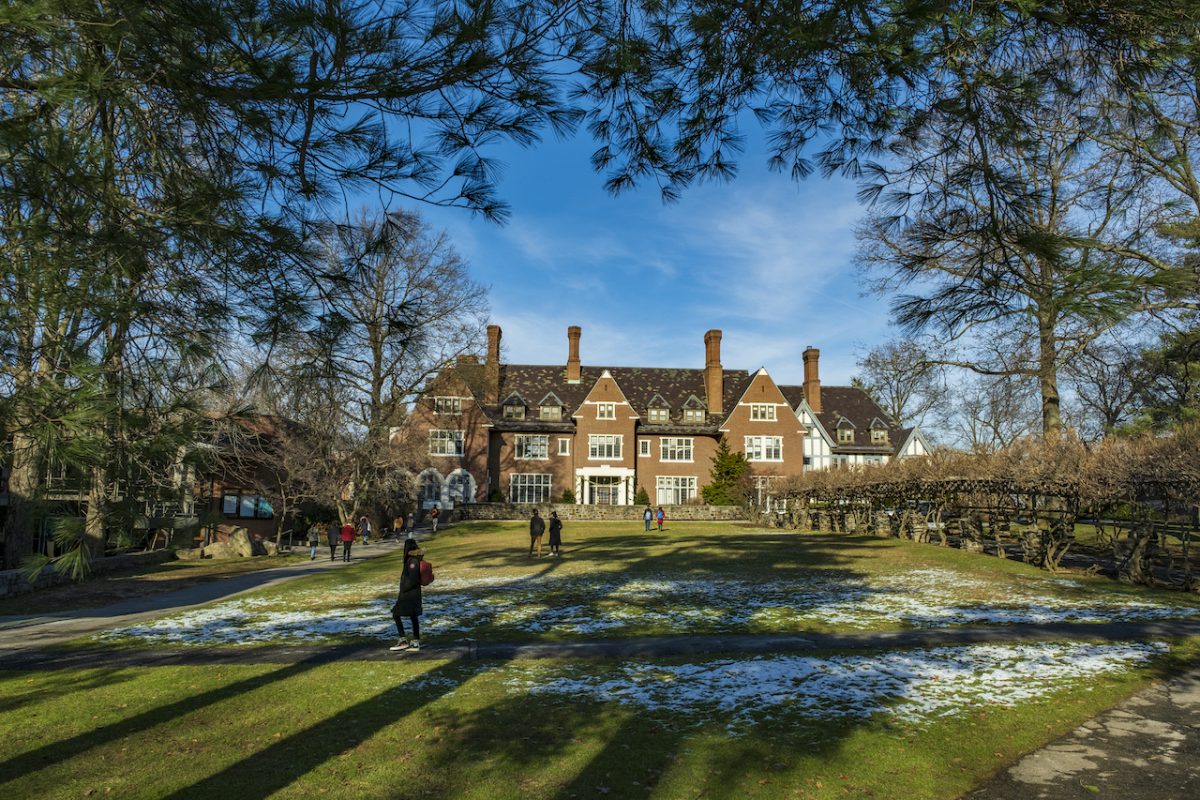
There are few institutions of higher education that have had a more defined image in the public imagination than Sarah Lawrence College (SLC) in Yonkers, which is rolling out its 100th anniversary celebration this year. That reputation is of a place that is smart and tony, one that puts the “liberal” and the “arts” into “liberal arts.”
It’s an image that has played out in works ranging from the novels “The Groves of Academe” by Mary McCarthy and “Pictures From An Institution” by Randall Jarrell – both of whom taught at the college – to such movies as “10 Things I Hate About You,” “The Notebook” and “Knives Out.”
But while the school’s academic success can be measured by any number of statistics – with 86% of students immediately going on to graduate school or employment – the rest of its image is more complex and nuanced.
Take the notion of wealth. While the annual tuition is $69,608 per year – among the highest in the United States – more than 80% of the college’s 1,490 undergraduates receive grants or scholarships, averaging $45,000-plus per package. The generous financial aid program is one reason Sarah Lawrence’s endowment ($168 million) pales in comparison to colleges like Swarthmore ($2.8 billion) and Williams ($3.9 billion), Sarah Lawrence President Cristle Collins Judd told the Westfair Business Journal in a Feb. 4 interview that included Patty Goldman, the college’s vice president of advancement and external relations.
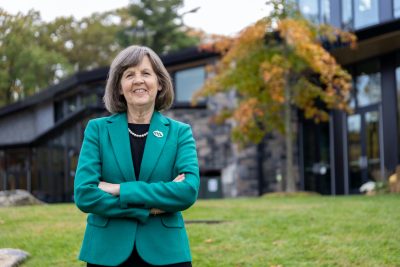
“We are a globally diverse community committed to the idea that every one of our students deserves to have the full experience of a Sarah Lawrence education,” Judd said, referring to a student body that hails from 43 different countries.
That experience is an intensive one, with small classes and a 10:1 student-faculty ratio that takes advantage of a don system in which each student works with a faculty adviser. In a school whose birthright is a pioneering approach to higher education, a student may study to be a physicist while also pursuing a passion for music, Judd said, adding that the manager of the school’s basketball team, junior and aspiring photojournalist Luca Mesiti, recently photographed LeBron James at Madison Square Garden.
Then there’s the idea of liberal arts in a job-minded era in which the utilitarian skills of a STEM (science, technology, engineering and math) education are in and the arts and humanities are out. While Judd said everyone graduates from Sarah Lawrence with a Bachelor of Arts degree in the liberal arts, students go on to an array of fields, including the arts, entertainment and media (39%); human services and education (34%); and STEM, business, law, government, advocacy and sustainability (27%). It’s a testament, she said, to the communication skills honed at the school and prized by the business world.
A school of firsts
Perhaps the least explored aspect of the college is its identification and engagement with the city of Yonkers (despite a Bronxville postal code, 10708) and Westchester County’s business community. (As early as the 1930s, Sarah Lawrence students were conducting studies on housing in Yonkers, Judd noted.) On Nov. 20 of last year, she and Goldman were on hand to accept a Founders Legacy Award from the Westchester County Association, the 75-year-old business advocacy group, as one of its charter members.
With the working world in mind, the college has repurposed an unused portion of its Performing Arts Center to create the Center for Experiential Learning that “brings together all the groups that help students to think about life beyond college,” Judd said. These include Career Services, Community Partnerships & Engagement, Global Education, Preprofessional Advising and SLC EmbeddED, which allows students to earn academic credit for internships, jobs, volunteering and other experiential work. (Currently, students intern at organizations ranging from Credit Suisse to the United Nations to sports film agencies.)
The center, which will feature a co-working space, will open mid-year near the entrance of the 44-acre campus, a mix of Tudor-style and Modernist buildings, and its HUB, a center for Humanity, Understanding and Belonging that reimagined the former Ruth Leff Siegel Center on the site of the old Pub, where students would gather to fuel themselves with coffee before class. (Today, the HUB is home to everything from shabbat dinners to Muslim iftärs, the sunset meals that break the Ramadan fast; LGBTQ gatherings; and even Judd – a native Texan with four music degrees who came to the college in 2017 from The Andrew W. Mellon Foundation – cooking for the school’s sports teams.)
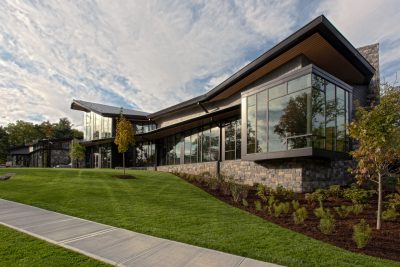
The Center for Experiential Learning is also near The Barbara Walters Campus Center, part of a $200 million capital campaign that ended in 2019 and named for the groundbreaking TV journalist (NBC’s “Today” show and ABC’s “20/20” and “The View”) who, Vice President Goldman observed, always said Sarah Lawrence taught her how to ask questions. (Other noteworthy alumni include filmmakers J.J. Abrams and Brian DiPalma; novelist Alice Walker; Hope Cooke, the former queen of Sikkim; actress Joanne Woodward; and Maggie Haberman, a White House correspondent for The New York Times and CNN analyst.)
The school is as renowned for its contributions to science as it is for its pipeline to the arts and media. Fall 2024 marked the launch of a new master’s degree in Genome Health Analysis, developed in partnership with New York University’s Grossman School of Medicine. The collaboration between SLC’s graduate program in human genetics and Institute for Genomics Education, Workforce & Leadership and NYU’s Vilcek Institute of Graduate Biomedical Sciences offers a reminder that among its many firsts, Sarah Lawrence’s Human Genetics Graduate Program was the first master’s-level genetic counselor training program in the United States.
Today, the Joan H. Marks Graduate Program in Human Genetics is the nation’s largest such program and has trained more than half of the country’s genetic counselors. (With 225 graduate students, Sarah Lawrence College also offers a range of specialized master’s degrees in such fields as creative writing, dance and theater; dance/movement therapy and health advocacy; and the art of teaching, child development and social work, with master’s candidates in the last group benefitting from their interactions with children ages 2 to 6 in the college’s pioneering Early Childhood Center (ECC), established in 1937.
Sarah Lawrence also created one of the first of its kind, The Center for Continuing Education (CCE), in 1962; the first graduate program in women’s history, in 1972; and the first master’s degree in health advocacy programs, in 1981. Its Heimbold Center for the Visual Arts, opened in 2004, was the first LEED-certified visual arts building in any college or university.
Founding fathers – and a founding mother

Firsts and business are baked into Sarah Lawrence’s DNA. The school was founded by real estate mogul William Van Duzer Lawrence (1842-1927), whose imprint on Bronxville included The Lawrence Investment Co. (1888), which ultimately evolved into Houlihan Lawrence, billed as the No. 1 real estate brokerage north of New York City; Lawrence Hospital, now NewYork-Presbyterian Westchester; and the Lawrence Park Historic District of 94 buildings; along with Yonkers’ adjacent Lawrence Park West neighborhood. With the 1926 death of his wife, Sarah Bates Lawrence, a lifelong advocate of higher education for women, Lawrence decided to donate his Yonkers home and lend his wife’s name to establish a junior college for women.
But the man who is often credited with putting the progressive education into Sarah Lawrence was Henry Noble MacCracken, then president of Vassar College in Poughkeepsie. MacCracken saw in Lawrence’s plan an opportunity to go beyond the traditional academic strictures of Vassar and the other Seven Sisters colleges (Barnard, Bryn Mawr, Mount Holyoke, Radcliffe, Smith and Wellesley), to create an experimental school more in tune with a focus on students and women’s changing roles in society. MacCracken served as the chairman of Sarah Lawrence’s board of trustees from 1926 to’ 36. During his stewardship, the school welcomed its first students (1928), graduated its first class (1929), received an absolute charter to award B.A. degrees (1931) and began doing so (1933).
In 1946 the first men were admitted under the G.I. Bill, and a year later the school changed its name from Sarah Lawrence College for Women to Sarah Lawrence College. (It officially became coeducational in 1968.)
The 21st century — and beyond
In another milestone for the school, Sarah Lawrence hosted a sitting U.S. president for the first time when Joe Biden visited the campus in 2022 for a “Get Out the Vote” rally in support of Gov. Kathy Hochul and other New York Democratic candidates.
Despite its prestige, however, the college has not been without controversy. Since December 2024, there has been an investigation by the U.S. Department of Education’s Office of Civil Rights into alleged antisemitism on campus. The probe, which includes possible Title VI violations, stems from a complaint filed by Hillels of Westchester, a Jewish student advocacy group, that said the college fostered a “hostile environment” for Jewish students, failing to address harassment after the Oct. 7, 2023, Hamas attack on Israel and the subsequent war that has sparked global campus protests and unrest.
In our interview, Judd said, “We believe strongly in freedom of expression, but it has to be balanced by a culture of respect.”
“In the course of our 100-year history, we’ve stood by those values,” added Goldman, whose résumé includes a Bachelor of Arts with honors in social anthropology from Harvard University, a Master of Fine Arts from the University of Southern California and stints at the March of Dimes, NewsCorp, Disney and Warner Bros.

The welfare and education of the students remain the focus of the school, Goldman and Judd added, as it looks to a series of centennial celebrations. But these won’t be marked by galas and fundraisers. Rather, the emphasis will be on expanding education, “leaning into lifelong learning,” Judd said, with a new director of that discipline, James Stakenburg, and new opportunities for the broader community. These include a slate of noncredit extension courses and workshops for adults, precollege credit programs for high school students and the Signature Learning Community, a membership program designed for adults 55 and older.
Programs rather than parties: Sarah Lawrence continues to go its own way.

The author holds a Bachelor of Arts and Master of Arts degree in critical writing from the college.