At a time when Mattel is modernizing — some would say Barbie-fying – part of its American Girl line of historical dolls, Yes She Can Inc. is providing neurodivergent individuals with job skills by training them to refurbish donated American Girl dolls that are sold, along with donated companion books, clothing and accessories, at the nonprofit’s Girl Again store in the heart of downtown White Plains.
“We’re giving them business practice skills in everything from quality assurance to marketing,” said Robin L. Davies-Small, M.Ed., Yes She Can’s executive director, along with the softer, social skills that often challenge the neurodivergent. The term refers to those who function mentally and neurologically in a way that is atypical. It is often used to describe those on the autism spectrum.
On the day we visited – a late-winter morning that was both characteristically frigid but uncharacteristically brilliant – the store offered some welcome warmth, humming with activity as the trainees worked at a long table that is deliberately visible to customers. Soon it was time for a movement break – studies have shown workers are more productive if they periodically get up and move around, Davies-Small said – and then lunch, the trainees flowing seamlessly from one activity to another.
For the 20 individuals – despite the name Yes She Can, the nonprofit has male as well as female trainees – in the Work Skills Training program, refurbishing the dolls is a path to employment success.
The 16-week program, which runs on a tri-semester basis, is one of three Yes She Can programs. Peer Connect has three students ages 14 to 21 with the hope of expanding to 10, Davies-Small said. It’s designed to build self-awareness and self-confidence as participants consider what they want to do beyond high school. These two programs are fee-based.
The free Mentorship program pairs 10 participants with 10 business mentors, including a chef, a librarian and representatives from Regeneron and Toyota.
Besides program income – which accounts for 22% of Yes She Can’s $726,000 operating budget – the nonprofit receives grants from the local, state and federal governments as well as foundations and corporations (32%) store revenue (27%), individual donations (14%) and money from special events (5%). Last year, supporters donated 11,000 items to Girl Again – including dolls, clothing and accessories – with sales of about $100,000. The store sets its price points below that of what new dolls sell for. Customers can expect to pay from $50 to $115 for a doll. (They generally range in price from $65 to more than $275). With clothes and accessories, fans can easily drop $1,000 on a visit to an American Girl Place, like the one in Manhattan, Davies-Small said, adding, “They’re not going to do that here.”
A phenomenon is born
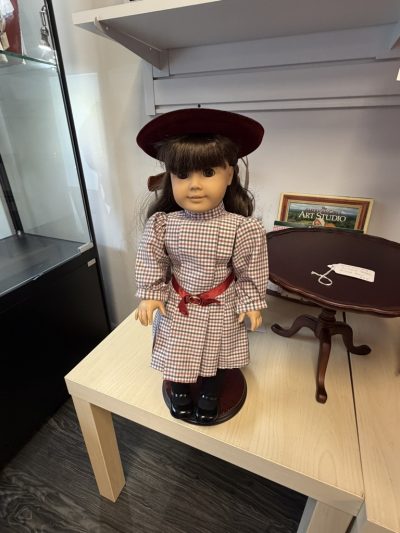
However, when Mattel “retires” a doll, as the company periodically does, it can have a beneficial effect on Girl Again’s offerings – occasionally big time. A rare Kirsten Larson doll, which tells the story of a Swedish girl growing up on a farm in 1854 Minnesota, sold for $2,500.
It helped that it was signed by Pleasant T. Rowland, an educator, journalist and textbook publisher who came up with the idea of teaching American history through a series of dolls and books representing fictional girls living in various periods. In 1986, she founded Pleasant Co. in Wisconsin to manufacture the first of the American Girl dolls – including Kirsten; Samantha Parkington, an orphan growing up amid the Gilded Age’s wealth and reforms; and spirited Molly McIntyre, doing her part on the home front during World War II – using most of the $1.2 million in textbook royalties that she had saved. In the first two years, the company’s sales grew from $1.7 million to $7.6 million.
Over the years, American Girl introduced Historical Character dolls of various races and ethnicities. (Addy Walker, a fugitive slave who escapes to Philadelphia, became the first Black American Girl doll in 1993.) Pleasant Co. also produced two other lines of dolls – Bitty Baby and the diverse, contemporary Truly Me. (Some of these are available at Girl Again.)
In 1998, Rowland sold her company to Mattel, makers of Barbie, for $700 million (about $1.4 billion in today’s money). Since then, Mattel has looked to update the brand, with Girl of the Year, featuring contemporary dolls facing today’s problems until they are retired at the end of the year; and custom-made Create Your Own dolls. For American Girl’s 40th anniversary, however, Mattel hit a nerve with its contemporary iterations of the first six historical dolls, which include Revolutionary War era Felicity Merriman and Josefina Montoya, who lives on a ranch in 1824 New Mexico, as well as Kirsten, Samantha, Molly and Addy, shrinking them from 18 inches to a more svelte 14 ½ inches.
“I’ve heard they’re making it more like Barbie,” Davies-Small said of the main criticism being leveled at Mattel (MAT), whose 2025 fourth-quarter earnings and 2026 guidance missed market expectations, causing significant stock price drops. Though the company had scored a marketing coup with the 2023 billion-dollar blockbuster “Barbie” film, grossing more than$125 million and seeing Barbie doll sales rise 16% in the third quarter of that year, the road has since been rockier. Q4 2025 net sales grew 7% to $1.76 billion, but net income declined to $106 million due to higher costs, weak U.S. demand and inventory pressures.
Other critics have noted that the addition of contemporary versions of some of the historical dolls suggests the continuing dissolution of historical education, with the National Assessment of Educational Progress (NAEP), often called “The Nation’s Report Card,” noting that 40% of eighth graders scored “below basic” in history in 2022.
Being seen and heard
Nonetheless, some fans have observed that the new dolls still look like girls — the characters are generally 8 to 14 years old — and may even offer an entrée to the potentially more collectible historical dolls, such as those on American Girl’s website and at Girl Again. And that’s fine with Davies-Small, who became executive director of Yes She Can in August 2022, a month after the nonprofit and Girl Again moved to its current location at 10 Church St., across from Grace Church and a short walk to City Center. The new locale doubles the organization’s footprint to 1,650 square feet and increases its visibility from its old locale in the shadow of the financial district on the edge of the city.
Greater visibility for Yes She Can, Girl Again and the neurodivergent community is key for Davies-Small, who grew up a severe asthmatic on Long Island, yearning to help the disabled.
“My parents made accommodations, not excuses,” she said of their approach to her asthma.
A mentally ill aunt whose condition wasn’t taken seriously only fueled her desire to make the mentally and emotionally marginalized seen and heard. She earned a Bachelor of Science degree in special education and elementary education with a minor in psychology and a Master of Educational Administration degree specializing in nonprofit administration at Boston University; worked at a number of Arcs, which advocate for those with intellectual and developmental disabilities; served as director of Westchester Jewish Community Services’ (WJCS) Shelanu program for young adults with autism; and worked as a consultant.
At Yes She Can, she took over from the retiring Marjorie Madfis, a former IBM-er who founded the organization in 2013 out of her frustrations at the lack of programming and professional options for daughter Izzie, who is autistic and an American Girl buff. (Today she works one day a week at Girl Again and has another job, Davies-Small said.)
Approximately 5.4 million-plus adults in the U.S. live on the autism spectrum. According to the Centers for Disease Control and Prevention (CDC), one in 31 (about 3.2%) of 8 year olds are diagnosed with autism, with the prevalence rate among adults estimated at 1 in 45. And while there are genetic and possible environmental factors at play, the Mayo Clinic backs the preponderance of studies that says there is no link between vaccines and autism.
One reason for autism’s seeming prevalence may be a growing awareness. And with awareness comes greater acceptance, Davies-Small added. She is strengthening that acceptance, hence the training area of Girl Again being visible to customers, who are waited on by the trainees. (Yes She Can also has nine employees.)
There are also two annual community events. One is the April 30th fundraiser, the “Voices in Autism Leadership Awards,” which will be held from 6 to 8 p.m. at The Mansion on Broadway in White Plains. (April is World Autism Month.)
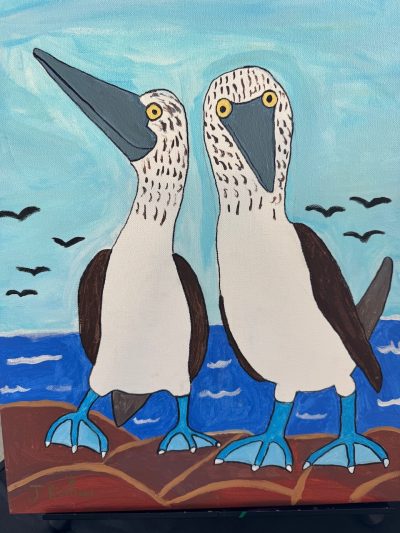
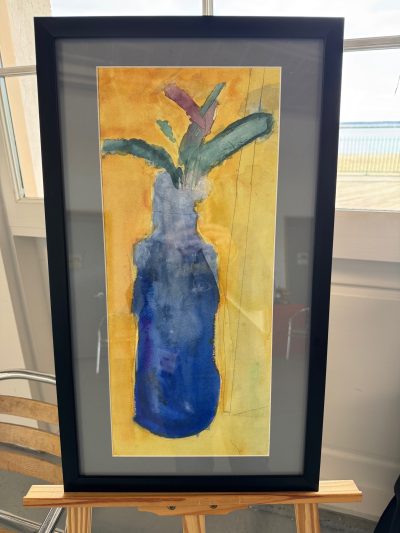
The second is the October art show for neurodivergent artists, held at the Westchester Children’s Museum at Playland in Rye.
“I want to build Yes She Can into a strong nonprofit,” Davies-Small said. “We’ve added birthday parties, craft projects and a collaboration with the Girl Scouts.”
All of which suggests that while some of the American Girl dolls may be shrinking, Yes She Can and Girl Again are only getting bigger.
Girl Again, 10 Church St. in White Plains, is open 11 a.m. to 4 p.m. Sundays; 11 a.m. to 2 p.m. Tuesdays; 11 a.m. to 5 p.m. Wednesdays, Thursdays and Fridays and 10 a.m. to 5 p.m. Saturdays. 914-358-1460.
For tickets to the April 30 “Voices in Autism Leadership Awards,” click here.