Perhaps the biggest trend in retail, hospitality and thus commercial real estate has been the quest to give consumers an experience.
“People leave their homes for what they can’t stream,” said Anthony Giallanzo, CEO of No Limit Ninja Yonkers, a 10,000-square-foot Ninja obstacle course gym in the city’s Alexander Smith Carpet Mills Art District. Or, for that matter, for what they can’t buy online.
Giallanzo was among the panelists for “An Experiential Economy: The Transformation of Retail and Hospitality,” presented Wednesday, Feb. 25, by the Rye Brook-based Business Council of Westchester (BCW) and Fordham University’s Real Estate Institute, part of its School of Professional and Continuing Studies in The Bronx. (The in-person event was switched to a webinar due to the recent spate of hazardous weather.)
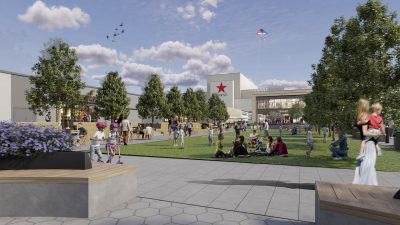
It was nonetheless not without what moderator Marsha Gordon, DBA, BCW’s president and CEO, called “breaking news”: Craig Deitelzweig, president and CEO of Marx Realty at the Cross County Center in Yonkers, announced a new “front door” for the multipurpose center – a four-acre park with a boardwalk and an allée of trees along with two buildings comprising 58,000 square feet of space that has as of this writing been 98% leased.
The 71-acre, 1.15-million-square-foot complex – which was born in 1954 as what Deitelzweig called “the first open-air shopping center in the country” – is an excellent example of the transformation of hospitality, real estate and retail, dropping “shopping” from its name to signal more than 100 offerings for 14 million visitors. These include dining, with almost a dozen food operations added in the last few years: hotel accommodations (Hyatt Place. Yonkers); medical services (Montefiore Medical Group – Cross County); summer and holiday festivals as well as other events; yoga in the park; and yes, shopping at stores like The Gap, H & M and Zara, which in turn must offer experiences, or, Deitelzweig said, they’re out.
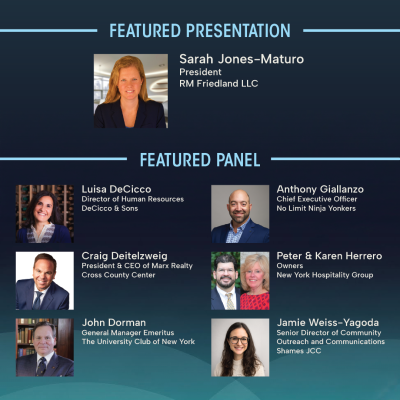
Cross County Center could be said to encompass what Sarah Jones-Maturo – president of RM Friedland LLC, the largest commercial brokerage in Westchester – described as the five Fs of the experiential economy – fun, family, fitness, food and fashion. Jones-Maturo offered a succinctly comprehensive account of the nation’s shift from an agrarian economy dominated by agriculture to an industrial one of manmade goods to a service-oriented society to our experiential present, briefly halted by Covid but reemerging. It is a present driven by millennials and Gen Z, who while “capitally constrained” in comparison to boomers are still willing to spend on social activities IRL (in real life), Jones-Maturo said. Among the examples of the five Fs, she added, are The Waterfront retail/entertainment center in Port Chester, and Edge-on-Hudson, a Sleepy Hollow community that so far has luxury residences, parks, trails, a waterfront promenade and a DeCicco & Sons gourmet market with second-floor dining and river views.
The experiential economy has also given rise to such off-price retailers as TJ Maxx, Marshalls, HomeGoods and Homesense, part of The TJX Companies Inc., and the decline of the big box stores, with Target among the notable exceptions in Westchester. Ross Dress for Less, a group of discount stores headquartered in Dublin, California, is also looking to make inroads in our area. As a result, Jones-Maturo said, Westchester has seen a retail market growth of 1.5 million square feet from 2019 to 2024 that includes Wegmans and Life Time Fitness, both off Westchester Avenue in Harrison.
The new economy reflects but also shapes the way we work, study and live. Panelist Luisa DeCicco, director of human resources at DeCicco & Sons, which has 11 markets in Westchester and Putnam counties, said the training of employees – 60% of whom are full-time – reflects a place that is more than shopping and service. “Every employee is a concierge.”
Anthony Davidson, dean of Fordham’s School of Professional and Continuing Studies, said that its hospitality programs are part of the school’s Real Estate Institute, because of the inextricable link between the two industries.
Panelist Jamie Weiss-Yagoda, senior director of community outreach and communications at the Harold & Elaine Shames Jewish Community Center on the Hudson in Tarrytown, added that members could spend the day and night at the Shames JCC, going from a yoga or art class, a swim or a lecture to an evening at The Ark, the center’s new theater and event space.
“We meet our customers where they are,” added Peter Herrero, who owns New York Hospitality Group in White Plains with wife and fellow panelist Karen Herrero. Those customers may be patrons of their Sam’s of Gedney Way restaurant, attendees of a catered event or patients visiting one of White Plains Hospital’s cafés. Wherever they are, the more than 90-year-old company’s 156 employees make eye contact and repeat the customers’ names, Peter Herrero said.
“People want social connections,” said panelist John Dorman, general manager emeritus of The University Club of New York.
And to deepen old acquaintances and make new ones, even if they are sometimes eating, drinking and spending less.
Perhaps the five Fs should include a new one, Deitelzweig suggested – friendship.