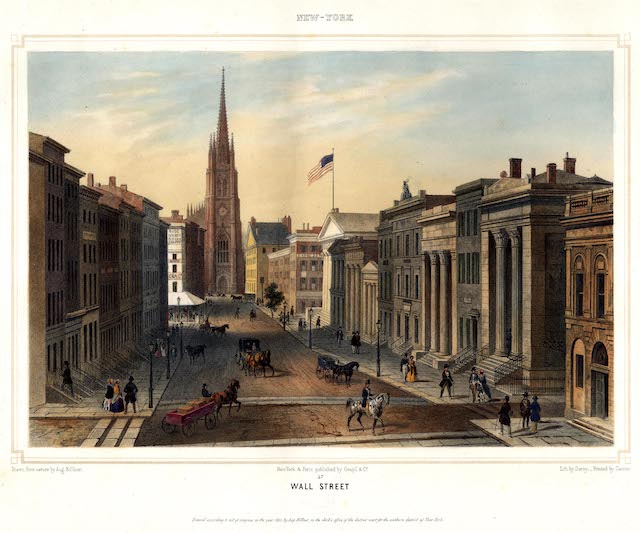
Wall Street: The very name conjures images of wealth, power and control with all the distrust, ridicule, envy and ambition that these inspire.
But the 21st century didn’t invent Wall Street or such related issues as media mockery of the one-percenters (Jeff Bezos’ wedding, anyone, everyone?); and women and minorities looking to break “the Street’s” glass ceiling. Those seeds were planted in the 18th century to bloom in the “Gilded Age,” the period between the end of the Civil War (1865) and the beginning of World War I (1914), when enormous industrialization and economic growth coexisted with political corruption, wealth inequity and poverty. (The phrase was coined by author-friends – and Hartford residents – Mark Twain and Charles Dudley Warner to underscore this disparity as gilding is often used to suggest pure gold, disguising baser materials.)
Now a new exhibit turns its eye on Wall Street in the Gilded Age – and a not-so-distant lens on our own. “Bulls of Wall Street: High Finance, Power, and Social Change in Victorian America” – opening Thursday, Sept. 4 at The Lockwood-Mathews Mansion Museum in Norwalk – includes period artifacts, photographs, documents and costumes from public and private collections, set amid the Second Empire elegance of what was financier LeGrand Lockwood’s summer home.
“This exhibit will examine the business and social dynamics that led to the emergence of a capitalist society in America,, reflected in the Wall Street life and experiences of…Lockwood,” museum consultant and exhibit curator Stacey Danielson said in a statement. “It will also consider the similarities and differences between the Gilded Age era and today.”
The story of Wall Street begins 400 years ago when the Dutch West India Co. founded New Amsterdam on the southern tip of Manhattan island, creating a stockade (wall) from which the street gets its name that ran from what is now Broadway to the East River.
While the mercantile Dutch would cede New Amsterdam in 1664 to the English, who renamed the colony for King Charles II’s brother, the Duke of York (later James II), they had set in motion New York’s financial destiny. It was cemented by the Compromise of 1790 in which Alexander Hamilton, President George Washington’s Treasury secretary, agreed to allow what is now Washington D.C. to become the nation’s capital — something Southern Founding Fathers Thomas Jefferson and James Madison favored — in exchange for being able to consolidate and fund the states’ Revolutionary War debt by floating federal bonds to pay it off.
This freed New York, the first capital of the country, to become its financial capital instead, although John E. Herzog, a lender to the exhibit who spearheaded the expansion of Herzog, Heine, Geduld Inc. into the third-largest NASDAQ market maker and founded the Museum of American Finance in Manhattan, said this was a more complex process, gradually spurred by the city’s location and commerce. But he lauds Hamilton as the key figure in creating a centralized economic system, complete with a national bank and support for American manufacturing, that has shaped the global economy and will, he added, continue to do so.
Hamilton’s actions also provided the framework for the establishment of the New York Stock Exchange (NYSE). In response to the new nation’s first financial panic, 24 stockbrokers came together outside 68 Wall St. on May 17, 1792 yo sign an agreement that established the regulations for trading securities. The Buttonwood Agreement – named for the buttonwood (sycamore) tree under which the brokers originally traded – “would become the foundational document of what officially became the New York Stock Exchange in 1863,” Danielson said.
As the exchange grew – from informal gatherings in neighboring coffeehouses; to, in 1817, the New York Stock & Exchange Board, which rented a room at 40 Wall St. with chairs for brokers to trade 30 stocks and bonds, hence the phrase “a seat on the stock exchange,” Herzog said; to its permanent Georgian-style home in 1903, complete with a brass opening bell — it spurred a new class of wealthy entrepreneurs considered titans of industries by some, “robber barons” by others.
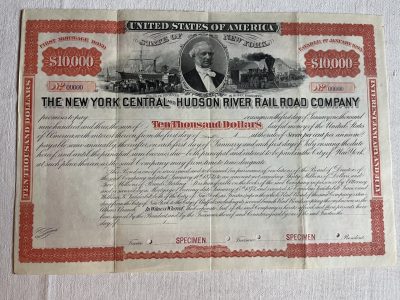
Lockwood, NYSE treasurer and a director of Cornelius “the Commodore” Vanderbilt’s New York Central and Hudson River Rail Road Co., Vanderbilt himself and Jay Gould, the railroad speculator who made Lyndhurst in Tarrytown his country home, were among the cutthroat, bold-faced names of the era, along with John D. Rockefeller, founder of Standard Oil. Co., and J. Pierpont Morgan, head of the banking firm that ultimately became JPMorgan Chase & Co. But they weren’t the only ones.
The exhibit considers Jeremiah G. Hamilton, described as “the only Black millionaire in New York” in the decade before the Civil War. A ruthless entrepreneur who was also the victim of racism, Hamilton took on Wall Street’s elite, earning him the nickname “the Prince of Darkness” and a $2 million fortune (about $58.7 million today).
In a man’s world, three women stood out. Hetty Green’s honest, disciplined approach to investing and lending – she was a proponent of value investing, “buy low, sell high” and financial literacy for women – enabled her to build on her family’s whaling fortune and to help bail out New York City in the Panic of 1907, when the NYSE fell 50% from its peak of the previous year. Sisters Victoria Claflin Woodhull and Tennessee Claflin would overcome poverty and parental abuse to open the first woman-owned Wall Street firm, Woodhull, Claflin & Co., on Feb. 14, 1870, soon a hit with a heretofore untapped female market, everyone from Gilded Age matrons and matriarchs to businesswomen, actresses and even madams and high-priced prostitutes.
“These women were pioneers. They made their way on their own terms,” said historian-author Sheri Caplan, adviser to the exhibit on the history of women in finance – a sector in which women and minorities have made strides but have not achieved parity in representation, leadership roles and compensation. In an age of excess, Green was frugal to the point of miserliness, her well-worn black garb helping to earn her the nickname the “Witch of Wall Street.” Woodhull and Claflin – whose firm was backed by Vanderbilt, reportedly Claflin’s lover – later published a newspaper, Woodhull & Claflin’s Weekly, advocating for women’s rights and free love.

Their individualism “led to success, but it also made them objects of ridicule in private and public,” Caplan said.
A cartoon from the New York Evening Telegraph – dated Feb. 18, 1870, four days after Woodhull and Claflin opened their firm – depicts the sisters driving a team of bulls and bears with the faces of Vanderbilt and company as their carriage rolls over men and man-faced birds.
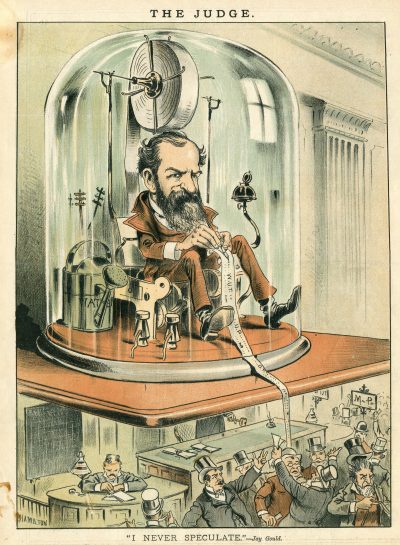
Another cartoon, circa 1886 and title “The Judge,” shows Jay Gould sitting on a throne inside a stock ticker machine, introduced in 1867, as traders run amok, with a caption that quotes the speculator saying: “I never speculate.”
In the age of the anonymous internet, our satires on the haves and have-mores are “much more scathing,” Danielson said.
A key difference between Wall Street then and now is that there are more vehicles for trading equities and more regulatory bodies, said Herzog, whose loans to the show range from photographs and newspaper illustrations to unissued bonds. Today, the NYSE is the largest stock exchange in the world, with a total market capitalization of $37.1 trillion as of May and some 2,800 companies representing everything from blue chips to high growth ventures. Right behind the NYSE is the NASDAQ (the National Association of Securities Dealers Automated Quotations), founded in 1971, with a total market capitalization of $29.9 billion. Approximately 3,890 companies trade on the electronic NASDAQ, with a heavy concentration of technology and growth businesses.
They’re overseen by such organizations as the Securities and Exchange Commission (SEC), which came out of President Franklin D. Roosevelt’s New Deal program in 1933, and the Financial Industry Regulatory Authority (FINRA), a self-regulatory organization (SRO) authorized by Congress and operating under the SEC.
They bring us full circle to that May day in 1792 when a group of concerned brokers sought to regulate their nascent industry to stave off a young nation’s financial panic, and the stock exchange was born.
“Having good rules ensures the nation’s progress,” said Herzog, a Southport resident. And that in turn, he added, benefits its individuals.
There will be a reception for “Bulls of Wall Street: High Finance, Power, and Social Change in Victorian America” from 5:30 to 7:30 p.m. Thursday, Sept. 4, at Lockwood-Mathews Mansion Museum, 295 West Ave. in Norwalk. RSVP to info@lockwoodmathewsmansion.com, or 203-838-9799, ext. 113.