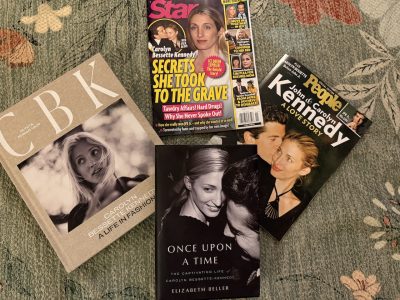
Although John F. Kennedy Jr. and his wife, Carolyn Bessette Kennedy, have been gone for almost 27 years – in the July 16, 1999 crash of a plane he was piloting that also took the life of her sister Lauren Bessette – they are having a media moment. It’s one that goes beyond the usual commemoration of celebrity death anniversaries (the 2024 release of two books, Elizabeth Beller’s “Once Upon a Time: The Captivating Life of Carolyn Bessette-Kennedy” and Sunita Kumar Nair’s “CBK: Carolyn Bessette Kennedy: A Life in Fashion”) and the controversial limited series “Love Story: John F. Kennedy Jr. and Carolyn Bessette,” which was based on “Once Upon a Time” and which some critics have said plays fast and loose with the truth. (Recently, actress Daryl Hannah took the unusual step of writing a guest essay in The New York Times that denounced the portrayal of her in the series as JFK Jr.’s “irritating, self-absorbed, whiny and inappropriate” ex-girlfriend.)
Is the fascination with JFK Jr. and CBK – as she is known to Gen Z – about the Kennedy mystique or something else? Manhattanville University President Frank D. Sánchez, Ph.D., also sees a kind of nostalgia for the 1990s, the last analog decade, on the part of Gen Z, those born between 1997 and 2012, who are considered the first generation to be entirely of the digital age.
The generation that’s glued to its screens finds it’s not so easy to escape them. While there were tabloids and plenty of TV options in the ’90s, there was no 24/7 social media to stoke insecurity and loneliness, fear and hate.
Sánchez is not alone in seeing a nostalgia for a technologically simpler but also freer time. In another New York Times piece, author and podcaster Glynnis MacNicol paints a portrait of New York in the years before 9/11 as a kind of summer before the dark. Though the ’90s started slowly, the stock market went on a tear — as did the New York Yankees — while the Disneyfication of midtown Manhattan helped remake New York’s image as a safe, approachable big city.
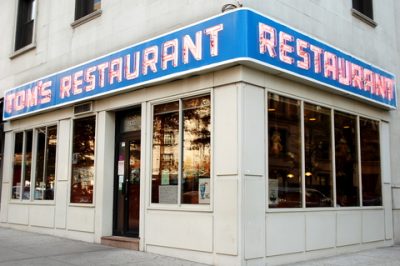
| Dreamstime.com.
It was a time when someone like Carolyn Bessette, who came from a well-to-do but by no means über-rich Greenwich family, could move to Manhattan and work and play hard, rising to director of publicity and director of show productions for the Calvin Klein Collection. That is not necessarily the case today. According to Reddit, “while the minimum wage and median household income in New York City have more than doubled, average rental prices have nearly quadrupled in many sectors.” In the 1990s, 30% of a New York City resident’s income went to rent. Today, it’s more than half.
That’s if you have an income. With older employees working longer and AI looming, those wished-for, $90,000-a-year entry-level jobs are drying up. In an ironic twist, the very STEM education today’s students have focused on may be limiting their options as employers look for hires who possess communication(s) and people skills as well as maturity and experience.
Not the least aspect of Gen Z ‘s interest in the 1990s is the fashion – JFK Jr.’s seemingly effortless elegance but especially Carolyn’s minimalist, monochromatic wardrobe that allowed texture rather than color to carry the day, attracting even as it receded. It was a style designed to protect and even arm the wearer, not unlike the approaches of two first ladies on opposite ends of the political spectrum – Melania Trump and Rama Duwaji, wife of New York City Mayor Zohran Mamdani.
A recent sale of 25 items from the CBK wardrobe by The Fashtion Auctioneer brought in $408,750, with a record $192,000 for her Prada camel coat. And a “CBK Edit” of her fashion looks regularly pops up on influencer blogs and podcasts and in lifestyle feeds.
For all the decade’s quiet luxury, however, the ’90s were not without their challenges — “heroin chic”; school shootings; the 1996 Oklahoma City bombing; the marginalization of the mentally ill and the rise of homelessness; a gentrification of cities like New York that shut out the working and middle classes; the failure to get out in front of the new technology; the outsourcing of jobs and factory closures.
In many ways, then, the ’90s were not only a symbol of a golden past but a creator and harbinger of our troubled present.