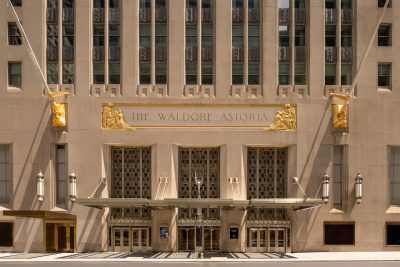
We are standing in the impossibly grand Park Avenue lobby, the first space you encounter after climbing the stairs at the Waldorf Astoria New York’s main entrance. Underfoot is the artist Louis Rigal’s 18-foot “Wheel of Life” circular mosaic, containing 148,000 hand-cut marble tiles, while in the corner pockets of the lobby, diners are experiencing the Kaiseki menu at the hotel’s new Japanese restaurant, Yoshoko. It’s “the pinnacle of Japanese culinary tradition, reimagined through a distinctly New York lens,” according to the blurb, and its menu, according to our tour guide, Charlotte Kriftcher, is “a nod to the hotel’s very international clientele.”
Some nod. Some clientele. Some hotel, you might very well say, and you’d be right.
A collaboration between cousins and competing hoteliers William Waldorf Astor and John Jacob Astor IV, the hotel – an amalgamation of the Waldorf and Astor hotels, which originally stood on the site of what was to become the Empire State Building – opened as the Waldorf Astoria on its new site on Park Avenue between 49th and 50th Streets in 1931. Its last major renovation was in 1980.
Now, after an eight-year closure and change of ownership – the new owners are Chinese, while Hilton remains the operator – the covers are at last off and facts, figures, proportions, opulence and the sheer scale of the project can make your head swivel. Take size, for one thing – an entire city block. Stand at the top of the staircase at the hotel’s Park Avenue end and, with the tiniest flick of your eyes to get around the Waldorf Astoria’s renowned gilt clock, you can see all the way to Lexington Avenue at the far end.

Ah, that clock. Commissioned by Queen Victoria for the World’s Columbian Exposition in Chicago in 1893 to showcase British craftsmanship, it was built by Goldsmith’s Co. of London and later bought by John Jacob Astor IV. It stands at the center of Peacock Alley, the huge public lounge at the hotel’s core, giving rise to the expression “Meet you at the clock.”
And the Peacock Alley piano? It was Cole Porter’s. He lived in the Waldorf Towers from 1935 until his death in 1964. The piano, a Steinway, was gifted to him by the hotel, and – come rain or come shine – it is still played every day from 5 p.m. on.
Following the grand restoration, the number of hotel rooms – “keys” as they’re known in the industry – is down from 1,400 to 375, with 372 private one- to four-bedroom residences added. Sales for the residences are apparently robust.
But as we toured the hotel’s magnificent public rooms, looking drop-jawed at its vast marble columns; marching along its broad, seemingly unending indoor promenades; and gazing up at its impossibly tall ceilings, “grand” became an increasingly inadequate way to describe any of it. You could fly a small airplane up there above Peacock Alley and, believe me, the people eating, drinking and schmoozing below probably wouldn’t even notice.
One floor above, a “transitional” space known as the silver corridor – with 16 murals representing the four seasons and the 12 months of the year – leads to some of the hotel’s 43,000 square feet of cutting-edge event space, comprising 14 private rooms over two floors.
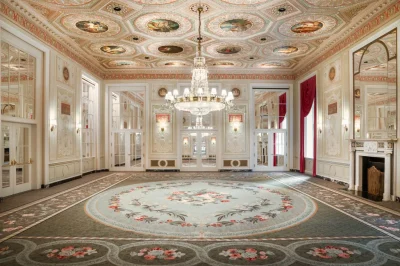
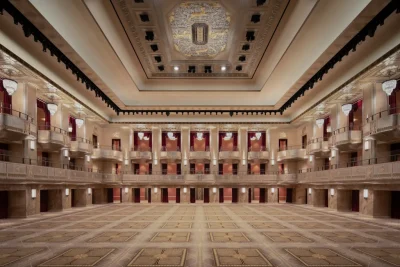
Among them is the breathtaking Basildon Room, whose 18th century crown moldings, chandeliers and artwork are all original. They were shipped from the 18th century Palladian mansion, Basildon Park, in England, making it the “oldest” room at the Waldorf. The Jade Room, another glorious space with its marble columns, has been opened up so that it now has natural light. And the three-story Grand Ballroom, with its vast stage, its balconies framed with red velvet drapes – it was home to the early Metropolitan Museum galas – has been restored to its former and very considerable glory. Able to host 1,500 guests, it is arguably the most magnificent ballroom in the city.
Up in my junior suite – the hotel had graciously invited me to stay the night – fixtures, fittings and general decoration, while of the highest caliber, were more restrained than in the public spaces, a good call, I thought, from the studio of designer Pierre-Yves Rochon. The palette was neutral, almost monochromatic; the gadgetry functional, but not overwhelming; the Kallista hardware in the bathroom handsomee; and theminibar treats from “Esprit Gourmand” of Paris particularly tempting. (I certainly was tempted.)
Little restraint had been shown with regard to the use of marble, however. There were what seemed like acres of it. Indeed, between the guest bathrooms and the public spaces, I’d be surprised if there were any marble left in the quarries of Carrara after the Hilton people had come a-calling.
“The Dead Duke, His Secret Wife and the Missing Corpse” was the title of the first book I picked at random from the collection of carefully curated novels in the bookcase, and I read a few pages before turning out the light. They didn’t stop me sleeping like a baby in the Waldorf’s gorgeous, off-the scale-thread-count sheets.
But of course, it’s not all about gilt, glamour, marble and razzmatazz. It’s about great service, too. So, I’m happy to report that the Waldorf’s front desk staff is thoroughly clued-in and utterly charming. And servers in Peacock Alley will fetch you a splendid dry martini and an appetizer of pigs in a blanket quicker than you can say “Let’s Do It” or “Begin The Beguine.”
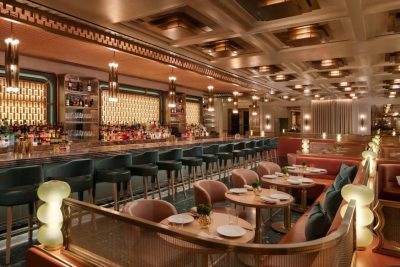
At breakfast in Lex Yard – the hotel’s “all-American brasserie” helmed by chef Michael Anthony, also of Gramercy Tavern – a server asked me how I was liking my Eggs Benedict. I mentioned – and I wouldn’t have done so if he hadn’t asked – that unfortunately the eggs were overcooked. A manager appeared a moment later. “It will not happen again,” he said with such deep authority that I believed him. (The cost was removed from the bill.) When I returned for brunch a few days later, those eggs were perfectly cooked.
A proud, historic hotel with a proud, mostly young, but occasionally older staff, much of the Hilton “premium brand”-speak has clearly been learned by rote and rehearsed. But when no less than four staffers said to me, in the space of a single morning, “We want you to enjoy your stay,” I had absolutely no doubt they all meant it.
It also gave me pause to reflect on Conrad Hilton’s famous remark, that The Waldorf Astoria was “The Greatest of Them All.” Because, who knows, perhaps it still is.