“There is no coincidence, only the illusion of coincidence,” the character V says in Alan Moore’s graphic novel “V Is for Vendetta.”
Perhaps, then, it was not so coincidental that on a 10-hour flight from Rome to New York recently we should find ourselves seated next to a personable wealth adviser with an unusual story to tell.
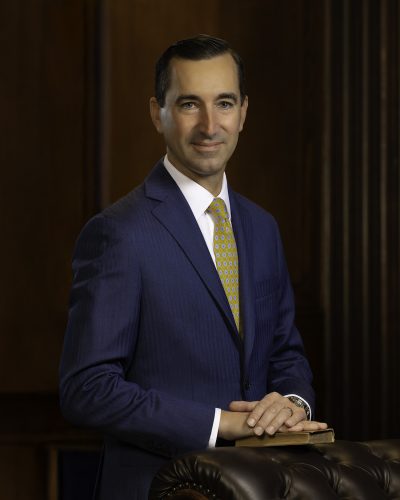
Patrick W. McGrory, Ph.D., CFP, CRPC, is the founder and private wealth adviser of Liberty Point Advisors in Vineland, New Jersey, which manages $500 million in assets for clients around the world, including in New York and Connecticut. (The company, with seven employees, also advises on another $500 million.)
McGrory, who earned a Ph.D. in finance and retirement planning in October 2024 from The American College of Financial Services, attended St. Joseph’s University, a private Jesuit institution in Montgomery County, Pennsylvania, where he majored in psychology and minored in finance.
When it comes to managing people’s money, “it really is more about psychology than finance,” he said.
Besides high net worth individual clients, there are also ultra-high net worth families focused on legacy planning. With a motto of “Life, Liberty, Legacy,” the company is committed to seeing its clients’ wealth last beyond their lifetimes, serving their communities and descendants. Legacy is something McGrory knows a great deal about personally. He is also the chair of the Raskob Foundation for Catholic Activities (RFCA), an organization of 90 family members and 10 professional staffers based in Wilmington, Delaware, that funds initiatives all over the world though mainly in the United States, everything from stemming the tide of homelessness, food insecurity and domestic abuse to projects at universities that do missionary work.
This support takes the form of grants of $20,000 to $30,000: “Our motto is ‘Ignite sparks of hope.’ A little goes a long way when you’re using it to benefit others.” Since its founding 80 years ago, the foundation has given away $225 million, with $210 million in endowment. And it all began with McGrory’s great-grandfather, financier John J. Raskob – the man behind the Empire State Building and several of today’s investing and workplace innovations.

The summer before the dark
Though his name may be unfamiliar to Americans now, Raskob (March 19, 1879-Oct. 15, 1950) was one of those larger-than-life, headline-grabbing Wall Streeters who shaped the American economy in the first decades of the 20th century. But more than that, he was a visionary who advocated for what we now know as mutual funds, consumer credit, the five-day work week and holiday Mondays. His story is told throughout Andrew Ross Sorkin’s new book “1929: Inside the Greatest Crash in Wall Street History – and How it Shattered a Nation” (Viking, $35, 567 pages), a juicy tale of wheeling and dealing, backstabbing and bribery that makes today’s shenanigans, while not acceptable, all too intelligible.
“Raskob really believed that everybody could get rich in the market through dollar cost averaging, dividends and systematic savings,” said McGrory, who has an original copy of the August 1929 issue of Ladies’ Home Journal that contained an article about Raskob titled “Everybody Ought to be Rich” by journalist Samuel Crowther. (It’s also the title of a 2013 biography by David Farber, “Everybody Ought to be Rich: The Life and Times of John J. Raskob, Capitalist.”)
It was a belief born of Raskob’s own story as the quintessential self-made, American entrepreneur. Of German-Irish descent, he was born in Lockport in Niagara County, New York, to John Raskob, a successful cigar manufacturer, and the former Anna Frances Moran. The younger Raskob attended parochial and public schools, delivering newspapers, working in local agriculture and participating in theater and the Roman Catholic community. He would’ve gone on to a business degree but had to drop out of business school to support his family as a secretary when his father died in 1898.
That career path turned out to be a blessing in disguise as three years later he became the personal secretary of Pierre S. du Pont, president of DuPont, an American multinational chemical company that began with gunpowder manufacturing. Over the next 17 years, Raskob rose from assistant treasurer to treasurer to president of finance – a title he would simultaneously hold at General Motors as well. A believer in the future of the automobile, Raskob would engineer Pierre du Pont’s ownership of 43% of GM’s stock.
He would also spearhead the creation of the General Motors Acceptance Corp. (GMAC), rebranded in the Great Recession as Ally Financial Inc., “pioneering the idea of consumer credit to buy cars,” McGrory added. And in a move that would foreshadow today’s retirement strategies, Raskob founded GM’s Managers Securities Co., in which 80 senior and junior executives contributed $5 million and borrowed $28 million, with the company distributing profits from the equities it invested in as executives retired or left, Sorkin writes in “1929.”
In a meeting with other movers and shakers at The Plaza on June 29, 1929, Raskob announced plans for the Equities Securities Co., which would do for the middle class, America’s new investors, what the Managers Securities Co. had done for GM’s executive class with a $15 monthly investment over 20 years. The Literary Digest hailed it as “the greatest vision of Wall Street’s greatest mind.” The problem, Sorkin writes, is that for most Americans that was too much money and too long a time, particularly as Wall Street speculators appeared to be getting rich quickly.
An Empire State of mind
By then, Raskob had amassed a fortune of about $500 million ($9.47 billion In today’s money). He had an apartment in Manhattan’s opulent Carlton House on West 46th Street and a walnut-paneled office at 230 Park Ave. He and his wife, the former Helena Springer Green, would have 13 children. But it wasn’t enough for a man whose personality and ego were as big as his talents and ambitions.
Those were summed up in the framed motto that hung in his office: “Go ahead and do things, the bigger the better,” Sorkin’s “1929” notes. Raskin’s devout Catholicism led the Republican to become not only a Democrat but chair of the Democratic National Committee (DNC) in a bid to make New York state Gov. Al Smith the first Catholic president of the United States in 1928 and discredit as well as defeat Republican opponent Herbert Hoover.
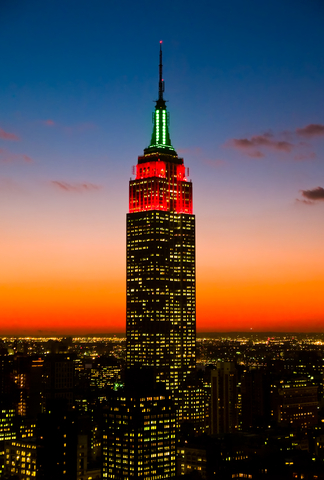
But anti-Catholic feeling ran high, and Smith garnered only 41% of the popular vote, handing Raskob the first defeat of his life. Having been forced to resign from GM by Hoover-supporting company chair Alfred P. Sloan and sell his GM stock, Raskob now used the proceeds to help fund a new dream – the Empire State Building, a project that he laid out to potential investors in an Oct. 2 luncheon three weeks before the rival Chrysler Building was topped and four before the stock market crashed on Oct. 29.
As stocks bounced like a knuckleball throughout the close of 1929 and anxiety grew, critics pointed fingers at the man who believed in credit and debt, Raskob himself. While he had limited his exposure to stocks as the market softened, Raskob denied ever shorting stocks. Instead, he turned his attention to the 1,424-foot, 102-story, William Lamb-designed Empire State Building, which opened on May 1, 1931, with Al Smith as president of the Empire State Co. Though today it is an international cultural icon, — one of the seven wonders of the modern world, featured in films ranging from “King Kong” to “Sleepless in Seattle” – its success was not a foregone conclusion. Lack of occupancy in the Great Depression led the Art Deco skyscraper – named for New York state’s nickname – to be nicknamed in turn the “Empty State Building.” Then tragedy struck at the end of World War II as a B-25 bomber, lost in the fog, crashed into the building between the 79th and 80th floors on July 28, 1945, killing 14 people.
But storefronts and tourists’ visits to the observation decks on the 86th and 102nd floors kept the building going, as did Raskob’s relentless marketing campaign, which included keeping the lights on to suggest a bustling environment. By the ‘40s, the skyscraper was 98% occupied, breaking even the following decade. A year after Raskob’s death from a heart attack in 1950, the building sold for $51 million ($644 million in today’s money).
In the end, Raskob offers a textbook case of the notion that qualities are neither here nor there. It’s the context that drives our perception of them. The crisp individualism that made him a Wall Street darling doomed him in the more collaborative arena of politics. A Hoover nemesis, he would become an opponent of his successor Franklin D. Roosevelt’s progressive New Deal, resigning as DNC chair in 1932. (In the politics-makes-strange-bedfellows department, President Hoover had turned on the lights of the Empire State Building with a ceremonial push of a button from Washington, D.C., when the skyscraper opened.)
Raskob would also run afoul of the Internal Revenue Service (IRS) and be forced to pay $1,450,000 in 1941 for a scheme that he argued was perfectly legal in which he and Pierre du Pont – whom he served as DuPont’s president of finance until 1946 – would sell each other big blocks of stock below the original prices, then buy them back the following year, taking a deductible “loss” on their taxes while essentially retaining their original stock positions.
Similarly, the determination that made Raskob a Wall Street titan also spurred him to support Catholic causes from the earliest days of his success. He was made a Knight of St. Gregory by Pope Pius XI and served as a treasurer to the Knights of Malta, an international lay religious order.
Views of the Vatican
Today, the Raskob Foundation’s work sometimes finds chair McGrory in papal company, giving him insight into the contrasting styles of the late, grandfatherly Pope Francis and his more measured successor, Pope Leo XIV, who has appointed Ronald Hicks, Bishop of the Diocese of Joliet, Illinois, to succeed the retiring Cardinal Timothy Dolan as archbishop of New York. (McGrory was returning from an audience with Leo when we met on the flight.)
Francis, he said, “was a gem of a soul, very loving, very caring.” Leo has a different style but the same interests.
“(Leo biographer) Christopher White points to the communal nature of the pope’s Augustinian background. He values people and cares about peace.”
Just as Leo follows in the footsteps of a dazzling predecessor, McGrory, too, knows what it’s like to be part of a brilliant legacy. Descended from Raskob through his maternal line – his grandmother was Raskob’s 12th child – McGrory is also a self-made man in keeping with his great-grandfather’s precept that his descendants work for their daily bread. But he stressed that the Wall Street of today is different – more regulated in part due to the excesses that led to the 1929 crash. And so is he.
“Or as he put it: I’m living out his legacy but in my own way.”