FAIRFIELD — A new national survey conducted by Sacred Heart University reveals that more than 60% of Americans are concerned that legalized sports gambling could increase the risk of corruption that could affect the outcome of games.
The digital survey of 1,500 participants, conducted in partnership with GreatBlue Research, examined public opinion on the rising prevalence of sports betting and its societal impact.
“This poll reflects a national tension in regard to comfort and acceptance of sports betting,” said Andrew Miller, chair of the sports communication & media bachelor’s and master’s programs at SHU.
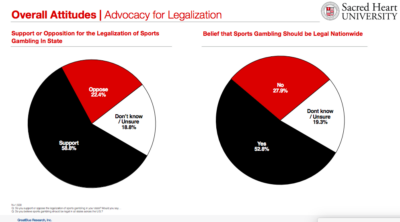
While perceptions of sports gambling were generally positive — 52.8% of respondents support legalization of sports gambling nationwide, and 58.8% support it in their own state — the survey also examined how sports gambling affects financial wellbeing as well as personal relationships.
When asked questions regarding the integrity of sports gambling, respondents were either “very concerned” (22.2%) or “somewhat concerned” (38.9%) about the risk of corruption in sports due to gambling. There also were significant differences based on gender and age. Younger respondents thought sports gambling should be more accessible (45.7% age 18-34, 43.6% age 35-54 and 18.7% age 55+). And sports gambling was viewed more favorably by men (60.8%) than women (41.9%).
“While sports betting is now widely accepted and easily accessible, a clear majority of Americans are uneasy about the potential for corruption and the erosion of fair play,” Miller said. “And while the question wasn’t included in the survey, obvious solutions might include advocacy for regulators, legislators and law and game enforcement to be more vigilant and more public service outreach around potential gambling problems such as addiction.”
Key findings from the poll:
- Skepticism toward league partnerships: Only 30.8% of Americans believe sports leagues should partner more with gambling platforms, while 50.1% oppose such partnerships
Perception of media saturation: Over one-quarter (26.5%) say the amount of gambling-related coverage in sports media is “too much,” while only 9.6% believe there’s “not enough”
Real-world consequences: Nearly 1 in 5 respondents (18.3%) said sports gambling has caused tension in their personal relationships, and 32.3% know someone whose well-being has been negatively affected by sports gambling
- Drivers to sports gambling: The top motivators included winning money (52.5%), excitement (31.2%) and promotions (26.5%)
- The top concerns: The primary barriers expressed by poll respondents include financial risk (59.5%); addiction (40.8%); and unfair odds (40.8%)
“There’s a complicated mix of enthusiasm and apprehension, especially among younger fans,” says Josh Shuart, director of SHU’s sport management program. “Gambling is making sports more interactive for viewers, but many people—especially those most engaged—are seeing firsthand how quickly it can become problematic.”
Despite these concerns, Americans remain divided over its overall impact: only 36.9% believe sports gambling has a more positive than negative effect on society, while 48.4% believe the effect is more negative or are unsure.
The 60-question poll was completed between Jan. 29 and Feb. 3, 2025, with a margin of error of ±2.43% and a confidence level of 95%. Participants represented diverse demographics across all U.S. regions.