It’s may not seem like a good omen when Athens, the city that’s the first leg of your vacation, is having a taxi strike. But it turns out to be the perfect way to begin a story about the Greek economy.
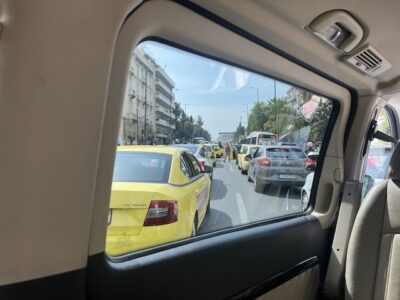
In our case, we arrived in Athens during a 24-hour taxi strike (to enable cabs to use bus lanes when carrying passengers) as a prelude to Arrangements Abroad and Museum Travel Alliance’s “Türkiye to Greece: Heroes, Saints & Emperors Aboard Emerald Azzurra,” a cruise of the Aegean Sea that took place April 16 through 26. Eventually, we made our way past a motorcade of taxis and police cars in the city center – creating the kind of traffic jam they wished to avoid – to the Hotel Grand Bretagne, the 150-year-old grand dame of Athenian hospitality, owned by Lampsa Hellenic Hotels S.A, a subsidiary company of the Laskaridis family, and managed by Marriott International Inc. as part of its Luxury Collection.
There the English edition of Kathimerini, the financial and political newspaper that’s appended to The International New York Times, a daily fixture in the hotel’s palm-dotted Winter Garden Restaurant, was filled with news of Greece’s economic outlook, much of it good but some of it challenging to say the least as the Greeks, like everyone else, try to thread the tariff needle.
In Kathimerini, Prime Minister Kyriakos Mitsotakis sounded a bullish note on the economy and working with President Donald J. Trump: “…There is a possibility of finding a win-win situation when it comes to trade, a solution that is mutually beneficial.” That was music to the president’s ears: “I agree. I know him. He’s a good man. I appreciate his comments.”
Think tank KOBE has projected the Greek economy will grow by 2.2% — down .2% of what was initially expected, due to the anticipated tariff effect. Still, the national budget saw a 12.1% increase in tax revenues over the winter, passenger traffic was up 6.5%, museum visits increased 14.7% while their revenues soared 22.3% and holiday homes remained a good investment for sale and rental.
But as in many countries, affordable housing for locals continues to be nettlesome, with more than half of tenants saying they spend more than 30% of their income on rent, and the country seeing a decline in revenues from house auctions due to less inventory.
Even tourism — a continuing bright spot that accounts for 20% of Greece’s GDP and employment – is not without its questions: Will the possible influx of tourists who might otherwise have gone to the United States make up for the anticipated loss of U.S. visitors? And will the looming challenge lead the nation to address the effects of tourism on infrastructure and the environment?
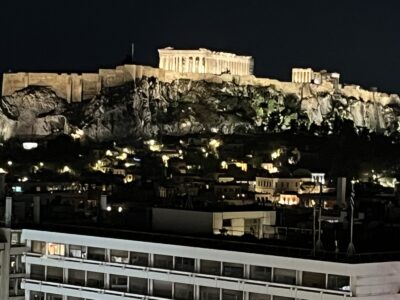
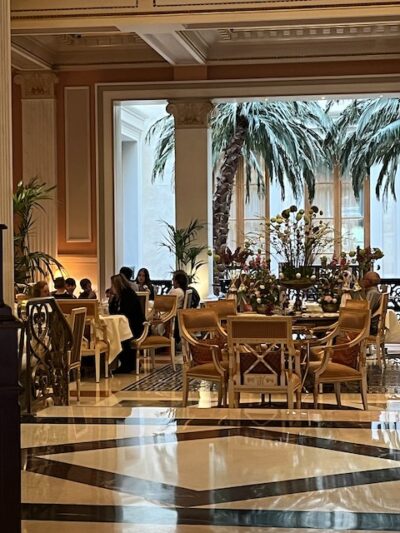
As Greeks enjoyed the two-week Easter holiday, those questions were put on pause. With the taxi demonstration over as the Athenian weather turned suddenly summery, the Grande Bretagne was flooded with Americans looking to take advantage of the pre-tourist season. In the afterglow of a $93.4 million renovation and its most successful year to date (both 2023), the Bretagne might best be described as a cross between the fanciful place in “The Grand Budapest Hotel,” Wes Anderson’s movingly quirky film, and The Plaza in Manhattan. At the Bretagne, traditional elegance (the 320 rooms and suites; the Winter Garden and GB Corner Gifts & Flavors, both off the lobby) meets contemporary sleekness (the GB Spa and the GB Roof Garden Restaurant, with its stunning views of the Parthenon and Acropolis, leafy Syntagma Square, Parliament and Mount Lycabettus) in an institution that’s a touchstone in modern Greece’s turbulent 195-year history.
Wars, including Nazi occupation; civil war; strikes; demonstrations; terrorist attacks; celebrity sightings; presidential and royal visits: The Grand Bretagne is a symbol of everything that Greece has lost and that has proudly remained. From our room window, we photographed the hourly changing of the guard at the Parliament of the Hellenes, located in the Old Royal Palace. A 10-minute walk put us in the Plaka – or Plaka, as the Greeks call the neighborhood – for neoclassical tchotchkes, although for our money some of the best of these souvenirs can be found at Artpoint Papasotiriou at Athens International Airport.
A 15-minute walk down Greece’s version of museum and embassy row led us to the Benaki Museum and the Museum of Cycladic Art, offering excellent overviews of ancient Greek history. (For the Acropolis Museum and the National Archaeological Museum, both musts, you’ll need a timed ticket and a cab ride respectively.)

Of course, you could be forgiven for just wanting to lounge around the Grand Bretagne. Some of our fondest memories – the impeccable service from everyone; the lobster pasta dish in the Roof Garden; the puréed soups in the Winter Garden, where the pianist seamlessly transitioned from one standard to the next; and the chocolate hazelnut and chocolate pistachio cookies at GB Corner Gifts & Flavors.
One gesture encapsulated the experience: At the Roof Garden, where the balcony is reserved for bar guests and a different menu, a bird perched on a chair and, seeing an opportunity, stole a cashew from a bowl of mixed nuts and flew off.
Our all-too-brief two-day stay at the Bretagne was but a morsel in time, but like that bird we snatched what prize we could before we, too, flew off to the charming port city of Izmir, Türkiye (as Turkey now wishes to be known), to begin our Aegean odyssey aboard the 100-passenger Emerald Azzurra.
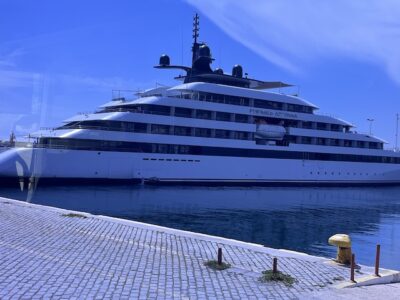
Founded in 2013 by Australian couple Glen and Karen Moroney and sailing out of Nassau under the Bahamian flag, Emerald Cruises has a fleet of Star-Ships for river voyages as well as two luxury yachts, with a third under construction. As at the Grand Bretagne, the service aboard the Azzurra was impeccable, attentive but unobtrusive; the varied menu options, delicious. As we plied the relatively tranquil teal waters of the Aegean under sunny skies but variable temperatures, we were reminded of a banner we saw at Athens airport – “caring for culture.” No port or inland city, no island is too small or too humble to have a well-appointed, carefully curated archaeological museum, to say nothing of many jewel-like Greek Orthodox churches and chapels.
Yet the culture that is so integral to Greece’s tourist industry comes with a healthy helping of relaxation, which we discovered while strolling the sinuous cobblestone streets and artisanal shops or savoring coffee in the light-dappled squares of two off-the-beaten-path islands, Skyros and Amorgos.
Mykonos and Santorini, move over.