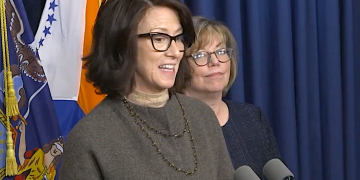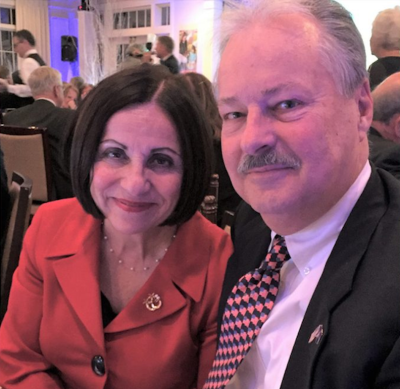
Toni Boucher, who is serving her first four-year term as Wilton’s first selectman, is most known for her time serving as state representative and senator (1997-2019) and chair of the Wilton Board of Education. In the past four years, she has spent a great deal of time as a philanthropist as she cements her and her husband’s legacy in Connecticut.
Henry “Bud” Boucher died in January 2021 after a bout with leukemia at the age of 73. While Toni has spent decades in local and state government, Bud worked as an energy, finance, insurance and healthcare management consultant. Bud was a mainstay in the Wilton civic organization world. A U.S. Air Force veteran, he served as an officer for American Legion Post 86, was the Trackside Teen Board treasurer, Wilton Rotary founder and two-time president, and a 4th Degree Knights of Columbus District Officer.
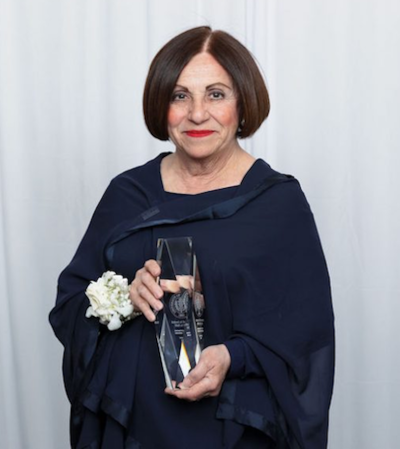
Toni Boucher, who earned an MBA from UConn in 2002, donated $11 million marked by a lead gift to establish the Boucher Management & Entrepreneurship Department. Toni also created the Henry “Bud” Boucher Faculty Fellowship and added to the Toni Boucher Scholarship Fund, which she established in 2004.
Toni has served on some of the nation’s top hospital and foundation boards. Locally, her positions have included board of education chairman, selectman, state board of education commissioner, state Vo-Tech Board of Education member, advisory board member of the Connecticut Office of the Child Advocate.
In March Boucher added author to her many titles as her book “The Husky Effect: How UConn is Creating the Entrepreneurs of the Future,” came out during the NCAA’s March Madness. The timing was impeccable as the UConn Women’s Basketball Team were on their 12th national title under Coach Geno Auriemma. The book was co-written by New York Times best-selling author Josh Young.
For Toni, the book represents a lesson for all entrepreneurs and small business owners looking to make it in today’s volatile world. It started out as part of a memoir about her Italian roots and the many stories that have shaped her life as the Iannuzzi family acclimated to life in America. “The Husky Effect” is a spinoff of that memoir that focuses on the business tales of her husband and how in his death an era was borne that is taking shape in the University of Connecticut School of Business.
This basketball success has created what we call the “UConn Husky Effect.” After the men’s team won their fifth NCAA Championship in 2023, applications for the 2024 fall semester hit a record high with more than 56,700 applicants, up from 48,000 in 2023 and 43,000 in 2022.
Entering 2024, UConn had risen to forty-sixth overall in the Wall Street Journal rankings and ninth among public universities. The business school tied with UMass for the top public undergraduate business education in New England.
The following is a recent conversation between Toni Boucher and the Fairfield County Business Journal regarding “The Husky Effect,” published by Amplify Publishing Group:
What was the impetus behind the book, “The Husky Effect?”
Over 25 years, when my cousin who was one of my first cousins from my father’s side who lived in Connecticut. I received about 67 pages of notes from Nick Iannuzzi about the early days in rural life in Italy living on a farm. He went to UConn. He was in the first class of physical therapists that they had.
When I got those notes, I kept them and they pretty much sat on a shelf. He also did a family tree. My brother calls me about a week after my husband passed away and asked me if I had started on the book. I told him I hadn’t even started on the book. He said, Toni, we’re going to die and that book isn’t get written.
I started on my computer keyboard for three years and I documented my family’s journey prior to WWII, coming to America at the age of 5. My parents were illiterate speaking no English and having no money in this world. All we encountered were hardships. This was failures, then success.
How did you and Josh Young intend to write and organize the book?
It includes profiles of such people who influenced not only my life but that of my husband. They are UConn President Radenka Maric; my husband; his brother, Paul; his brother-in-law Guy Iannuzzi. We stressed that the ultimate goal is to build UConn’s network around excellence in all areas, nurtured by everyone who is a part of it, and do things for the greater good that benefit society as a whole. Just as UConn’s basketball success has helped attract better student athletes, its rising academic reputation is drawing stronger applicants across all fields.
The entrepreneurial programs are also attracting former residents and alumni back to Connecticut to launch businesses.
Was the book a piece all onto its own?
The book I was originally working on is titled “Stone Doll,” a memoir. On the farm when I was along in Italy, my family suffered through the Great Depression. Our family farm was pummeled by Nazi aircraft. My father was sent to the front lines. His brothers were smuggled to America by my grandfather because he didn’t want his sons to be sent to war and fight for Mussolini. My father experienced unspeakably horror. He wound up being shipped to England as a farmer. He was captured as a prisoner in Libya and sent to England.
(In November 2025, the memoir “Stone Doll” will come out. “The Husky Effect” was spun off from the end of “Stone Doll” in a section about philanthropy.)
I was making the connection between the nationally celebrated basketball teams of UConn and their coaches, who are striving for excellence as a way to brand the university altogether. The university is now going from 12,000 applications a year to 64,000.
In the book and in our conversation, you refer to a business miracle that occurred?
My husband and I did not know he was going to die. It was a complete surprise. It was six weeks from the diagnosis to the day of his death. The diagnosis said that for 95% of the people who have this disease we have a miracle drug, called Sparcel. But it was very expensive. It was thousands of dollars. Even one of his business clients who had it said he had been on the drug for 20 years. He said, ‘You’re going to be OK, Bud.’”
Unfortunately, he wound up being in the 5% of the people diagnosed who the drugs did not work.
In November (2020), there was the business miracle when an internet company bought his (flailing) flooring company only because it was already set up as a public pink sheets company on the OTC. But this was a fintech company out of California with online payment systems. It had remotely nothing to do with his company. They wanted to take their company public on an already traded company even though it was trading for next to nothing. All he had to do was wait until February 2021 to receive the money from the sale of the restricted shares after the deal would close. However, he died on Jan. 24, 2021. But before he died his life insurance company called with the news that his $100,000 life insurance policy would be in force on Jan. 22.
(His death) meant I had to implement all of it (the sale of the company). Everyone I spoke to, whether it was the OTC trading desk or the pink slip block trader desk at Fidelity said it might not be the most historic in the amount of how much money is realized from the sale, but it’s just the velocity of change from (for a company worth) less than nothing to something that is pretty significant. It’s a story that has never happened before.
Once the sale went through, instead of crying tears of joy, I just cried because it was so unjust. It still bothers me. Every time I do something good with legacy, I think he should have been doing this because he wanted to do this.
What about the philanthropy you have been involved with since your husband’s death?
Prior to his death, we talked about using the money for such good things as UConn, Johns Hopkins, his small college (St. Michael’s in Vermont). It was a lot of little things. He wanted to put a deck on his American Legion Hall.
What are your aspirations for the newly named Boucher Management & Entrepreneurship Department at UConn?
Twenty years ago, when he first took the company public, we were able to get a little bit from it. I had $30,000 that I could give to philanthropy. I gave that to a scholarship fund for students who couldn’t afford at the business school at UConn. I told Michael (Van Sambeck, head of development for UConn’s business school) who helped me set it up for the college that if this ever takes off I want to do something really big for the school. Then, after my husband died, I called Michael. I asked him if he remembered the time if there would be a day to do something big? Well, the day has come. He was blown away. He asked me what were my thoughts. I told him I wanted to do something for entrepreneurship. They had a student investment fund called Hillside Ventures. We then named it the Boucher Management & Entrepreneurship Department. It gives them real world experience and real money to invest.
I told him in a world of philanthropy, I’m a minnow. There are whales out there giving much substantially more. But he told me, yeah but of a percentage of what you have you give much more. It brings me great joy. I know it would make my husband happy.
Is there anything else you want to share?
There is a Winston Churchill quote in the book that I live by: “Success is moving from one failure to another without losing your enthusiasm.” That really speaks to the entrepreneurship mindset. If you just stick with it and really believe in yourself. Seventeen campaigns, and I won 15. And those two losses were big ones. You just pick yourself up. In the long run, you will be rewarded.